Summary
Suzhou (苏州) is a city of roughly 13 million people in Jiangsu province, about 100 km west of Shanghai and twenty-five to forty minutes away by high-speed train. For most of the past thousand years it has been one of the richest cities in China — first through rice, silk and the imperial examination system, now through advanced manufacturing and the China–Singapore Industrial Park. What pulls travelers here is a combination that barely exists anywhere else: a compact historic core of whitewashed courtyard houses, canals and humpbacked stone bridges; the classical gardens in which Chinese landscape design reached its most refined form; and, twenty minutes to the east by metro, a lakefront business district with a skyline that would not look out of place in Singapore.
We wrote this guide for people with limited time who want direct answers: which two gardens to pick when you cannot see five, where to sleep, what a proper bowl of Suzhou noodles should cost, and how to dodge the tour groups that fill Pingjiang Road between 10:00 and 16:00. Two full days cover the core of the city comfortably. A third day adds a water town — Tongli is the easiest to reach — without rushing.
Three practical realities shape a Suzhou trip more than in most Chinese cities. First, the headline gardens require real-name online reservation tied to a passport number, so carry your passport at all times; it is also your ticket. Second, daily life is effectively cashless, and you should have Alipay or WeChat Pay working with a foreign card before you land. Third, seasons matter: late spring and mid-autumn are close to ideal, while July and August combine heat, humidity and peak domestic tourism.
This guide was last checked in September 2026. Prices are in CNY and given as typical ranges rather than exact tariffs, which shift with the season; where a number may have moved, we give a range and tell you how to verify it. Nothing here is sponsored, and we have no commercial relationship with any business named in these pages.
Why Suzhou
Founded around 514 BC as the capital of the kingdom of Wu, Suzhou has occupied the same grid of streets and canals for more than 2,500 years. The old town inside its moat covers only about 14 square kilometers, and it is one of the few Chinese historic cores that came through the twentieth century with its street plan broadly intact. The Grand Canal — itself a UNESCO World Heritage Site since 2014 — still threads past the city, and cargo barges share the water with tour boats.
Nine classical gardens are on the UNESCO World Heritage List, inscribed in 1997 and 2000. Gardens elsewhere in China imitate these. Within a single morning you can walk the lake-and-pavilion geometry of the Humble Administrator's Garden, the rockwork labyrinth of the Lion Grove, and the Song-dynasty austerity of the Canglang Pavilion, each a different answer to the same question: how do you compress mountains, rivers and forests into a walled family compound the size of a city block?
The city's crafts run just as deep as its gardens. Suzhou silk fed imperial workshops for centuries; Su embroidery, worked in threads split finer than a human hair, is still produced in studios near Lake Tai; kunqu opera, the refined stage art that shaped Peking opera, was born in this region and is recognized by UNESCO as intangible heritage. Marco Polo passed through in the 1270s and described a city of stone bridges and silk; Europeans later reached for Venice as the only comparison that made sense. The local saying is older and more direct: above there is heaven, below there are Suzhou and Hangzhou.
Then there is the plain convenience of the place. Shanghai's Hongqiao transport hub is under an hour away by rail; trains for Shanghai leave every few minutes; the metro ties the old town, the industrial park and even the Shanghai network together. You can land at Hongqiao in the morning, stand inside a Ming-dynasty garden before noon, and eat a bowl of noodles that locals have been refining for a century. That reachability, as much as the gardens themselves, is why we put Suzhou on a first trip to China ahead of several far larger cities.
Top Attractions
A warning before the list: Suzhou has dozens of gardens and several canal streets, and the fastest way to ruin a visit is to try to see them all. Two major gardens per day is the comfortable maximum; each deserves ninety minutes to three hours, and they blur together if you stack five in one day. The main municipal gardens require timed e-ticket reservation (passport number needed), booked through the official garden-tourism WeChat channel or a platform such as Trip.com; in peak season reserve one to seven days ahead. Our selection is opinionated: if you see only two gardens, make them the first two below.
Humble Administrator's Garden (拙政园)
The largest and most celebrated classical garden in Suzhou, built in 1509 for the retired censor Wang Xianchen, spreads over about 5.2 hectares of pools, islets, lotus beds and half-hidden pavilions at the northeastern corner of the old town. The name is a modest joke: "administering a garden badly," the poet claimed, was better than administering a province. Come in early summer and the central pond is a solid sheet of lotus; in late autumn the persimmon trees drop fruit across the moss.
The visit works best as a slow loop: enter from the south into the central section, cross the bridges west of the hall of Distant Fragrance, and finish in the western section's octagonal Flying Rainbow gallery. Give it two to three hours, more if you like photography. Metro Line 4 to Beisita (North Pagoda) station puts you a ten-minute walk away, and the Suzhou Museum is next door, which makes a natural pairing.
Admission runs about 80-90 CNY in peak season (roughly mid-April to October) and 70-80 CNY off-season. This is the one garden in the city that can genuinely sell out in high season — book the earliest slot you can tolerate. We entered at 07:30 on an October weekday and had the western courtyards almost to ourselves for an hour; by 10:30 the same paths were four deep in tour groups.
Lingering Garden (留园)
If the Humble Administrator's Garden is about water and vistas, the 1593 Lingering Garden is about compression and rock. Its 23,000 square meters are carved into four distinct zones — court, central pond, pastoral east, and the northern rockery — threaded by a 700-meter covered corridor whose windows frame views like a film editor cutting between scenes. The star exhibit is Guanyun Peak, a 6.5-meter Taihu limestone standing in a courtyard of matching stones; emperors are said to have lusted after it.
The garden is a fifteen-minute walk west of Shilu station on metro Line 2, close enough to Shantang Street to combine the two in one afternoon. Admission is around 45-55 CNY depending on season, and timed entry applies here as well, though tickets are usually available a day or two out. One to two hours is enough unless you plan to sketch or linger over the calligraphy stones; the corridor between the central and northern sections is where the crowd thins and the design shows its intelligence.
Tiger Hill (虎丘)
The Song-dynasty poet Su Shi wrote that visiting Suzhou without seeing Tiger Hill is a waste of the trip, and the hill still earns the compliment. The site is a 36-meter rise at the city's northwestern edge, crowned by the Yunyan Pagoda, a brick tower finished around 961 that leans about three degrees — engineers stabilized it in the 2010s, and it is often called China's answer to Pisa. Below it, the Sword Pool hides, by legend, the tomb of King Helü of Wu, buried — so the story goes — with three thousand swords.
Give Tiger Hill ninety minutes to two hours, including the walk up through cypresses and the bonsai courtyard at the base. Admission is roughly 60-80 CNY by season. Metro coverage here is indirect; take a 15-20 minute taxi from the old town (expect 20-35 CNY) or one of the local buses, and go early — the hill has little shade after 11:00 in summer. Our preferred plan is Tiger Hill first thing in the morning, then a taxi or bus down to Shantang Street, which the hill's canal flows into.
Pingjiang Road (平江路)
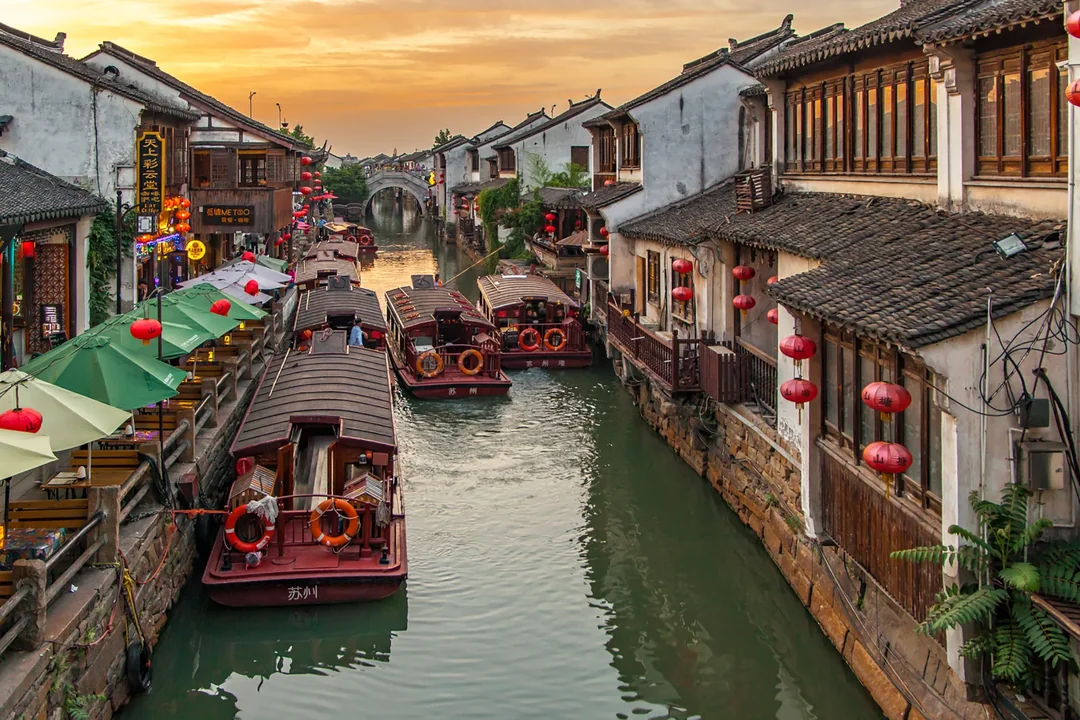
Pingjiang Road is a 1.6-kilometer lane running north-south through the best-preserved quarter of the old town, a street pattern documented on a stone map carved in 1229 and still recognizable today. On one side, a canal barely two boats wide; on the other, low shopfronts selling everything from osmanthus cake to hand-painted fans; crossing it every hundred meters, stone bridges worn into shallow curves. Side alleys — Dajing Lane, Xuanqiao Lane — hold working noodle shops, a kunqu museum, and private courtyards you glimpse through doorways.
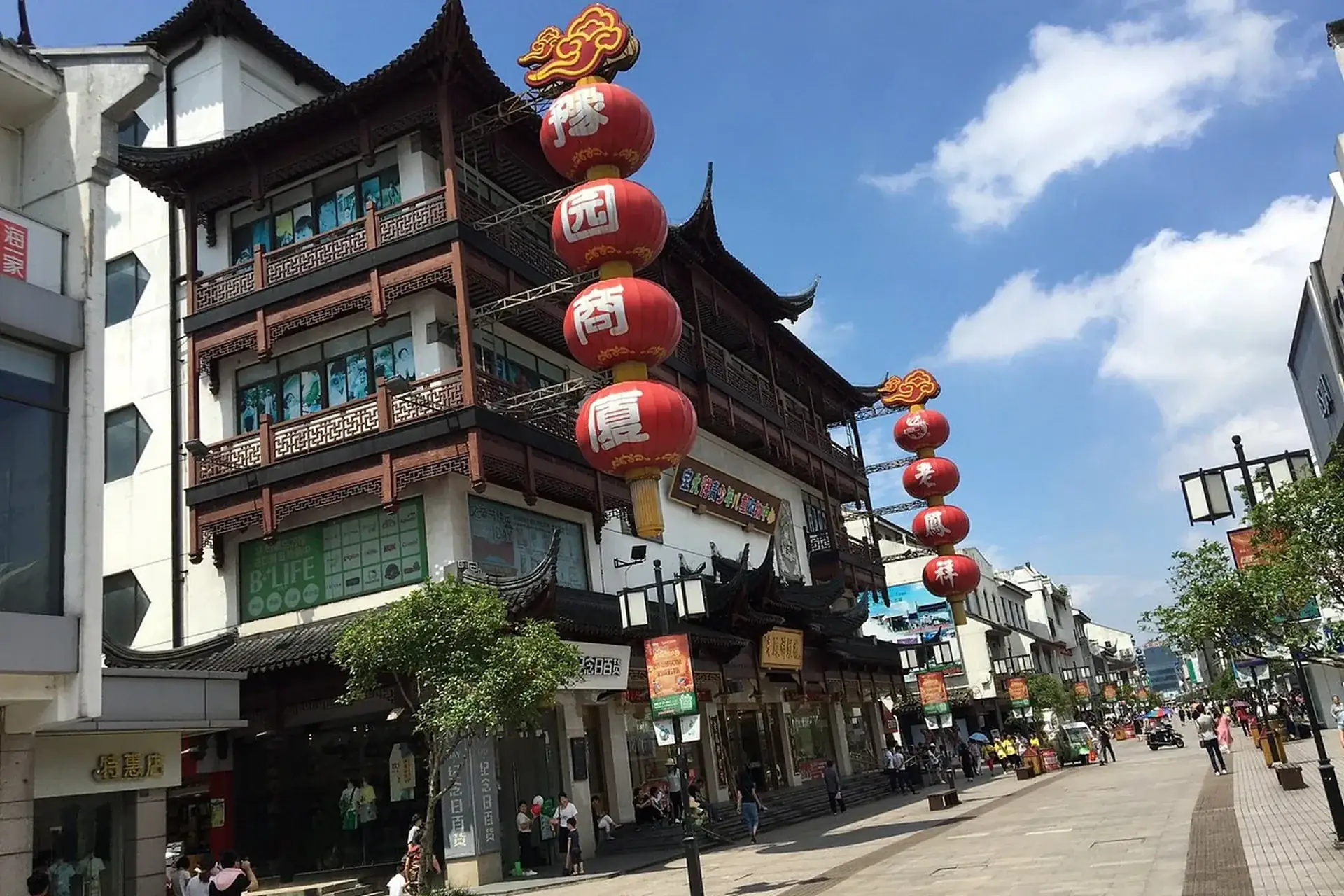
It is free, which is part of the problem: from mid-morning to late afternoon the lane belongs to the crowd. Walk it before 09:00, when residents hang laundry over the canal and the teahouses put out their first stools, or after 20:00, when lanterns reflect off the water and the day-trippers have gone. The lane anchors the old town geographically; metro Line 1 to Xiangmen or Line 4 to Beisita both leave you within fifteen minutes on foot, and the Humble Administrator's Garden lies at its northern end.
Shantang Street (山塘街)
In 825 the Tang-dynasty poet Bai Juyi, then prefect of Suzhou, had a canal dug from Changmen Gate northwest toward Tiger Hill; the embankment became a street, and the street became a 3.8-kilometer ribbon of houses, guild halls and bridges known as Seven-Li Shantang. The restored eastern end near Shilu is the tourist stretch — lantern-lit at night, thick with snack vendors, and genuinely pretty from the water — while the middle and western sections remain an ordinary working street where the tour groups thin to nothing.
There is no ticket for the street itself; a combined pass for the small courtyard museums on the eastern section costs around 30-45 CNY and is skippable unless it rains. The move we recommend: arrive at Shilu station (Line 2) around 17:00, eat along the street, then take the night boat back down the canal toward the moat (roughly 60-120 CNY depending on route and operator) and watch the lanterns double themselves in the black water. This is the single best hour of photography in the city.
Suzhou Museum (苏州博物馆)
I. M. Pei, whose family traces back to Suzhou, came out of retirement to design this museum, which opened in 2006 on the block between the Humble Administrator's Garden and the Zhongwang Mansion. The building itself is the exhibit: grey-and-white geometry, a glass-roofed lobby, and a rockery of sliced stone set against a whitewashed wall — a modern distillation of the garden vocabulary across the street. The collection concentrates on Wu-culture bronzes, Buddhist statuary, Ming furniture, calligraphy and porcelain; the hardware is excellent and the captions are bilingual. First-time visitors consistently rank the museum above several paid gardens, which is remarkable for a free sight, and the queue discipline is better than anywhere else in the city.
Admission is free but reservation is mandatory and Monday is the closing day; book several days ahead for weekends and holidays, since slots go fast. Ninety minutes covers the permanent collection well. In 2021 the museum opened a large western branch in the New District — worth it for serious museum-goers, skippable on a short trip. Note that the whole museum-plus-garden block makes a tight half-day circuit: museum at opening, garden at noon, noodles after.
Where to Stay
Suzhou splits cleanly into two lodging worlds, and your choice shapes the trip more than the star rating does.
The old town (Gusu district) is where you want to sleep if gardens, canal streets and breakfast noodles are the point. The best-located pockets are the lanes around Pingjiang Road and Shuangta market, where 400-800 CNY buys a boutique room in a converted courtyard house — low ceilings, wooden staircases, a lantern over the door. Chain hotels near Guanqian Street or Leqiao station run 250-500 CNY and put you on metro Lines 1 and 4; hostels around Shilu and the north rail station offer beds for 60-150 CNY. Trade-offs are real: rooms are smaller, plumbing older, and taxis cannot reach the deepest lanes, so pack lighter than you think you need.
The Industrial Park (SIP), twenty to thirty minutes east by Line 1, is the modern counterweight: towers around Jinji Lake, international hotel brands, malls, and walkable lakefront promenades. Rates for five-star lakeshore rooms commonly run 700-1,600 CNY, lower than the equivalent in Shanghai or Hong Kong. Stay here if you value a gym and a bathtub over morning canal light, if you have business in the park, or if you are using Suzhou as a calm, cheap base for Shanghai day trips. The park is also where most conference and exhibition traffic sleeps, so weekday availability is better than weekend.
The third option nobody mentions is the value pocket around Shilu and Changmen, on the old town's western edge. Rooms here cost ten to thirty percent less than the Pingjiang lanes, sit directly on Line 2 and the Shantang Street canal, and trade boutique charm for square footage. We would pick it over the industrial park without hesitation on a second visit: you keep the lantern evenings and gain a food street downstairs.
Our practical advice for a first visit on a mid-range budget: two nights in the old town near Pingjiang Road, and if you crave the skyline, move the last night to the lake. Book two to four weeks ahead for April-May, October, and any date touching a public holiday; outside those windows, same-week booking is realistic. Avoid properties marketed as "garden view" without naming the garden — in Suzhou that phrase usually means a wall.
Gastronomy
Suzhou cooking is the sweet, precise end of Jiangnan cuisine: seasonal, soup-forward, and quieter on chili than almost anywhere else in China. The flavors reward attention more than adrenaline — sugar is used the way other regions use heat.
- Squirrel mandarin fish (松鼠桂鱼): the city's signature banquet dish — a mandarin fish cross-hatched, fried until it arches like a squirrel's tail, then sauced with sweet-sour tomato and pine nuts. Songhelou on Guanqian Street, a restaurant lineage dating to the eighteenth century, serves the classic version; expect 150-300 CNY for the fish and 250-600 CNY per person for a full old-school banquet. Deyuelou across the street is the traditional rival and equally safe.
- Suzhou-style noodles (苏式面): the city's true daily religion. Breakfast shops open before 06:00 and wind down by mid-morning; a clear brown soup topped with braised pork shoulder (焖肉), pork chop (大排) or eel; the local shorthand for customizing — more soup or less, garlic greens or none — is half the fun. A plain bowl runs 15-25 CNY, topped bowls 25-50 CNY, and the famous tri-shrimp noodle of early summer 80-160 CNY. Look for a queue of grandmothers at 07:00 and join it.
- Pastries and sweets (糕点): Suzhou has snacked seriously for centuries. Daoxiangcun, founded here in 1773, and Caizhizhai (1870) sell gift boxes of flaky sweets for 30-100 CNY; Huangtianyuan specializes in rice-flour cakes; street stalls do plum-blossom cakes for 5-15 CNY. The pan-fried buns at Yaba Shengjian, a short walk from Lindun Road, cost 10-20 CNY and draw lines worth waiting in.
- Seasonal anchors: hairy crab from Yangcheng Lake, just north of the city, from late September into December (market price, rarely under 80 CNY per crab in a restaurant); sweet osmanthus and gordon-euryale seed soup (鸡头米) in early autumn; the "eight water delicacies" — lotus root, water shield, water chestnut and friends — through the warm months.
One habit worth importing from the locals: the city eats early and on schedule. Noodle counters peak before 08:00, proper restaurants stop taking orders around 20:30, and the kitchen at a famous name will not be persuaded otherwise. Plan dinner for 18:00-19:00 and you eat better than anyone who arrives at nine. Between meals, a canal-side teahouse pouring biluochun — the local green tea — at 30-80 CNY a seat with unlimited hot water is the correct way to spend a hot afternoon.
If you eat one splurge meal, make it lunch rather than dinner: the classic restaurants run set lunches at half the dinner price, the kitchen is calmer, and you will want the afternoon for walking. Reservations matter only at the Guanqian Street institutions on weekends.
Practical Information
The mechanics of a Suzhou trip are simpler than they look from abroad. Four topics cover ninety percent of the questions we receive.
Visa
China maintains unilateral visa-free entry — generally thirty days per visit — for ordinary-passport holders of a long list of countries, including most of the EU, Australia and New Zealand, with a 240-hour transit-without-visa scheme covering a much wider list. These lists have been revised repeatedly in recent years, and your eligibility depends on nationality and entry point, so confirm the current rules with the Chinese embassy in your country, or with your airline, before booking. Overstaying even a day is treated seriously; keep your entry stamp clean and legible.
Currency and Payments
The renminbi (CNY) has traded around 7.0-7.3 to the US dollar in recent years. In practice you will barely touch cash: Alipay and WeChat Pay both accept foreign credit and debit cards, and cover everything from a 6-CNY noodle bowl to a hotel bill. Install one app, register your card, and test it on a convenience-store purchase within an hour of arrival. Carry 300-500 CNY in notes as a backstop for the rare cash-only stall; ATMs at Bank of China and ICBC branches take foreign cards, though withdrawal limits and fees vary by issuing bank.
Getting Around
Metro Lines 1 and 4 are the traveler's spine: Line 1 runs east-west under the old town through Leqiao (Guanqian Street) toward the Industrial Park and Jinji Lake; Line 4 runs north-south past Suzhou rail station, the Beisita stop for the museum-garden block, and south all the way to Tongli. Fares run 2-8 CNY by distance; station signage and announcements are bilingual, and the Alipay transit code passes the fare gates directly. Trains run roughly 05:30-23:00. Taxis are metered and honest — a cross-town ride rarely exceeds 40 CNY — and Didi hails work through Alipay. Within the moat, walk: the old town is 3 km top to bottom.
For intercity rail, Suzhou station (Lines 2 and 4) sits on the Beijing-Shanghai high-speed line at the old town's northern edge; Suzhou North serves fewer but faster trains; the Industrial Park station serves the lakeside. Shanghai trains leave every few minutes. Suzhou has no airport of its own — fly to Shanghai Hongqiao and rail in.
Best Time to Visit
Late March through May and September through early November are the sweet spots: 15-26 CNY-degree days, low rain (outside the mid-June to early-July plum-rain season), gardens in flower or under autumn light. July and August run 30-36 CNY with sauna humidity and domestic school-holiday crowds. Winter is damp and 0-8 CNY but quiet, cheap, and occasionally magical when snow outlines the black roofs. Avoid the first weeks of May and October and the Lunar New Year window entirely — national holidays multiply every queue in the country by three.
Cultural Considerations
Suzhou is a conservative, well-off city with a strong local identity, and it handles visitors with more patience than noise. A few things help:
- Language: Mandarin is universal, but the local tongue is a Wu dialect so soft it is nicknamed "the sound of women arguing politely." A spoken "nong ho" (hello, local style) earns more smile than a textbook "nǐ hǎo." English is limited outside hotels and the museum; have your destination written in characters.
- Queues and crowds: The British-style queue is aspirational. At noodle counters, buy a chit first, then state your order; on metro platforms, let the wave exit before you board. Nobody will thank you, but nobody will glare either.
- Tipping: Not practiced, and can cause genuine confusion. Service charges at top hotels are the exception.
- Photography: Residents of the canal lanes are living their lives, not modeling. A nod before raising the camera at a courtyard doorway is repaid with a shrug instead of a scowl. Drones are prohibited over the gardens and the old-town core.
- Gardens as public living rooms: Early mornings belong to retirees doing tai chi, playing chess and airing songbirds in cages hung from pines. Walk around, not through. Rocks and scholar's stones are roped for a reason — climbing them for photos is the fastest way to mark yourself as a problem.
- Teahouse manners: When a pingtan performer is on stage, conversation drops to a murmur; the regulars will school you with silence. Tea is refilled from thermoses; leave the lid askew if you want more.
Two-Day Itinerary
Two days is the honest minimum for Suzhou, and the geography cooperates: the heavy sights cluster in a corner of the old town you can cross in twenty minutes.
Day 1 — old town core. Start at 07:00 with noodles near Lindun Road, then walk Pingjiang Road before the crowd builds. Enter the Suzhou Museum at opening (09:00, ticket pre-booked), spend ninety minutes, then cross directly into the Humble Administrator's Garden for the late morning. Lunch on Guanqian Street — Songhelou if you want the classic squirrel fish, a noodle counter if you want speed. In the afternoon, either the Lion Grove's rock labyrinth (three minutes from the museum, cheap ticket, children love it) or the Canglang Pavilion to the south, the city's oldest surviving garden, laid out in the 1040s around a covered walkway that borrows the river as scenery. At 17:00 take Line 1 or a taxi to Shantang Street for the lantern hour and a night boat back down the canal.
Day 2 — hill, garden, and the lake. Taxi to Tiger Hill for 08:00; climb past the sword pool to the leaning pagoda while the air is still cool. Descend and follow the Shantang canal back east by bus or boat for lunch around Shilu. Early afternoon, the Lingering Garden for the rockery and the corridor. Around 16:30 ride Line 1 east to Jinji Lake: walk the promenade as the towers light, watch the weekend fountain show if it is running, and eat in Suzhou Center. If your train leaves from the north station that evening, you have lost nothing — Line 4 connects the lake fringe back through the old town to the station in forty minutes.
A third day, if you have it, belongs to Tongli: Line 4 runs there directly, and the water town is detailed in the next section.
Beyond the Highlights
Once the two-garden circuit is done, Suzhou opens up sideways. Inside the old town, the Panmen gate complex in the southwest preserves the world's only surviving land-and-water double gate, with a Song pagoda beside it and hardly a tour flag in sight. The Master of the Nets Garden, barely half a hectare, is the small masterpiece connoisseurs prefer to its giant neighbors — and in the warmer half of the year it runs evening performances of kunqu and folk music inside the garden, roughly 100-160 CNY, which is the best single introduction to the city's performing arts. On the city's western rim, the hills above Lake Tai — Dongshan and Xishan — hold tea terraces, loquat orchards and lake fish restaurants an hour from the center and a world away in pace.
And then there are the water towns, the canal villages southeast and south of the city that prefigure everything Venice metaphors promise about Suzhou itself.
Zhouzhuang (周庄)
The most famous water town in China, 30-40 minutes by road from Suzhou in Kunshan, Zhouzhuang is a ring of canals around the twin halls and bridges — the Double Bridge made famous by a 1984 painting in the UN — that invented the modern Chinese water-town tourism template. Admission is around 100 CNY for the day; boats run roughly 100-180 CNY per craft. Between 10:00 and 16:00 the main lanes are a solid river of group tours, and we think the critics who write it off for that are half right: they simply arrive at the wrong time. Come for the last admission, stay overnight in a converted merchant house (300-600 CNY), and the town performs its morning ritual — laundry over the water, coal stoves, deliveries by punt — for almost no one.
Tongli (同里)
Our recommendation when there is room for only one water town. Tongli is bigger than it looks, leafier, and still home to full-time residents; its Retreatment and Reflection Garden, an intimate 1880s enclosure built by a dismissed official, made the UNESCO list in 2001. The S-shaped brick bridge over the willow canal is the postcard; the back lanes past the wine museum are the point. Admission about 100 CNY covers the garden and minor museums; the last entry is late afternoon, and the town empties beautifully after 17:00. The effortless part is the journey: metro Line 4 runs to its own Tongli terminal station, from which a short shuttle or a 15-minute walk delivers you to the gate — no bus booking, no tour, no car.
Nightlife
Suzhou is not a late city, and its nights are better for it. The old town's evening runs on lantern light: Pingjiang Road at 20:00, teahouses pouring the third infusion, a pingtan singer's pipa leaking from a doorway on Zhongzhangjia Lane. Several venues along the canal stage 40-80 CNY pingtan sets with tea included; you will understand ten percent of the Suzhou-dialect storytelling and enjoy all of it. The China Kunqu Museum and the Suzhou Kunqu Theatre keep performances on the calendar — check listings for the week you are there, since kunqu stagings are the city's most under-priced cultural asset, typically 80-280 CNY.
Across town, the Industrial Park does the modern evening: Jinji Lake's promenade, the weekend fountain and light shows against the Gate of the Orient (the 300-meter tower locals call "the trousers"), bars in and around Suzhou Center, and the concert and opera program at the Culture and Arts Centre. Shiquan Street near the south gate is the middle path — a low-rise street of small bars, wine shops and cafes where the young design crowd actually goes. Real nightclubs exist but are thin and transient; if dancing until 03:00 is the goal, take the last train connection toward Shanghai and do it there.
Two timings to remember: the canal night boats from Renmin Bridge and Changmen run last departures around 20:30-21:00, and the metro shuts down shortly after 22:30-23:00 — after that you are in Didi's hands.
Day Trips from Suzhou
Shanghai (上海)
Twenty-five to forty minutes by high-speed train at 30-45 CNY, Shanghai functions as Suzhou's big-city annex: trains from Suzhou station arrive roughly every ten minutes, and a day there costs nothing in logistics. The efficient day: out on the 08:00, walk the Bund at low-tide hours before it mobs up, duck into Yu Garden's bazaar when rain threatens, lunch in the former French Concession, museum or gallery until 17:00, dinner in Jing'an, and a train back as late as 22:00. Passport and a charged phone are all you carry; buy rail tickets on the 12306 app or Trip.com in advance for holiday weeks. For the completists: Suzhou's metro Line 11 now connects through Kunshan to Shanghai's Line 11 — an intercity metro ride of about ninety minutes to the western suburbs, a curiosity more than a shortcut, but proof of how fused the two cities have become.
Wuxi (无锡)
Fifteen to twenty minutes north by high-speed rail (25-40 CNY), Wuxi is Suzhou's quieter sibling on Lake Tai. The draws are two: Yuantouzhu, the turtle-head peninsula whose cherry blossoms in late March draw the largest crowds in the region (admission around 90 CNY, go on a weekday at opening); and the Lingshan Grand Buddha, an 88-meter bronze figure fronted by a Brahma palace whose interior has to be seen to be believed (around 100 CNY including the shuttle). Either fills half a day; doing both makes a full, satisfying, slightly marathon day. Wuxi's old town and its braised pork ribs (酱排骨) are the lunch reward if you skip one sight. Trains run late enough that you can eat in Wuxi and sleep in Suzhou.
Events and Festivals
- Lunar New Year (late January to mid-February): lantern decorations in the gardens and temple fairs around Guanqian Street. Magical and mobbed; book lodging months ahead.
- Biluochun harvest (late March to April): the famous green tea is picked on the Dongting hills by Lake Tai; some orchard families sell from the pan. First-flush grades run to four figures per 500 g; honest everyday grades cost 100-300 CNY.
- Spring tourism festival (April): performances and fireworks events around Jinji Lake most years; schedules are announced short notice, so ask at your hotel rather than trusting old listings.
- Dragon Boat Festival (June): races on Jinji Lake and the moat; loud, free, and photogenic.
- Plum rains (mid-June to early July): not a festival, but a planning fact — three damp weeks when indoor hours matter.
- Hairy crab season (late September to December): the food event of the Suzhou autumn; the Yangcheng Lake crabs steamed with ginger vinegar are the peak, and prices fall as the season matures.
- Mid-Autumn Festival (September or October): osmanthus — the city flower — perfumes the streets; gardens run evening openings with lanterns.
- National Day week (October 1-7): the country's biggest travel surge. Avoid, or if unavoidable, book everything and expect queues measured in hours.
- Hanshan Temple bell (December 31): the temple immortalized in the Tang poem about a boat moored by Maple Bridge rings its bell 108 times at midnight; the event has run since 1979 and tickets are limited and sold ahead. Listening to it — cold, sleepy, packed — is the most Suzhou way to end a year.
Shopping
Silk is the city's original industry and still its best buy. The Suzhou Silk Museum on Renmin Road explains the worm-to-loom story in an hour, and factory-outlet tours show reeling and weaving live before steering you into a showroom — the demonstration is worth the sales pitch, and mulberry-silk scarves there run 100-400 CNY, duvets 800-2,500 CNY. For tailoring, the qipao workshops around Shiquan Street and the old town cut and fit in three to seven days (from roughly 800-1,000 CNY for synthetic blends to 3,000 CNY and far beyond for hand-embroidered silk); start the process on day one if you want the garment before you leave.
Su embroidery is the other signature. Workshop-grade pieces near Zhenhu Embroidery Town by Lake Tai start around 50-300 CNY for small double-sided works; museum-grade panels run into the thousands and are genuinely art. Check that what you are buying is hand- rather than machine-stitched — the price gap is the honest signal, and any credible seller will show the back of the work.
Everything else gathers in three zones. Guanqian Street for heritage snack brands — Daoxiangcun and Caizhizhai boxes travel well and cost 30-100 CNY; ask for vacuum packing. The old town lanes off Pingjiang Road for fan carving, jade, and the current wave of design-forward stationery and ceramics from young studios. And Suzhou Center at Jinji Lake for the full international mall experience when the weather turns. Bargaining is expected at markets and pointless in shops with cash registers; scan the WeChat pay code, keep the receipts, and remember that export-grade antiques need paperwork — if a "Ming" statue is cheap and easy, it is neither.
Decision Support
Map
The mental map is simple: a square moat around 3 km per side containing the entire old town. The northeast corner holds the museum-garden block (Humble Administrator's, Lion Grove, Suzhou Museum) near Beisita station on Line 4; Guanqian Street and Leqiao interchange anchor the center; Shantang Street juts west toward Tiger Hill from Shilu on Line 2; Jinji Lake and the modern skyline sit east on Line 1; Tongli is the southern terminus of Line 4. Download Amap (Gaode) or Baidu Maps before arrival — Google Maps is unreliable in China for routing — and screenshot your hotel's Chinese address.
Cost breakdown
Typical per-person daily figures, 2026:
- Budget: 200-350 CNY — hostel bed 60-150, noodle-and-pastry meals 60-100, metro 10-20, one garden 45-90.
- Mid-range: 500-1,000 CNY — boutique or chain room 400-800 split between two, one proper restaurant meal 150-300, two paid sights, taxis and a boat ride.
- Comfort: 1,500 CNY and up — lakeshore five-star 700-1,600, banquet dining, evening performances, a private car for Tiger Hill or a water town.
- Fixed costs beyond the city: Shanghai-Suzhou rail 30-45 CNY each way; water-town admission about 100 CNY; hairy crab, when in season, is the budget wildcard.
When to go
Choose late March-May for blossom and tea season, or September-early November for dry air, osmanthus and crab. June's plum rains are for museum days; July-August trade comfort for lotus in full bloom; winter is quiet and half-price in spirit if not always on the ticket. Never the first week of May or October, nor Lunar New Year week, unless the trip is built around them — every number in this guide doubles in difficulty those weeks.
Practical
Bring your passport everywhere: gardens, museums and trains all bind tickets to it. Set up Alipay or WeChat Pay with a foreign card before flying; carry a 300-500 CNY cash backstop and a tourist eSIM or roaming plan, and install a VPN before arrival if you need Google or Western social media on the road. Book the Suzhou Museum and Humble Administrator's Garden one to seven days ahead; remember Monday closures for museums. Trains: buy on 12306 or Trip.com, arrive 30 minutes early at Suzhou station, and check which of the city's three rail stations your ticket actually departs from. Save 12301 (tourist hotline) and 110/120/119 for police, ambulance and fire.
Sources
Official and reference links used when checking this guide (accessed September 2026):
https://www.suzhou.gov.cn The official Suzhou municipal portal; opening hours, ticket notices and event announcements are published here first, in Chinese.
https://whc.unesco.org/en/list/513 UNESCO World Heritage entry for the Classical Gardens of Suzhou, with maps and the full documentation for the 1997 and 2000 inscriptions.
https://www.trip.com/travel-guide/suzhou/ Consolidated practical reference for current garden reservations, show times and day-trip logistics, useful for cross-checking prices above.