Jingshan Park (Prospecting Mountain Park)景山公园
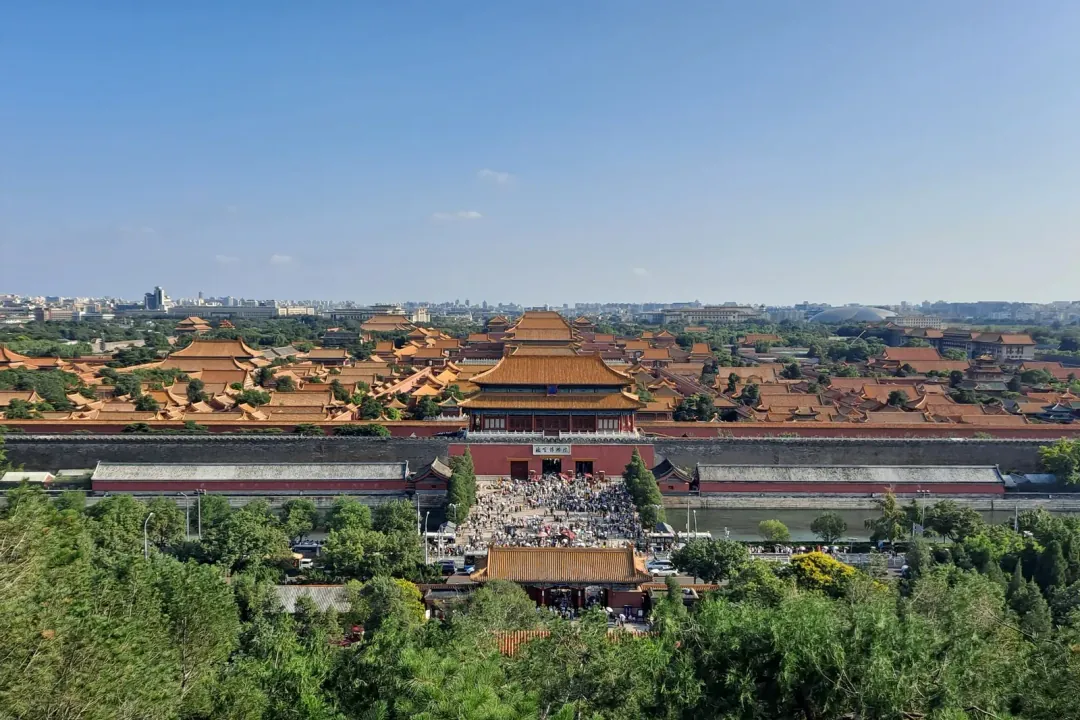
Jingshan Park sits just north of the Forbidden City — a compact imperial garden built on an artificial hill. From Wanchun Pavilion at the summit you get the classic full panorama of the palace; for viewing the Forbidden City there is simply no better spot. The park is small but its position is one of a kind, and at sunset the golden light over the red walls and yellow roofs is stunning.
Beijing · Visitor Guide2026-10-18
Quick Answer
Is Jingshan Park (Prospecting Mountain Park) worth visiting?
The best viewpoint over the Forbidden City: Jingshan's 45 m hill tops Beijing's central axis at Wanchun Pavilion; entry 2 yuan, open 6:00-21:00, opposite the palace north gate.
Quick facts
| Ticket | ¥2 |
|---|---|
| Hours | 6:00-21:00 (peak season), 6:30-20:00 (off season) |
| Recommended duration | 1-2 hours |
| Best time to visit | At sunset; in autumn |
| How to get there | Metro Line 1 to Tian'anmen East or Wangfujing, then a 15-minute walk; buses 58 and 111 to Jingshan Park stop |
| English signage | Yes |
| Wheelchair accessible | Partial |
| Height | About 45 m |
| Wanchun Pavilion | Qing dynasty, highest point of Beijing's central axis |
| Area | About 230,000 m² |
| Location | Directly opposite the palace's Shenwu (north) gate |
| Trees | Mostly pines and cypresses |
| Best view | The full Forbidden City panorama |
What to expect
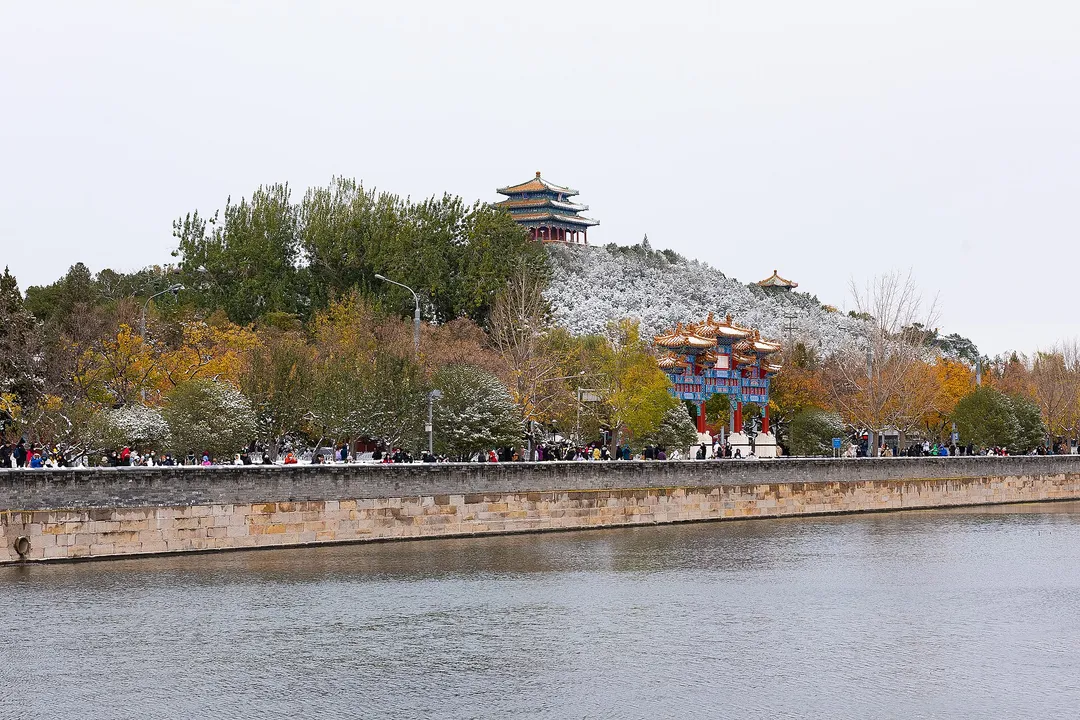
Jingshan Park is not large, but its unusual position makes it pivotal. Five pavilions crest the hill from east to west — Guande, Zhoushang, Wanchun, Fulan and Jifang — arrayed like guardians. Wanchun, on the axis itself, marks the highest point of Beijing's north-south central axis.
How to get there
Metro Line 1 to Tian'anmen East, walk north up Nanchizi Street past the Shenwu gate; or buses 111 and 58
Best photo spots
- The Forbidden City panorama from Wanchun Pavilion (best frame)
- Sunset view toward the Military Museum direction
- The five pavilions in a row
- Shots of the palace from the summit, facing south
Tips
- Arrive an hour before sunset to claim a spot — golden hour is short
- Afternoon is backlit; for palace panoramas come in the morning or at midday
- The park is small; the climb takes only 5-10 minutes
- Peak season is crowded — a morning visit is calmer
Scams to avoid
- Beware of paid "professional photo" services at the top
- Don't trust cheap-ticket discount offers
Frequently asked questions
Are Jingshan Park and Xiangshan the same place?
No — Jingshan is in the city center; Xiangshan (Fragrant Hills) is in the northwest suburbs, famous for autumn foliage
Is the climb long?
No, a few minutes to the top
Can I bring a camera?
Yes; use tripods carefully
Read next
Other things to do in Beijing
798 Art District
Contemporary art in a former East German-designed electronics factory. 200+ galleries, UCCA ¥100. Half day (3–5 hours). Open 24/7, galleries 10:00–18:00. Free district entry.
Badaling Great Wall
The most classic stretch of the Great Wall, 60 km from Beijing at roughly 1,000 m. Entry CNY 40 off-season and CNY 45 in season, cableway extra; allow 2-4 hours.
Beihai Park
Beijing's most central imperial garden — a circular island temple, lotus-covered moat, and white pagoda rising from the lake, walking distance from the Forbidden City. ¥5 park entry, 2 hours.
Old Summer Palace (Yuanmingyuan)
The ruins of the 18th-century imperial garden destroyed by Anglo-French troops in 1860 — haunting stone arches, reconstructed marble bridges, and a museum of recovered artifacts. 2–3 hours. ¥10.
Beijing Botanical Garden
Beijing Botanical Garden at the foot of Fragrant Hills, about 200 hectares with 10000+ species; entry 5 yuan, greenhouse 50 yuan more, open 06:00-19:00.
The Forbidden City
The world's largest ancient palatial complex — 980 surviving buildings across 72 hectares. 3-4 hours minimum. Book tickets 7 days in advance.
Fragrant Hills Park
Beijing's most famous spot for autumn foliage: Xianglufeng peak rises 575 m, entry 10 yuan (5 off-season), cableway 100 yuan one way; best in late October, open 06:00-19:00.
Great Wall at Mutianyu
The best-preserved Great Wall section, 70 km from central Beijing. Cable car + toboggan slide. 3-4 hours including travel.
Gubeikou Great Wall
Wild, unrestored Ming Wall section 2.5h from Beijing. Crumbling watchtowers, no crowds, camping allowed. ¥45. Best for hikers and photographers wanting the real Wall.
Juyongguan Great Wall
Famed Juyong Pass of the Great Wall near Beijing, rebuilt in the Ming dynasty with 12 watchtowers; entry 45 yuan including the Yuan-era Cloud Platform, open 8:30-17:00.
Yonghe Temple (Lama Temple)
Beijing's largest Tibetan Buddhist monastery, once a living Buddha's residence — home to the Hall of the Wheel of Law and its five hundred arhats. Entry CNY 25.
Liulichang (Glazed Tile Factory)
Beijing's antique and calligraphy street with over 800 years of history, about 750 m long and home to Rongbaozhai (founded 1672); free to stroll, shops open 9:00-18:00.
798 Art District
Beijing's contemporary art hub, the 798 Art District reuses Bauhaus-style factory buildings from the 1950s across about 600,000 sqm; free entry, galleries about 10:00-18:00.
Mutianyu Great Wall
One of the best-preserved Great Wall sections near Beijing, about 5400 m with 22 watchtowers; entry 40-45 yuan, cable car 120 yuan, open 7:30-18:00, allow 3-5 hours.
Nanluoguxiang (South Luogu Alley)
Old Beijing's signature hutong — 800 years of history, now a lane of creative shops, snacks and cafes.
National Day 70th Anniversary Exhibition
An exhibition of the People's Republic's achievements across its first 70 years, on the west side of Tiananmen Square. Free, with advance reservation.
National Museum of China
The world's largest museum by floor area, with 48 galleries carrying 5,000 years of Chinese civilization.
Old Summer Palace Ruins Park
Ruins of the famed 'Garden of Gardens', burned by the Anglo-French forces in 1860 — a site that stands as a warning to later generations.
China Art Museum (Red Wall Museum)
China's top art museum, founded in 1962 with 100,000+ works in 21 galleries; free with reservation, 9:00-17:00 and closed Mondays, a 15-minute walk from Dongdan station.
Shichahai
Old Beijing's lakeside hutong-and-bars district — Houhai nights and the filming location of Mr. Six. Free to explore; allow 2-4 hours.
Summer Palace
Empress Dowager Cixi's summer palace in Beijing, about 290 hectares with Kunming Lake covering three quarters; entry 50-60 yuan, 728-metre Long Corridor, built in 1750, UNESCO-listed in 1998.
Working People's Cultural Palace (Imperial Ancestral Temple)
Site of the former Imperial Ancestral Temple southeast of the Forbidden City, with about 140,000 sqm of ancient cypress woods, many Ming-era trees; free with reservation, 6:00-20:00.
Temple of Heaven
Ming and Qing emperors' altar of heaven in Beijing, a 273-hectare park with the 38.2-metre Hall of Prayer for Good Harvests; entry 10-15 yuan or a 34-yuan combo ticket, built in 1420.
Tiananmen Square
The world's largest city square — 440,000 sq m, completed in 1959, free and open all day. The dawn flag-raising is a must-see; Metro Line 1 to Tiananmen East or West.
Museums in Beijing
798 Art District (798 Art Zone)
Beijing's converted 1950s East German factory complex now packs roughly 200 galleries, cafes, and design shops into about 600,000 sqm of Bauhaus industrial space — a full day of wandering.
Beijing Ancient Architecture Museum
Chinese architectural history from Neolithic to Qing, housed inside the 15th-century Temple of Agriculture (先农坛). ¥15. The Hall of Jupiter ceiling alone is worth the trip.
Beijing Auto Museum
China's automobile history from Chairman Mao's limousine to modern EVs, in a striking turbine-shaped building in southwest Beijing. Rare Hongqi and Shanghai sedans. ¥30.
Beijing Capital Museum
Beijing's city-level museum in its landmark new building — the definitive collection of Beijing's imperial, folk, and modern urban culture. Free with passport; 2.5–3.5 hours.
Beijing Planetarium
China's largest planetarium with two buildings, a 3D space theater, and a 200mm refractor telescope open to the public. ¥45. Excellent for families and space enthusiasts.
Beijing Police Museum
Police history, forensics, and criminal investigation through the ages. Free. Passport required. Allow 1.5–2 hours. One of Beijing's most unusual specialty museums.
Capital Museum
Beijing's city museum: 3,000 years of the capital's history with world-class galleries of ancient bronzes, Buddhist art, and Beijing folk culture. Free.
CAFA Art Museum
China's top fine-arts university museum holds roughly 13,000 works across six floors inside a purpose-built I.M. Pei-adjacent campus; allow 2 to 3 hours.
China Customs Museum
Seized smuggled goods — ivory, endangered animal parts, counterfeit luxury items — and the 2,000-year history of Chinese customs. Free. One of Beijing's strangest museums.
China Railway Museum
Stand inside Mao Zedong's personal train carriage, then walk among dozens of steam locomotives in a vast roundhouse — all for ¥20.
Military Museum of the Chinese People's Revolution
Beijing's massive free military museum — tanks, missiles, and Korean War exhibits told through a Chinese perspective, housed in a Stalinist architectural landmark. Allow 3–4 hours.
Museum of Chinese Gardens
All Chinese garden styles in one place — from Suzhou scholar gardens to Lingnan tropical courtyards — in a museum with real outdoor gardens and indoor exhibitions. ¥20.
National Art Museum of China
China's flagship state-run art museum with 100,000+ modern Chinese paintings, calligraphy, and folk art; 1.5-3 hours is enough to see the highlights during a single sit-and-skim visit.
National Museum of China
China's premier national museum on Tiananmen Square — 1.2 million artifacts spanning 3 million years of Chinese history.
Palace Museum (Forbidden City)
The imperial palace of Ming and Qing Dynasty emperors for 500 years — 180-acre palace complex with 980 buildings and the definitive collection of imperial Chinese art, furniture, and ceramics.
Red Gate Gallery
China's first privately-run contemporary art gallery, operating since 1991 in a Ming-dynasty watchtower.
Today Art Museum
Contemporary Chinese art in a converted boiler factory. ¥20. One of Beijing's first private contemporary art museums. Experimental and unpredictable.
UCCA Center for Contemporary Art
The anchor museum of Beijing's 798 Art District. World-class contemporary exhibitions. ¥100. The most internationally recognized contemporary art museum in China.