Beijing · specialty museum
Beijing Police Museum (北京警察博物馆, Běijīng Jǐngchá Bówùguǎn)
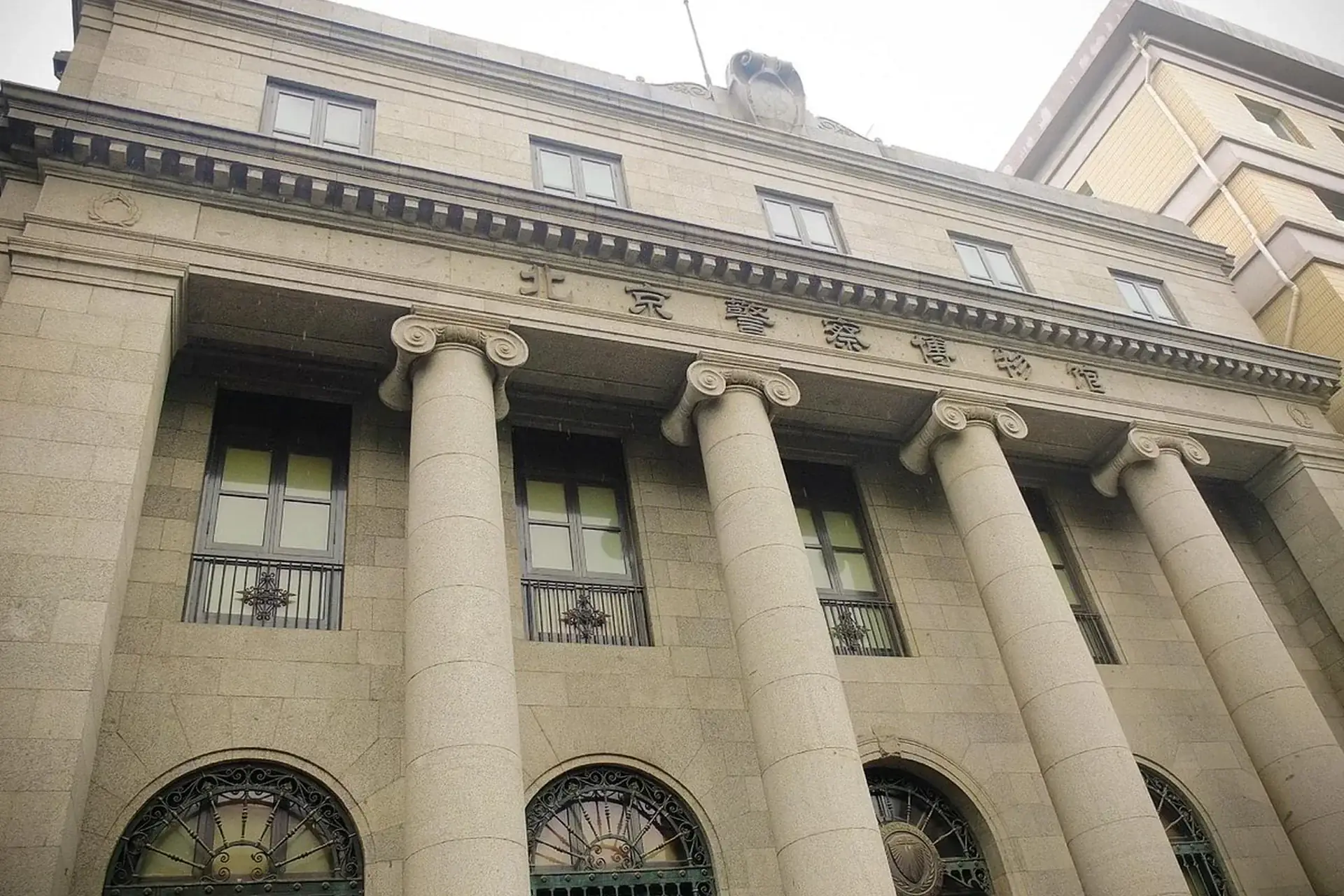
"The Beijing Police Museum occupies the former headquarters of the Beijing Municipal Public Security Bureau, a historic building near the Supreme People's Court. Its four floors cover the history of policing in Beijing from the Qing Dynasty through the present day, with a focus on criminal investigation techniques, forensic science, and major cases. The museum displays include historic police uniforms and equipment, forensic tools from different eras, documentation of famous solved cases, and a sobering section on public security threats. The building itself — a Republican-era structure with a distinctive clock tower — is part of the experience.".
Last updated:
Quick Answer
Is Beijing Police Museum worth visiting?
Police history, forensics, and criminal investigation through the ages. Free. Passport required. Allow 1.5–2 hours. One of Beijing's most unusual specialty museums.
Quick facts
| Category | specialty |
|---|---|
| Ticket | Free. Passport required for foreign visitors. Reserve via WeChat mini-program "北京警察博物馆" or register on-site. |
| Hours | 9:00-16:30 (last entry 16:00). Closed Mondays. |
| Recommended duration | 1.5-2 hours. |
| Best time to visit | Weekday afternoons. The museum is little-known and rarely has more than a handful of visitors at any time. |
| How to get there | Metro Line 1 or 2 to Jianguomen (建国门), Exit B. Walk north 10 minutes on Dongjiaomin Lane. Or bus routes 8, 9, 20, 41, 44, 59, 60, 103, 104, 110 to Zhengyi Road (正义路). |
| English signage | no |
Why visit
The forensics floor is unexpectedly fascinating — early fingerprinting kits, 1950s crime scene photography, and the evolution of forensic science in China from imperial coroners to modern DNA analysis. It is a niche museum that rewards curiosity.
Collection highlights
- Historic police uniforms — from Qing Dynasty constables through Republican-era police to modern Beijing SWAT gear
- Forensic science gallery — early fingerprinting equipment, 1950s crime scene cameras, and the development of forensic techniques in China
- Major cases exhibition — documentation of famous Beijing criminal cases, including the investigation process and evidence (some graphic content)
- Firearms collection — police weapons from the Qing Dynasty matchlocks to modern pistols and non-lethal equipment
- Public security education section — displays on counter-terrorism, fire safety, and cybercrime prevention (propaganda-heavy but culturally interesting)
- The building itself — a Republican-era structure with a clock tower, formerly the Beijing police headquarters
Tips
- Passport is mandatory for foreign visitors — you will not be admitted without it. This is strictly enforced
- English signage is essentially nonexistent — bring a translation app. The visual exhibits (uniforms, weapons, forensic tools) are self-explanatory; the case documentation requires translation
- The forensics floor (3rd floor) is the most interesting for international visitors — the rest is police history that requires Chinese reading ability to appreciate
- I found the Qing Dynasty coroner tools in the forensics section fascinating — the 13th-century text "Collected Cases of Injustice Rectified" (洗冤集录) is the world's oldest forensic manual
- Photography is permitted in some galleries but not others — ask staff before photographing. The firearms gallery generally prohibits photos
- Combine with the China Customs Museum (1 km south) and the Ancient Observatory (800 m northeast) for a trio of offbeat Beijing museums
Frequently asked questions
Do I need my passport to enter the Beijing Police Museum?
Yes — passport is mandatory for foreign visitors. This is strictly enforced. You will go through security screening and passport registration at the entrance.
Is the Beijing Police Museum free?
Yes, free entry. Reserve via WeChat mini-program "北京警察博物馆" or register on-site with your passport.
Does the Beijing Police Museum have English signage?
No — essentially all signage is Chinese-only. The visual exhibits (uniforms, weapons, forensic tools) are understandable without Chinese. The case documentation and historical panels require a translation app.
How long do I need at the Beijing Police Museum?
1.5-2 hours. The forensics floor (30 minutes), uniforms and weapons (30 minutes), and major cases section (20 minutes) are the main draws. It is a small museum.
Can I take photos inside?
Photography is permitted in some galleries, prohibited in others (especially the firearms gallery and some case exhibits). Ask staff before photographing. Signs are posted but are in Chinese.
Where is the Beijing Police Museum?
On Dongjiaomin Lane in central Beijing, near the Supreme People's Court. Metro Line 1 or 2 to Jianguomen (建国门), Exit B, then a 10-minute walk north. It is in a historic Republican-era building with a clock tower.
Read next
Other things to do in Beijing
798 Art District
"\" Contemporary art in a former East German-designed electronics factory. 200+ galleries, UCCA ¥100. Half day (3–5 hours). Open 24/7, galleries 10:00–18:00. Free district entry.\".".
Badaling Great Wall
badaling-great-wall in Beijing: 最经典长城段落,距北京约60公里,海拔约1000米。门票淡季40元旺季45元,缆车另付120元。建议2-4小时,避开节假日。
Old Summer Palace (Yuanmingyuan)
The ruins of the 18th-century imperial garden destroyed by Anglo-French troops in 1860 — haunting stone arches, reconstructed marble bridges, and a museum of recovered artifacts. 2–3 hours. ¥10.
The Forbidden City
"The world's largest ancient palatial complex — 980 surviving buildings across 72 hectares. 3-4 hours minimum. Book tickets 7 days in advance.".
Great Wall at Mutianyu
"The best-preserved Great Wall section, 70 km from central Beijing. Cable car + toboggan slide. 3-4 hours including travel.".
Gubeikou Great Wall
"Wild, unrestored Ming Wall section 2.5h from Beijing. Crumbling watchtowers, no crowds, camping allowed. ¥45. Best for hikers and photographers wanting the real Wall.".
Yonghe Temple (Lama Temple)
lama-temple in Beijing: ""北京最大藏传佛教寺庙,活佛府邸,法轮殿五百罗汉山".".. 2026 verified.
Nanluoguxiang (South Luogu Alley)
nanluoguxiang in Beijing: "老北京胡同名片,800年历史,文创小店美食一条街.".
National Day 70th Anniversary Exhibition
national-day-flagship in Beijing: "展现新中国成立70周年发展成就,天安门广场西侧,需预约.".
National Museum of China
national-museum in Beijing: "世界上最大博物馆,48个展厅,代表中华五千年文明.".
Old Summer Palace Ruins Park
old-summer-palace in Beijing: "万园之园废墟,1860年英法联军焚毁,遗址警示后人.".
Shichahai (Ten Grounds Lakes)
shichahai in Beijing: "老北京胡同酒吧区,后海夜色,老炮儿拍摄地.".. 2026 verified.
Tiananmen Square
tiananmen-square in Beijing: 世界上最大的城市广场,面积44万平方米,1959年建成。免费开放,全天。人民英雄纪念碑高37.94米。升降旗仪式必看(每天日出前30分钟)。地铁1号线天安门东站或天安门西站。
Museums in Beijing
798 Art District (798 Art Zone)
"Beijing's converted 1950s East German factory complex now packs roughly 200 galleries, cafes, and design shops into about 600,000 sqm of Bauhaus industrial space — a full day of wandering,.".
Anhui Museum
"Huizhou art and architecture, Shang-Zhou bronze, and the Anhui School of painting — a strong provincial museum in Hefei's 2011 landmark building. Free.".
Beijing Ancient Architecture Museum
Chinese architectural history from Neolithic to Qing, housed inside the 15th-century Temple of Agriculture (先农坛). ¥15. The Hall of Jupiter ceiling alone is worth the trip.
Beijing Auto Museum
"China's automobile history from Chairman Mao's limousine to modern EVs, in a striking turbine-shaped building in southwest Beijing. Rare Hongqi and Shanghai sedans. ¥30.".
Beijing Capital Museum
"Beijing's city-level museum in its landmark new building — the definitive collection of Beijing's imperial, folk, and modern urban culture,.".. 2026 verified.
Beijing Planetarium
"China's largest planetarium with two buildings, a 3D space theater, and a 200mm refractor telescope open to the public. ¥45. Excellent for families and space enthusiasts.".
Capital Museum
"\"Beijing's city museum: 3,000 years of the capital's history with world-class galleries of ancient bronzes, Buddhist art, and Beijing folk culture. Free.\".".
China Customs Museum
"Seized smuggled goods — ivory, endangered animal parts, counterfeit luxury items — and the 2,000-year history of Chinese customs. Free. One of Beijing's strangest museums.".
China Railway Museum
"Stand inside Mao Zedong's personal train carriage, then walk among dozens of steam locomotives in a vast roundhouse — all for ¥20.".
Military Museum of the Chinese People's Revolution
"Beijing's massive free military museum — tanks, missiles, and Korean War exhibits told through a Chinese perspective, housed in a Stalinist architectural landmark. Allow 3–4 hours.".
Museum of Chinese Gardens
"All Chinese garden styles in one place — from Suzhou scholar gardens to Lingnan tropical courtyards — in a museum with real outdoor gardens and indoor exhibitions. ¥20.".
National Art Museum of China
"China's flagship state-run art museum with 100,000+ modern Chinese paintings, calligraphy, and folk art; 1.5-3 hours is enough to see the highlights during a single sit-and-skim visit.".
National Museum of China
"China's premier national museum on Tiananmen Square — 1.2 million artifacts spanning 3 million years of Chinese history,.".
Palace Museum (Forbidden City)
"The imperial palace of Ming and Qing Dynasty emperors for 500 years — 180-acre palace complex with 980 buildings and the definitive collection of imperial Chinese art, furniture,.".
Red Gate Gallery
"China's first privately-run contemporary art gallery, operating since 1991 in a Ming-dynasty watchtower,.".
Today Art Museum
"Contemporary Chinese art in a converted boiler factory. ¥20. One of Beijing's first private contemporary art museums. Experimental and unpredictable.".
UCCA Center for Contemporary Art
"The anchor museum of Beijing's 798 Art District. World-class contemporary exhibitions. ¥100. The most internationally recognized contemporary art museum in China.".