Beijing · science museum
Beijing Auto Museum (北京汽车博物馆, Běijīng Qìchē Bówùguǎn)
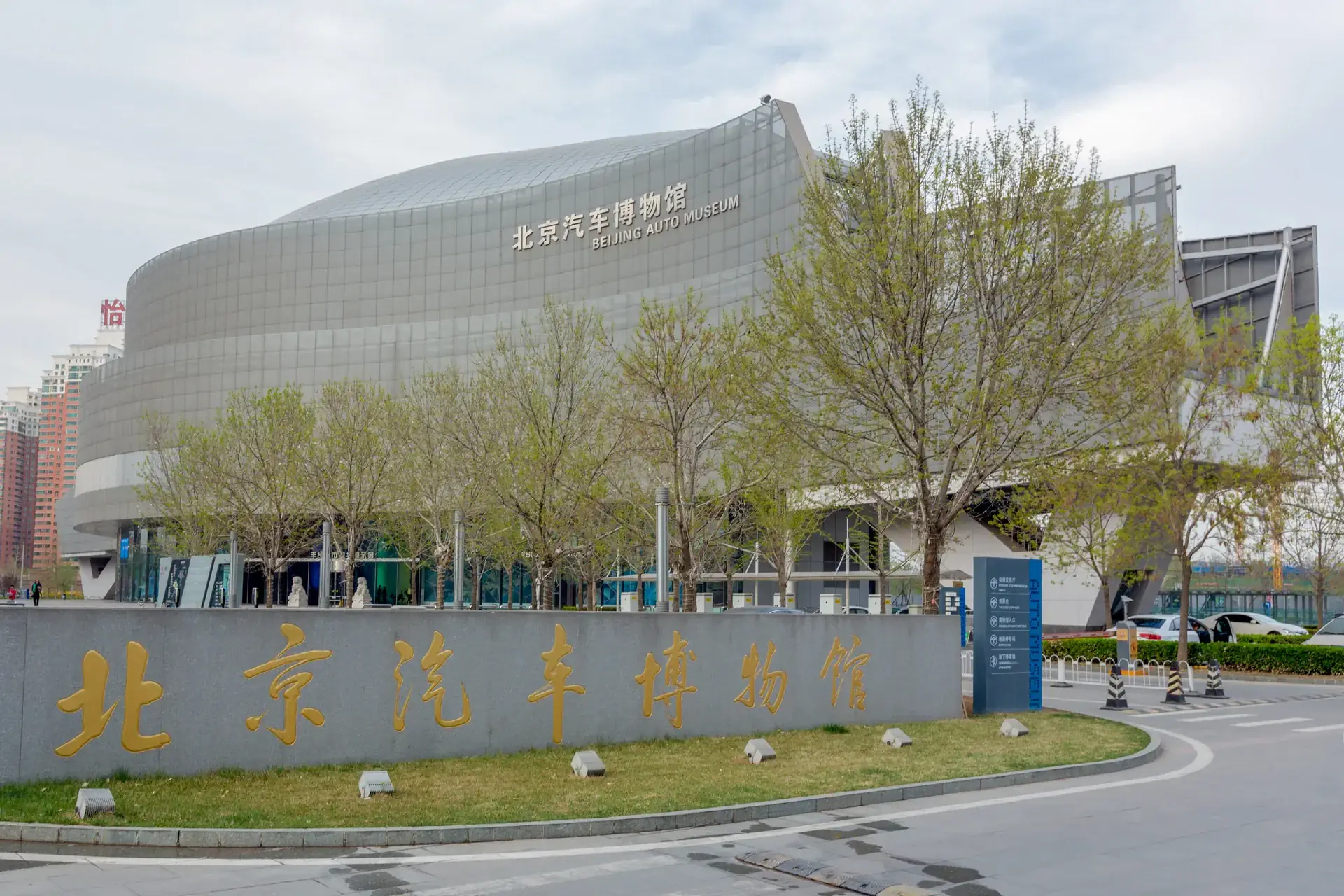
"The Beijing Auto Museum occupies a dramatic 2011 building shaped like a turbine or eye in Beijing's Fengtai District — far from the central tourist circuit but worth the journey for automotive enthusiasts. The collection traces China's auto industry from the 1950s, when the First Automobile Works (FAW) produced the Jiefang truck (a Soviet ZIS-150 clone), through the Great Leap Forward's backyard furnaces-turned-automotive factories, to the Hongqi (红旗, Red Flag) luxury sedans that carried Mao Zedong and Deng Xiaoping. The signature exhibits are the Chairman Mao Hongqi parade cars — massive black open-top sedans with three rows of seats, chrome bumpers, and Chinese flag standards on the front fenders. The museum also covers international automotive history (a replica Benz Patent-Motorwagen, a Ford Model T) and the EV transition (BYD, NIO, and Tesla displays). The top floor has an interactive driving simulator zone popular with families.".
Last updated:
Quick Answer
Is Beijing Auto Museum worth visiting?
"China's automobile history from Chairman Mao's limousine to modern EVs, in a striking turbine-shaped building in southwest Beijing. Rare Hongqi and Shanghai sedans. ¥30.".
Quick facts
| Category | science |
|---|---|
| Ticket | ¥30 (as of June 2026). Purchase at the ticket office or via the museum WeChat mini-program. Children under 1.2 m free. Seniors over 60 half price. |
| Hours | 9:00-17:00 (last entry 16:00). Closed Mondays. |
| Recommended duration | 2-2.5 hours. Add 30 minutes for the interactive driving zone. |
| Best time to visit | Weekday mornings. The museum is popular with school groups on weekday mornings (9:00-11:00) — weekday afternoons are quieter. Avoid weekends when families fill the interactive zone. |
| How to get there | Metro Line 9 to Keyi Road (科怡路), Exit B. Walk south 10 minutes on South Fourth Ring Road West. Or Metro Line 4 to Gongyi Xiqiao (公益西桥), Exit C, transfer to bus 740 or T9. Bus routes 353, 354, 451, 477, 480, 692, 736, 740, 840, 845, 913, 959, 967, 969, 998, T9, Yuntong 115 to World Park (世界公园) stop — the museum is across the street. DiDi from central Beijing costs ¥50-70 (the museum is in southwest Beijing, about 15 km from Tiananmen). |
| English signage | partial |
Why visit
The Chairman Mao Hongqi limousines are the emotional core of the museum and a window into Chinese state ceremony. The Hongqi CA770 — a three-row, 5.8-meter black sedan designed in 1963 without any foreign assistance — is a genuinely significant piece of Chinese industrial design. The comparison between the Soviet-influenced 1950s vehicles and the 2020s Chinese EV prototypes in the same building tells the arc of Chinese manufacturing in one visit.
Collection highlights
- Hongqi CA770 parade limousine — a 5.8-meter black sedan with three rows, designed in 1963-1965 by FAW engineers without foreign assistance. Used by Chairman Mao, Zhou Enlai, and visiting heads of state. The interior has wool upholstery, a radio telephone, and retractable flag standards
- Hongqi CA72 — the first Hongqi model (1958), a two-tone sedan modeled loosely on a 1955 Chrysler Imperial but with Chinese-designed front grille shaped like a folding fan (symbol of hospitality)
- Chairman Mao's personal Jiefang CA10 inspection vehicle — an open-top green truck used for military parades, with chrome grab bar and microphone stand in the truck bed
- Shanghai SH760 sedan — China's most common car from the 1960s-1980s, a boxy sedan based on the Mercedes-Benz 220S (W180). Tens of thousands were produced for government officials
- Beijing BJ212 jeep — the famous green 4x4 that served as the PLA's standard light vehicle from 1965 into the 1990s, designed by Beijing Automobile Works
- BYD Han EV cutaway display — a deconstructed modern Chinese electric sedan showing battery pack, motor, and chassis design, contrasting with the 1950s exhibits on the floor below
Tips
- The museum is in southwest Beijing, far from central tourist attractions — plan 40-60 minutes travel time from central Beijing by Metro. Combine with a visit to the World Park (世界公园, next door, ¥100) if you want to make the journey worthwhile
- I visited in June 2026 and found the Chairman Mao parade car gallery genuinely moving — the cars are in near-perfect condition and the black lacquer, chrome, and flag standards communicate state power in a way that a photograph cannot
- English signage is present for the major exhibits but becomes sparse in the section covering 1970s-1990s Chinese auto development — the brands and model names are in English but detailed explanations are Chinese-only
- The top-floor interactive zone has driving simulators (¥20 per session) that are popular with children — it gets noisy on weekends
- The museum cafe serves mediocre coffee (¥25) — there is a better cafe at the nearby Fengtai Wanda Plaza (丰台万达广场, 1 km east)
- Photography is allowed throughout. The Hongqi limousines photograph beautifully under the museum's theatrical lighting
Frequently asked questions
What is a Hongqi car?
Hongqi (红旗, "Red Flag") is China's oldest and most prestigious automobile brand, founded in 1958 by First Automobile Works (FAW) in Changchun. It was created to produce limousines for Chinese leaders — the first model, Hongqi CA72, debuted at the 1959 National Day parade. Hongqi cars carried Mao Zedong, Deng Xiaoping, and every subsequent Chinese leader, as well as visiting foreign heads of state (Nixon rode in a Hongqi during his 1972 visit). The Hongqi CA770, designed in 1963-1965, is the most famous model — a 5.8-meter black sedan that remained in production until 1981 with only minor changes. Hongqi was relaunched as a luxury brand in 2018 and now produces electric SUVs.
Is the Beijing Auto Museum worth visiting if I am not a car person?
If you have an interest in Chinese political history, the Chairman Mao limousine gallery is worth the trip — these cars are physical artifacts of Chinese state ceremony and the Hongqi sedans are genuinely interesting as examples of mid-century Chinese industrial design. If neither cars nor Chinese political history appeal, this museum is unlikely to convert you. The museum is far from central Beijing, which adds a time cost.
How many cars are in the Beijing Auto Museum?
The museum displays approximately 80 vehicles across five floors, covering Chinese automotive history (1950s-present), international automotive history, and future mobility. About two-thirds of the vehicles are Chinese. The collection includes roughly 15 Hongqi limousines and parade vehicles — the largest Hongqi collection in public hands.
Where is the Beijing Auto Museum?
The Beijing Auto Museum is at 126 South Fourth Ring Road West, Fengtai District (北京市丰台区南四环西路126号), in southwest Beijing. It is about 15 km from Tiananmen Square. The nearest Metro station is Keyi Road (科怡路) on Line 9, about a 10-minute walk south. The World Park (世界公园) is next door — both are in a relatively distant location from central Beijing.
How much time to allow for the Beijing Auto Museum?
Allow 2-2.5 hours for the full museum and an additional 30 minutes if you plan to use the interactive driving simulators on the top floor. Add 40-60 minutes each way for travel from central Beijing.
Does the Beijing Auto Museum have electric vehicles?
Yes, the top floor of the museum covers new energy vehicles (NEVs) with cutaway displays of Chinese EV models including the BYD Han and NIO ES8, showing battery pack layout, electric motor design, and chassis architecture. The contrast with the 1950s Soviet-influenced trucks on the lower floors tells the arc of Chinese manufacturing in a single building.
Read next
Other things to do in Beijing
798 Art District
"\" Contemporary art in a former East German-designed electronics factory. 200+ galleries, UCCA ¥100. Half day (3–5 hours). Open 24/7, galleries 10:00–18:00. Free district entry.\".".
Badaling Great Wall
badaling-great-wall in Beijing: 最经典长城段落,距北京约60公里,海拔约1000米。门票淡季40元旺季45元,缆车另付120元。建议2-4小时,避开节假日。
Old Summer Palace (Yuanmingyuan)
The ruins of the 18th-century imperial garden destroyed by Anglo-French troops in 1860 — haunting stone arches, reconstructed marble bridges, and a museum of recovered artifacts. 2–3 hours. ¥10.
The Forbidden City
"The world's largest ancient palatial complex — 980 surviving buildings across 72 hectares. 3-4 hours minimum. Book tickets 7 days in advance.".
Great Wall at Mutianyu
"The best-preserved Great Wall section, 70 km from central Beijing. Cable car + toboggan slide. 3-4 hours including travel.".
Gubeikou Great Wall
"Wild, unrestored Ming Wall section 2.5h from Beijing. Crumbling watchtowers, no crowds, camping allowed. ¥45. Best for hikers and photographers wanting the real Wall.".
Yonghe Temple (Lama Temple)
lama-temple in Beijing: ""北京最大藏传佛教寺庙,活佛府邸,法轮殿五百罗汉山".".. 2026 verified.
Nanluoguxiang (South Luogu Alley)
nanluoguxiang in Beijing: "老北京胡同名片,800年历史,文创小店美食一条街.".
National Day 70th Anniversary Exhibition
national-day-flagship in Beijing: "展现新中国成立70周年发展成就,天安门广场西侧,需预约.".
National Museum of China
national-museum in Beijing: "世界上最大博物馆,48个展厅,代表中华五千年文明.".
Old Summer Palace Ruins Park
old-summer-palace in Beijing: "万园之园废墟,1860年英法联军焚毁,遗址警示后人.".
Shichahai (Ten Grounds Lakes)
shichahai in Beijing: "老北京胡同酒吧区,后海夜色,老炮儿拍摄地.".. 2026 verified.
Tiananmen Square
tiananmen-square in Beijing: 世界上最大的城市广场,面积44万平方米,1959年建成。免费开放,全天。人民英雄纪念碑高37.94米。升降旗仪式必看(每天日出前30分钟)。地铁1号线天安门东站或天安门西站。
Museums in Beijing
798 Art District (798 Art Zone)
"Beijing's converted 1950s East German factory complex now packs roughly 200 galleries, cafes, and design shops into about 600,000 sqm of Bauhaus industrial space — a full day of wandering,.".
Anhui Museum
"Huizhou art and architecture, Shang-Zhou bronze, and the Anhui School of painting — a strong provincial museum in Hefei's 2011 landmark building. Free.".
Beijing Ancient Architecture Museum
Chinese architectural history from Neolithic to Qing, housed inside the 15th-century Temple of Agriculture (先农坛). ¥15. The Hall of Jupiter ceiling alone is worth the trip.
Beijing Capital Museum
"Beijing's city-level museum in its landmark new building — the definitive collection of Beijing's imperial, folk, and modern urban culture,.".. 2026 verified.
Beijing Planetarium
"China's largest planetarium with two buildings, a 3D space theater, and a 200mm refractor telescope open to the public. ¥45. Excellent for families and space enthusiasts.".
Beijing Police Museum
Police history, forensics, and criminal investigation through the ages. Free. Passport required. Allow 1.5–2 hours. One of Beijing's most unusual specialty museums.
Capital Museum
"\"Beijing's city museum: 3,000 years of the capital's history with world-class galleries of ancient bronzes, Buddhist art, and Beijing folk culture. Free.\".".
China Customs Museum
"Seized smuggled goods — ivory, endangered animal parts, counterfeit luxury items — and the 2,000-year history of Chinese customs. Free. One of Beijing's strangest museums.".
China Railway Museum
"Stand inside Mao Zedong's personal train carriage, then walk among dozens of steam locomotives in a vast roundhouse — all for ¥20.".
Military Museum of the Chinese People's Revolution
"Beijing's massive free military museum — tanks, missiles, and Korean War exhibits told through a Chinese perspective, housed in a Stalinist architectural landmark. Allow 3–4 hours.".
Museum of Chinese Gardens
"All Chinese garden styles in one place — from Suzhou scholar gardens to Lingnan tropical courtyards — in a museum with real outdoor gardens and indoor exhibitions. ¥20.".
National Art Museum of China
"China's flagship state-run art museum with 100,000+ modern Chinese paintings, calligraphy, and folk art; 1.5-3 hours is enough to see the highlights during a single sit-and-skim visit.".
National Museum of China
"China's premier national museum on Tiananmen Square — 1.2 million artifacts spanning 3 million years of Chinese history,.".
Palace Museum (Forbidden City)
"The imperial palace of Ming and Qing Dynasty emperors for 500 years — 180-acre palace complex with 980 buildings and the definitive collection of imperial Chinese art, furniture,.".
Red Gate Gallery
"China's first privately-run contemporary art gallery, operating since 1991 in a Ming-dynasty watchtower,.".
Today Art Museum
"Contemporary Chinese art in a converted boiler factory. ¥20. One of Beijing's first private contemporary art museums. Experimental and unpredictable.".
UCCA Center for Contemporary Art
"The anchor museum of Beijing's 798 Art District. World-class contemporary exhibitions. ¥100. The most internationally recognized contemporary art museum in China.".