
Shichahai什刹海
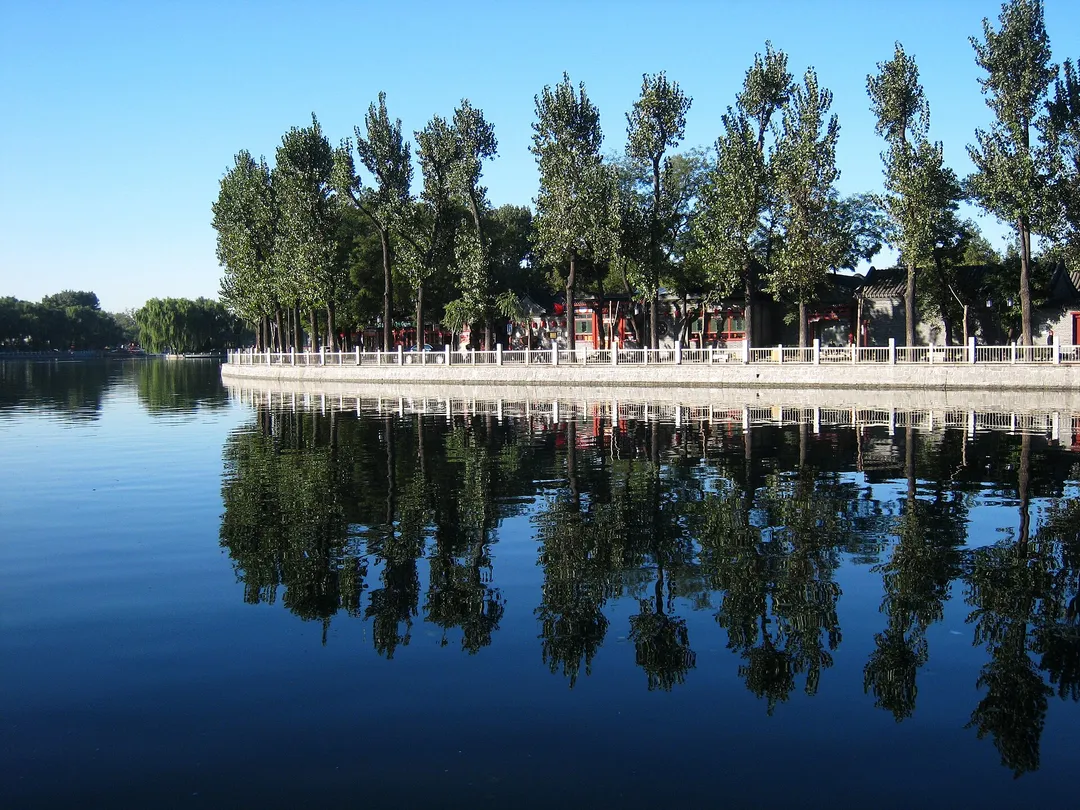
Shichahai is three linked lakes — Qianhai, Houhai and Xihai — a rare stretch of waterside scenery inside Beijing's old city. Hutong crowd the shores and Silver Ingot Bridge is the signature landmark. After dark the Houhai bar street lights up, the very image of Beijing nightlife.
Beijing · Visitor Guide2026-11-17
Quick Answer
Is Shichahai worth visiting?
Old Beijing's lakeside hutong-and-bars district — Houhai nights and the filming location of Mr. Six. Free to explore; allow 2-4 hours.
Quick facts
| Ticket | Free admission |
|---|---|
| Hours | Open all day; the bar street runs roughly 18:00-02:00 |
| Recommended duration | 2-4 hours |
| Best time to visit | Summer evenings into the night; in winter the frozen lakes host ice fun |
| How to get there | Metro Line 6 or 8 to Shichahai, Exit A; buses 5, 60 and 90, among others |
| English signage | Partial |
| Wheelchair accessible | Partial |
| Made up of | Qianhai, Houhai and Xihai lakes |
| Location | Northeastern Xicheng District |
| Silver Ingot Bridge | Ming-dynasty landmark |
| Bars | Around 100 along Houhai |
| History | A scenic area since the Yuan dynasty |
| Film | Filming location of "Mr. Six. |
What to expect
Shichahai is one of the few stretches of open water in central Beijing; its three lakes, together with the surrounding hutong and siheyuan courtyards, form the classic old-Beijing townscape. Legend holds the area once served as stabling for imperial horses, and the name "Shichahai" has several explanations. Willows trail into the water — boating in summer, skating in winter.
Silver Ingot Bridge spans the narrows where the lakes meet and is Shichahai's signature structure. From the bridge you can gaze toward the Western Hills and, on clear days, pick out the Jade Peak Pagoda on Jade Spring Hill. The bridge area is the best photo spot and the busiest with visitors.
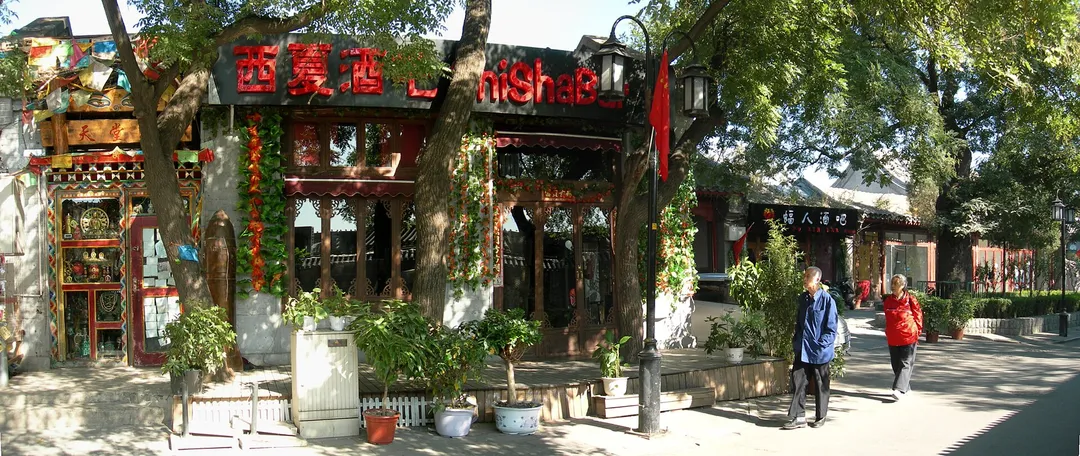
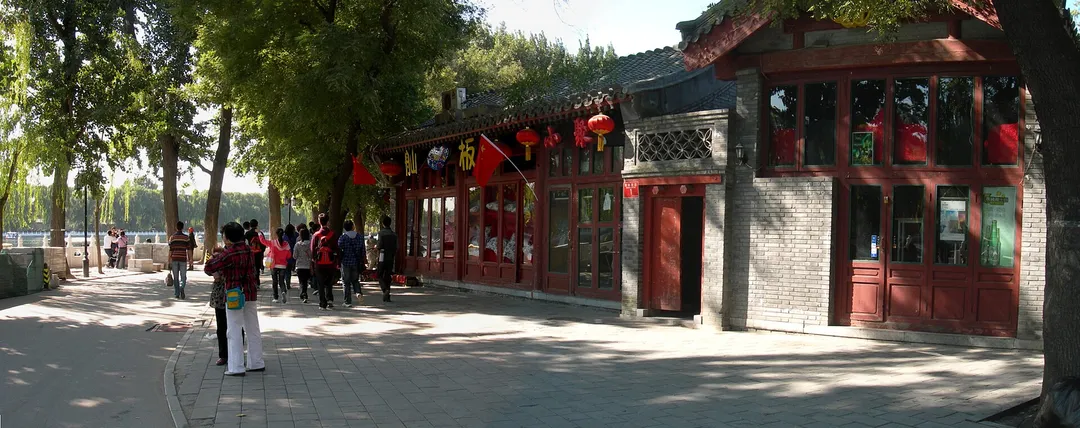
The Houhai bar street is the face of Beijing nightlife, with a hundred -plus bars and restaurants lining the water. By day the shore is quiet and old-world; by night the neon flickers and singers' voices drift from the windows. The strip has turned commercial in recent years, but it remains a classic Beijing night out.
How to get there
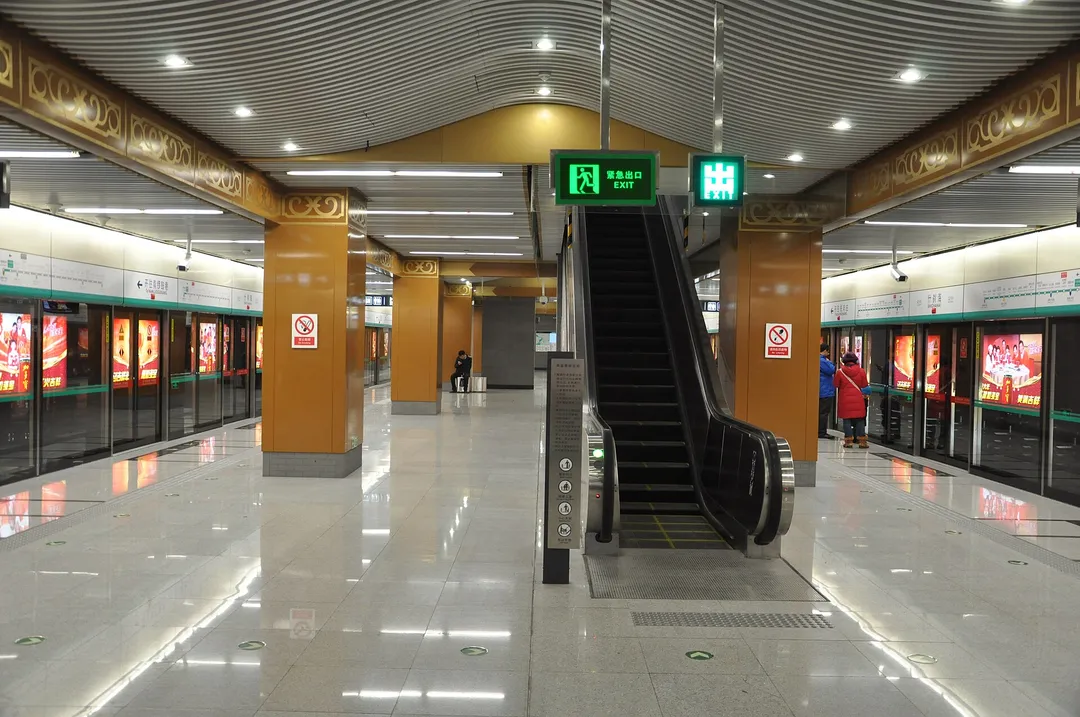
Metro Line 6 or 8 to Shichahai, Exit A, then about 5 minutes on foot.
Best photo spots
- Panoramas from Silver Ingot Bridge
- Houhai bar street after dark
- Willows reflected in the lake
- Winter ice activities on the frozen lakes
Tips
- Come at dusk to catch both the daytime scenery and the lights
- Bar prices run high — check the menu before you sit
- When the lake freezes you can skate — a different kind of fun
- Wander the surrounding hutong in search of old-Beijing life
Scams to avoid
- Watch out for touts steering you into bars
- Don't trust cut-price boat rides
Frequently asked questions
How does Shichahai relate to Nanluoguxiang?
They are next door to each other, about 10 minutes on foot — easy to combine.
Are the bars expensive?
Fairly — a beer runs about CNY 30-50; check the menu first.
Can you go boating in summer?
Yes — both Qianhai and Houhai have pleasure boats.
Read next
Other things to do in Beijing
798 Art District
Contemporary art in a former East German-designed electronics factory. 200+ galleries, UCCA ¥100. Half day (3–5 hours). Open 24/7, galleries 10:00–18:00. Free district entry.
Beijing
The capital's imperial core as a day-trip destination — Forbidden City, Temple of Heaven and hutong lanes. Forbidden City ¥60 peak / ¥40 off-peak, closed Mondays.
Badaling Great Wall
The grandest fully restored stretch of the Great Wall, 60 km northwest of Beijing on a ridge that tops out at 888.9 m at North Tower 8. Entry CNY 40 in season and CNY 35 off-season, reserved online in advance; cable car extra. Allow 2.5-4 hours.
Beihai Park
Beijing's most central imperial garden — a circular island temple, lotus-covered moat, and white pagoda rising from the lake, walking distance from the Forbidden City. ¥5 park entry, 2 hours.
Old Summer Palace (Yuanmingyuan)
The ruins of the 18th-century imperial garden destroyed by Anglo-French troops in 1860 — haunting stone arches, reconstructed marble bridges, and a museum of recovered artifacts. 2–3 hours. ¥10.
Beijing Botanical Garden
Beijing Botanical Garden at the foot of Fragrant Hills, about 200 hectares with 10000+ species; entry 5 yuan, greenhouse 50 yuan more, open 06:00-19:00.
The Forbidden City
The world's largest ancient palatial complex — 980 surviving buildings across 72 hectares, home to 24 emperors from 1420 to 1912. Reserve up to 7 days ahead at the 20:00 release (tickets sell out); allow 3-4 hours minimum.
Fragrant Hills Park
Beijing's most famous spot for autumn foliage: Xianglufeng peak rises 575 m, entry 10 yuan (5 off-season), cableway 100 yuan one way; best in late October, open 06:00-19:00.
Great Wall at Mutianyu
The greenest, best-restored Great Wall section, 70 km northeast of Beijing in Huairou. Cable car up to Watchtower 14, toboggan down from Watchtower 6, far fewer crowds than Badaling. Allow 3-4 hours on the wall plus 1.5-2 hours travel each way.
Gubeikou Great Wall
Wild, unrestored Ming Wall section 2.5h from Beijing. Crumbling watchtowers, no crowds, camping allowed. ¥45. Best for hikers and photographers wanting the real Wall.
Jingshan Park (Prospecting Mountain Park)
The best viewpoint over the Forbidden City: Jingshan's 45 m hill tops Beijing's central axis at Wanchun Pavilion; entry 2 yuan, open 6:00-21:00, opposite the palace north gate.
Juyongguan Great Wall
Famed Juyong Pass of the Great Wall near Beijing, rebuilt in the Ming dynasty with 12 watchtowers; entry 45 yuan including the Yuan-era Cloud Platform, open 8:30-17:00.
Yonghe Temple (Lama Temple)
Beijing's largest Tibetan Buddhist (Gelug) monastery — Prince Yong's residence turned imperial temple, home of the single-tree Maitreya Buddha. Entry CNY 25; reserve online ahead.
Liulichang (Glazed Tile Factory)
Beijing's antique and calligraphy street with over 800 years of history, about 750 m long and home to Rongbaozhai (founded 1672); free to stroll, shops open 9:00-18:00.
Nanluoguxiang (South Luogu Alley)
Old Beijing's signature hutong — an 800-year-old Yuan-dynasty lane with 16 fishbone side alleys, now a spine of creative shops, snacks and cafes.
National Museum of China
The world's largest museum by floor area, with 48 galleries carrying 5,000 years of Chinese civilization.
Old Summer Palace Ruins Park
Ruins of the famed 'Garden of Gardens', burned by the Anglo-French forces in 1860 — a site that stands as a warning to later generations.
China Art Museum (Red Wall Museum)
China's top art museum, founded in 1962 with 100,000+ works in 21 galleries; free with reservation, 9:00-17:00 and closed Mondays, a 15-minute walk from Dongdan station.
Summer Palace
Empress Dowager Cixi's lakeside summer palace in northwest Beijing, about 290 hectares with Kunming Lake covering three quarters; entry CNY 30/20 by season or a CNY 60/50 combined ticket, 728-metre Long Corridor, built in 1750, UNESCO-listed in 1998.
Working People's Cultural Palace (Imperial Ancestral Temple)
Site of the former Imperial Ancestral Temple southeast of the Forbidden City, with about 140,000 sqm of ancient cypress woods, many Ming-era trees; free with reservation, 6:00-20:00.
Temple of Heaven
Ming and Qing emperors' altar of heaven in Beijing, a 273-hectare park centred on the 38.2-metre nail-free Hall of Prayer for Good Harvests; entry CNY 15/10 by season or a CNY 34/28 through ticket, built in 1420, UNESCO-listed in 1998.
Tiananmen Square
The world's largest city square — free, but every visitor needs a free advance reservation and passes a security check. Come at dawn for the flag-raising (sunrise year-round); Metro Line 1 to Tiananmen East or West.
Museums in Beijing
798 Art District (798 Art Zone)
Beijing's converted 1950s East German factory complex now packs roughly 200 galleries, cafes, and design shops into about 600,000 sqm of Bauhaus industrial space — a full day of wandering.
Beijing Ancient Architecture Museum
Chinese architectural history from Neolithic to Qing, housed inside the 15th-century Temple of Agriculture (先农坛). ¥15. The Hall of Jupiter ceiling alone is worth the trip.
Beijing Auto Museum
China's automobile history from Chairman Mao's limousine to modern EVs, in a striking turbine-shaped building in southwest Beijing. Rare Hongqi and Shanghai sedans. ¥30.
Beijing Capital Museum
Capital Museum (首都博物馆) — alias page. See the full guide at capital-museum.
Beijing Planetarium
China's largest planetarium with two buildings, a 3D space theater, and a 200mm refractor telescope open to the public. ¥45. Excellent for families and space enthusiasts.
Beijing Police Museum
Police history, forensics, and criminal investigation through the ages. Free. Passport required. Allow 1.5–2 hours. One of Beijing's most unusual specialty museums.
Capital Museum
Beijing's city museum: 3,000 years of the capital's history with world-class galleries of ancient bronzes, Buddhist art, and Beijing folk culture. Free.
CAFA Art Museum
China's top fine-arts university museum holds roughly 13,000 works across six floors inside a purpose-built I.M. Pei-adjacent campus; allow 2 to 3 hours.
China Customs Museum
Seized smuggled goods — ivory, endangered animal parts, counterfeit luxury items — and the 2,000-year history of Chinese customs. Free. One of Beijing's strangest museums.
China Railway Museum
Stand inside Mao Zedong's personal train carriage, then walk among dozens of steam locomotives in a vast roundhouse — all for ¥20.
Military Museum of the Chinese People's Revolution
Beijing's massive free military museum — tanks, missiles, and Korean War exhibits told through a Chinese perspective, housed in a Stalinist architectural landmark. Allow 3–4 hours.
Museum of Chinese Gardens
All Chinese garden styles in one place — from Suzhou scholar gardens to Lingnan tropical courtyards — in a museum with real outdoor gardens and indoor exhibitions. ¥20.
National Art Museum of China
China's flagship state-run art museum with 100,000+ modern Chinese paintings, calligraphy, and folk art; 1.5-3 hours is enough to see the highlights during a single sit-and-skim visit.
National Museum of China
China's premier national museum on Tiananmen Square — 1.2 million artifacts spanning 3 million years of Chinese history.
Palace Museum (Forbidden City)
The imperial palace of Ming and Qing Dynasty emperors for 500 years — 180-acre palace complex with 980 buildings and the definitive collection of imperial Chinese art, furniture, and ceramics.
Red Gate Gallery
China's first privately-run contemporary art gallery, operating since 1991 in a Ming-dynasty watchtower.
Today Art Museum
Contemporary Chinese art in a converted boiler factory. ¥20. One of Beijing's first private contemporary art museums. Experimental and unpredictable.
UCCA Center for Contemporary Art
The anchor museum of Beijing's 798 Art District. World-class contemporary exhibitions. ¥100. The most internationally recognized contemporary art museum in China.