nihaovisit

Luoyang · Visitor Guide

Longmen Grottoes (龙门石窟, Lóngmén Shíkū)

The Longmen Grottoes are a 1-kilometer stretch of limestone cliffs on both banks of the Yi River near Luoyang, carved with 100,000+ Buddhist statues in 2,345 niches and caves between the Northern Wei (493 AD) and Tang (907 AD) dynasties. It represents the peak of Chinese Buddhist stone carving, distinct from Dunhuang (painted murals) and Yungang (earlier, Indian-influenced). The centerpiece Vairocana Buddha (Lucena, 卢舍那大佛) — carved circa 675 AD under Empress Wu Zetian — is 17.14 m tall, and its face was supposedly modeled on the empress herself. The grottoes are a UNESCO site and an easy half-day from Luoyang city.

Last updated:

Longmen Grottoes travel photo

Quick Answer

Is Longmen Grottoes worth visiting?

100,000+ Buddhist statues carved into 1 km of limestone cliffs along the Yi River — the peak of Chinese stone carving art (5th–10th century). 2,345 caves. ¥120.

Quick facts

Ticket¥120 (as of June 2026). Audio guide ¥20. Night illumination ticket: ¥120 (April–October, Friday–Sunday only).
Hours8:00–18:00 (Mar–Oct), 8:00–17:00 (Nov–Feb).
Recommended duration3 hours for the main west bank cliff walk + east bank panorama. Add 1 hour for the Xiangshan Temple and Bai Juyi's tomb.
Best time to visitMorning (8:00–10:00 AM) — the west bank cliffs face east and catch morning light. Avoid Saturday and public holidays. April for Luoyang peony festival but expect crowds.
How to get thereFrom Luoyang: bus 53 or 60 from city center (¥2, 40–50 min). Taxi/DiDi: ¥25–35, 25 min. From Luoyang Longmen HSR Station: 10-min taxi (¥12).
English signagepartial
Wheelchair accessibleno
Caves2,345 niches and caves
Statues100,000+ Buddhist figures
Carving period493–907 AD (Northern Wei to Tang)
Vairocana Buddha17.14 m tall — carved circa 675 AD
Cliff length1 km along the Yi River
UNESCO2000

What to expect

The Longmen Grottoes hit differently than Mogao. Where Mogao is about painted murals inside dark caves, Longmen is an open-air gallery — statues carved into sunlit limestone, visible from the riverbank as you walk 1 km along the base of the cliff. The scale is overwhelming: thousands of niches, some no larger than a matchbox, containing tiny, exquisite Buddhas; others cut 17 m into the rock face.

The central Vairocana Buddha is the masterpiece — 17.14 m tall, seated, with an expression that Chinese art historians describe as the perfect balance of serenity and authority. The face is said to depict Empress Wu Zetian, who ruled China in her own name (690–705, the only woman to do so) and personally funded the statue. Flanking it are disciples, bodhisattvas, and the famous guardian warriors (天王) — one of whom, on the right side, has been photographed so often that his scowling face is the unofficial mascot of the site.

The east bank (opposite the main carvings) offers the best panoramic view — walk up the steps to the pavilion and look back across the Yi River at the entire 1 km cliff face of carvings. On the east bank, Xiangshan Temple (香山寺) and the tomb of Bai Juyi (白居易墓) — one of China's greatest poets, who lived his final years in Luoyang — add a quieter second hour to the visit.

How to get there

From Luoyang city center: bus 53 or 60 (¥2, 40–50 min) to the Longmen Grottoes stop. DiDi/taxi: ¥25–35, 25 min. From Luoyang Longmen HSR Station (洛阳龙门站): 10-minute taxi (¥12) or 20-minute walk. The park entrance is a 15-minute walk from the ticket office to the first carvings — electric carts (¥10) shortcut this.

Best photo spots

  • Vairocana Buddha — ground level looking up, the 17 m face fills the frame
  • Vairocana Buddha from the east bank pavilion — the full west bank cliff panorama across the Yi River
  • The guardian warrior (天王) on the right side of Vairocana — the scowling icon, best in morning light
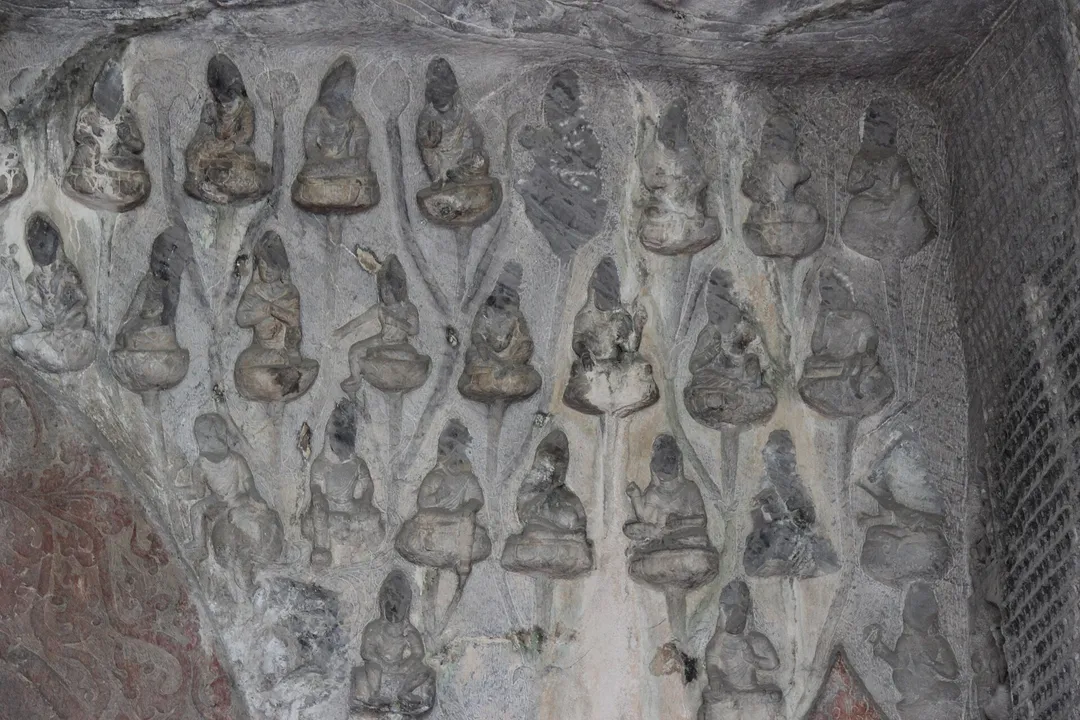
  • The "10,000 Buddha niche" (万佛洞, Cave 75) — a wall of tiny, repeating seated Buddha carvings

Tips

  • Arrive at 8:00 AM opening for morning sun on the west bank — the light on the limestone is best before 10:30 AM
  • Walk west bank first (the carvings), then cross the bridge to the east bank for the panorama
  • The electric cart from the ticket office to the carvings (¥10) saves 15 minutes of unshaded walking — worth it in summer
  • Luoyang is famous for water banquet (水席, ¥50–100) — a 24-course soup meal. Eat it after the grottoes
  • Combine with White Horse Temple (白马寺, China's first Buddhist temple, built 68 AD) — 30 min drive from Longmen, ¥35 entry

Scams to avoid

  • Touts near the ticket office selling "Longmen Grottoes + White Horse Temple + Shaolin Temple same-day tours" for ¥300+ — impossible to do all three in one day; they squeeze each into 30 minutes
  • Fake "calligraphy rubbings" sold outside the grottoes — claimed to be from the original cliff carvings but are machine-made reproductions

Frequently asked questions

How are Longmen Grottoes different from Mogao Caves?

Longmen (Luoyang) = stone carvings in open air, limestone cliff along a river, 100,000+ statues, emphasis on sculpture, 90 minutes by bullet train from Xi'an. Mogao (Dunhuang) = cave temples with murals, desert setting, 45,000 m² of paintings, emphasis on polychrome art, requires a flight to remote Gansu. Both are UNESCO and extraordinary. Longmen is more accessible. Mogao is more remote and atmospheric.

How much time do I need at Longmen Grottoes?

3 hours for the essentials: west bank cliff walk + east bank panorama. 4 hours if adding Xiangshan Temple and Bai Juyi's tomb. A fast visit to just the Vairocana Buddha and main west bank section takes 2 hours.

Can I visit Longmen Grottoes as a day trip from Xi'an?

Yes — bullet train from Xi'an North to Luoyang Longmen Station: 90 minutes (¥175). Taxi to grottoes: 10 minutes (¥12). Visit the grottoes 8:00 AM–12:00 noon, lunch in Luoyang, return to Xi'an by 15:00. Total day trip: 6–7 hours. Combine with White Horse Temple if you take the 6:30 AM train.

What happened to the missing heads and statues?

A combination of: (1) systematic removal by Western collectors and museums in the early 20th century, (2) destruction during the anti-Buddhist persecutions of 845 AD, (3) weathering over 1,500 years of rain and wind on limestone. Many heads and fragments are now in museums worldwide — the Met, the British Museum, the Tokyo National Museum. Repatriation is an ongoing issue.

Who was Empress Wu Zetian and why is her face carved here?

Wu Zetian (武则天, 624–705) was the only woman to rule China in her own name, as empress of her own Zhou Dynasty (690–705). She was a major patron of Buddhism and personally funded the Vairocana Buddha carving. According to the stone inscription at the site, the face of Vairocana was modeled on her own — a political statement equating her rule with Buddhist authority. The statue was completed around 675 AD, when she was still empress consort, and may have been part of her campaign to legitimize her eventual seizure of the throne.

Is the Longmen night illumination worth it?

The night illumination (April–October, Friday–Sunday only, ¥120) lights the west bank carvings with colored spotlights. It is dramatic and the Vairocana Buddha lit from below is impressive. However, it is also artificial — if you want the authentic historical experience, morning light on the limestone is more beautiful. Photographers: the night illumination is tricky with mixed color temperatures.

Can I combine Longmen Grottoes with a Shaolin Temple visit?

Yes. Shaolin Temple (少林寺) — the birthplace of Chan Buddhism and kung fu — is 1.5 hours drive from Longmen. A two-day Luoyang itinerary: Day 1, Xi'an → Luoyang (90 min train), Longmen Grottoes + White Horse Temple. Day 2, Shaolin Temple (morning kung fu demonstration at 10:30 AM) + return to Xi'an or continue to Zhengzhou.

Read next

Sources