
Summary
Dehong (德宏) is the Dai and Jingpo Autonomous Prefecture in far western Yunnan, a low, warm plain where China meets Myanmar along a border of roughly 503 km. A visit is built around two cities: Mangshi, the prefecture capital under its 73-metre golden pagoda, and Ruili, the border-trade town where the national gate, the jade markets and the "one village, two countries" park sit within a short drive of each other. Two to three days cover the pair — one for Mangshi's pagodas and lake, one or two for Ruili and the Moli rainforest waterfall.
This guide is written for travelers deciding whether Dehong earns a stop on a Yunnan route, and how to chain the two cities without a car-dependent failure. Every figure below was cross-checked against current listings and our own 3-day Dehong itinerary; the page was last verified on 2026-10-12.
Why Dehong
Dehong is a prefecture of about 1.32 million people spread across roughly 11,500 square kilometres of river plain and hills — two county-level cities, Mangshi and Ruili, plus three counties (Yingjiang, Longchuan, Lianghe) strung along the Myanmar frontier. The name is Dai for the lands on the lower reaches of the Nu River (the Salween), and the climate follows the latitude: winter daytime highs sit in the low twenties Celsius, while the rains run from about May to October. This is the one corner of Yunnan where you pack for Southeast Asia rather than the plateau.
The pull here is the line on the map. The old Burma Road crossed into Myanmar at Wanding when it opened in 1938, and cross-border trade built the modern towns: Jiegao, a 1.92-square-kilometre trade zone set up in 2000 at Ruili, runs an "inside the border, outside the customs" model that fills warehouse districts with Myanmar jade, timber and farm goods. The Ruili jade market is now one of the largest in China — part showroom, part live-streaming economy. None of that makes Ruili pretty; it makes it interesting, in the way port towns are.
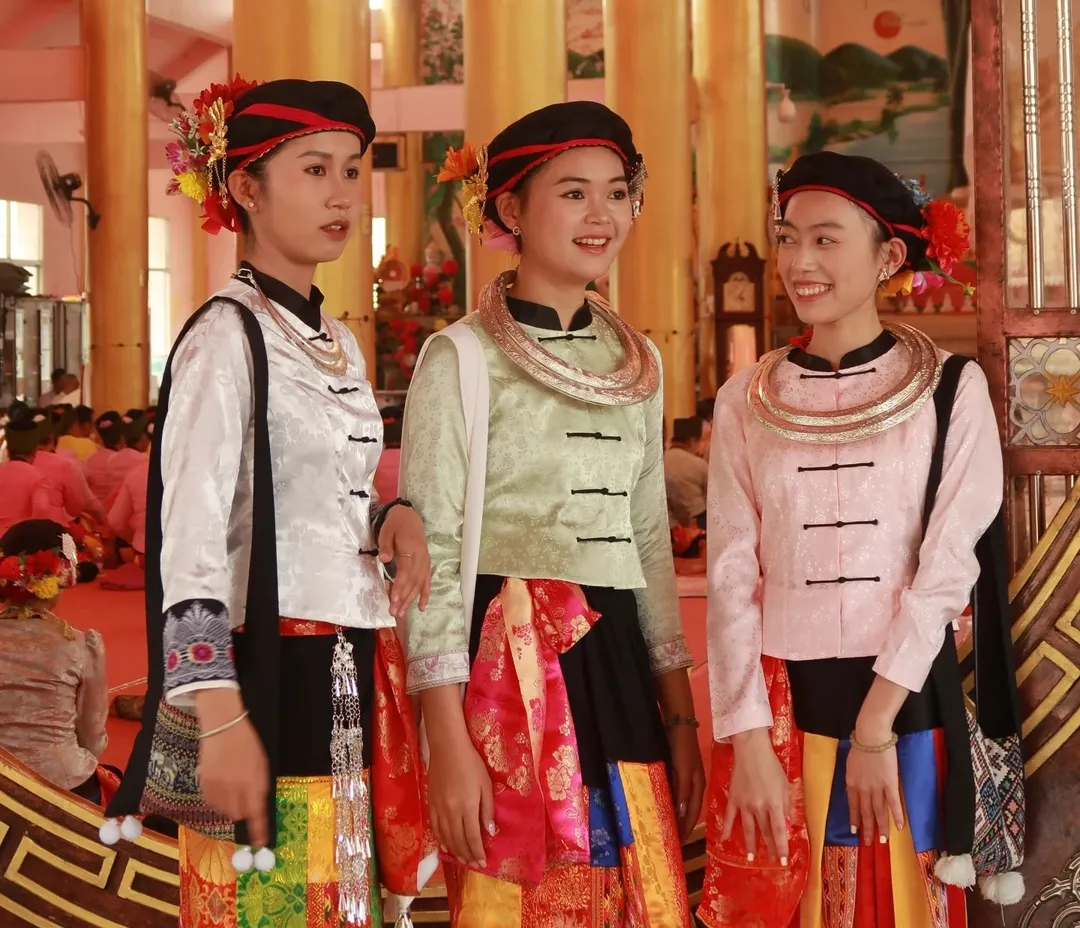
The other pull is the ethnic fabric. Dehong is home to Dai, Jingpo, De'ang, Lisu and Achang communities, and their year still runs on two big festivals: the Dai Water-Splashing new year in mid-April, and the Jingpo Munao festival in the weeks after the lunar new year, when thousands of dancers move in columns behind costumed leaders. These are living local calendars, not staged shows — timing a trip to either one changes the whole city for a few days.
The honest trade-offs: Dehong has no railway yet — the Dali–Ruili line reached Baoshan in 2022, but the half through the Gaoligong mountains is still under construction — so everything moves by air or road; distances between sights are real (Mangshi to Ruili is about 90 km); English signage is thin outside hotel lobbies; and the wet season turns sightseeing afternoons unreliable. Dehong rewards travelers who give it two or three focused days and punishes attempts to see it in an afternoon between flights.
Top Attractions
Menghuan Great Golden Pagoda, Mangshi
The 73-metre stupa crowns the hill above Peacock Lake on Mangshi's eastern edge and is visible from most of the city — by day a gold-covered silhouette, by night a floodlit one. It is a working Theravada Buddhist site for the local Dai community, not a stage set: dress with shoulders and knees covered, keep voices low in the halls, and follow the clockwise flow of local worshippers around the terrace. The smaller silver pagoda on the neighbouring hill makes a natural second stop, and the view over the plain is best in the last hour of light. Down in town, the centuries-old "tree-wrapped stupa" — a banyan grown straight through an old pagoda — is worth ten minutes on any walk through the centre. Budget half a day for the pair of hills plus the lakeside.
Ruili's border belt: Jiegao, the national gate and the jade markets
Jiegao sits across a channel of the Ruili River, joined to the rest of the city by one bridge and to Myanmar's town of Muse by the border gate. The zone's numbers explain its feel: 1.92 square kilometres, established in 2000, operating under the "inside the border, outside the customs" regime, which is why the streets behind the national gate are lined with warehouses and duty-free storefronts rather than boutiques. Watching trucks queue through the gate in the morning is the closest thing Ruili has to a spectacle. The jade and gem markets nearby are genuinely wholesale — go to look, and treat any purchase above pocket money as requiring independent expertise, because live-stream sellers and "gambling stone" stalls are set up for insiders. Note that crossing the border itself is a separate matter: it requires valid documents — a passport and a Myanmar visa — and remains subject to current policy on both sides, so check notices on arrival rather than assuming the gate is open to travelers. Everything described above is on the Chinese side.
Yizhai Liangguo: one village, two countries
About 10 km from central Ruili, the border runs straight through Yinjing village, dividing it from the Myanmar hamlet of Mangxiu next door. The Chinese side is managed as a small scenic park built around Boundary Marker No. 71, with a border well shared by both villages and a swing set so close to the line that a full arc passes over it — the photo everyone comes for. It is a modest half-day sight, best paired with the Jiegao gate on the same loop; go in the morning before tour groups land.
Moli waterfall: the rainforest hour
About 20 km northeast of Ruili, a boardwalk follows a gorge through genuine tropical rainforest — tree ferns, lianas, the sound of cicadas — to a waterfall that drops roughly 60 metres into a green pool. The walk in is about 1.5 km each way on stairs and catwalks, shaded the whole way, which makes it the best midday option in the region when the plains are hot. Half a day including transport; shoes with grip, because the boards are often damp.
Where to Stay
Two bases, two trips. Mangshi works best for arrival and departure days: the airport is about 7 km from town, mid-range chains run roughly 150-300 CNY a night, and the pagoda hill is a short taxi ride after dinner. Ruili is the base for the border day — hotels near the Jiegao bridge and the markets start around 120 CNY and climb modestly from there, and the evening border food streets are the reason to sleep here rather than commute. Peak pressure follows the festival calendar: the Water-Splashing week in mid-April and the Munao period after the lunar new year fill both cities, so book two or three weeks out for those windows and walk in otherwise.
Gastronomy
The table is Dai with Jingpo and Achang accents, and it leans sour, herbal and fresh rather than spicy-hot. The signature dishes: sapi, the Dai cold dish dressed with a sharp herb sauce (the bitter cattle-bile version is the connoisseur's order — start with the sour one); hand-eaten rice (shouzhua fan) served on banana leaves with grilled meats and dips; guoshou mixian, the Achang rice-noodle dish from the Husa valley eaten straight off the hand; and baoshao, vegetables and fish grilled in banana-leaf parcels. For dessert, puluda — coconut milk over sago, jelly and crushed ice — is the region's own answer to the heat. A breakfast of xidoufen (warm soybean porridge over rice noodles) runs 5-10 CNY; a proper leaf-table dinner runs 40-80 CNY per person. Eat where the queue is local and long.
Practical Information
Getting there
Flying does most of the work. Dehong Mangshi Airport (LUX) sits about 7 km from central Mangshi, with direct flights from Kunming in about 1 h 15 min, several times a day, plus services from Chengdu and Guangzhou on some schedules. Road is the alternative: Kunming to Ruili is roughly 730 km, a 9-10 hour drive on the G56 expressway, and Dali is about 330 km from Mangshi (4-5 hours). The railway is coming but not here: the Dali–Ruili line's first half opened to Baoshan in 2022, and the mountain section onward is still under construction. First time in China? Our China visa guide covers the entry side.
| Route | Best mode | Typical time | Notes |
|---|---|---|---|
| Kunming → Mangshi | Direct flight | about 1 h 15 min | Several daily; airport about 7 km from town |
| Kunming → Ruili | Flight to Mangshi + road | about 3 h door to door | Roughly 730 km by road if driving the whole way |
| Dali → Mangshi | Road (G56) | about 4-5 h | About 330 km; pairs with a Dali stop |
| Tengchong → Mangshi | Road | about 1.5-2 h | About 100 km by expressway; pairs with the Tengchong guide |
| Ruili → Wanding | Road | about 30 min | About 20 km; the old Burma Road bridge |
| Mangshi → Ruili | Expressway bus or car | about 1-1.5 h | About 90 km; frequent daytime buses |
Getting around
Mangshi is a taxi town — rides across the centre cost 10-20 CNY, and the pagoda hill about 20-30 CNY from the lake area. Between cities, the Mangshi–Ruili shuttle buses run frequently through the day, or a hired driver (about 400-600 CNY a day) covers the border loop — gate, village, waterfall — without depending on timetables. Ruili's own sights spread 10-20 km, so taxis or a driver for the day are the sane choices; there is no useful city bus spine for visitors.
When to go
Ranked: first, November to February — dry, warm rather than hot, and the Munao festival lands after the lunar new year; second, mid-April, specifically for the Water-Splashing new year (usually around the 13th to 15th), accepting that rooms sell out; third, March and October-November, the settled shoulders. The roster's "spring (April-May) and autumn (September-October)" answer holds, but note the rains run from about May to October, so a September trip means planning around afternoon downpours. Winter is the sleeper pick: this is the one Chinese destination where January is a selling point.
Money and connectivity
Alipay and WeChat Pay both bind international cards and work at ticket windows, markets and most stalls; carry about 200 CNY in cash for market vendors with weak signal. Tourist eSIMs work fine in both cities. Two local practicalities: hotels must be licensed to host foreign guests — book places that say so — and this is a border prefecture, so police ID checks are routine; keep your passport on you.
Two-Day Core Itinerary
| Day | Base | Morning | Afternoon | Evening |
|---|---|---|---|---|
| 1 | Mangshi | Golden pagoda at opening, silver pagoda next door | Tree-wrapped stupa in town, Peacock Lake loop | Night market dinner near the centre |
| 2 | Ruili | Yizhai Liangguo village park, then the national gate at Jiegao | Moli waterfall boardwalk (or jade markets if rained off) | Border food streets near the bridge |
The border day that wastes the least time:
- Start at the village park by 09:00, before tour groups, and walk the marker and the swing first.
- Drive on to Jiegao; watch the gate traffic, then walk the streets behind it — skip any purchase you cannot verify.
- Have an early lunch in Ruili, then be at the Moli gorge entrance by 13:00 for the coolest, emptiest boardwalk.
- If the afternoon rains, swap the waterfall for the covered jade markets — both are half-day-proof.
- End at the food streets after dusk, when the grills and the puluda carts are out.
Two variations are worth making. With a third day, go east to Wanding for the Burma Road bridge, or north to Yingjiang — in the dry months it is the best place in China to look for hornbills — and the 5-day Dehong itinerary shows the sequencing. With a week, the loop extends naturally to Tengchong's volcanic country and then Dali, or follows the minority-culture corridor laid out in the 7-day Yunnan minorities itinerary; the day-by-day Dehong versions are in the 3-day, 5-day and 7-day itineraries, and the Yunnan guide stitches the province together.
Pacing notes: put the pagoda hill on a clear morning and the waterfall on any afternoon; do not schedule the border gate on a weekend, when border-town traffic peaks; and keep one slot loose — festival dates shift with the lunar calendar.
Beyond the Highlights
Wanding is the region's most under-visited stop: a town of a few streets where the 1938 Burma Road crossed into Myanmar, with the old bridge and a small museum telling the wartime supply-line story — an easy half-day from Ruili. Yingjiang, three hours north, doubles as a birding destination: between November and May, hides and local guides put you on hornbills and a long list of lowland species found almost nowhere else in China. And in Lianghe and Longchuan, the western counties most tourists skip, the tusi compound — Yunnan's largest and best-preserved chieftain residence — and the Achang silversmith-and-blade valley of Husa make a slow loop that ends at the best guoshou mixian in the prefecture. For the wider region, our Yunnan–Guizhou destinations hub picks out the neighbouring stops.
Decision Support
Map
Orient on two axes. The G56 expressway runs east-west through Mangshi, Wanding and Ruili toward the border; the sights hang off it like beads — pagoda hill at the east end, the village park, the gate and the waterfall fanned around Ruili at the west end, Yingjiang off to the north. Amap (Gaode) has the best local routing; offline-download it, because signal fades in the valley stretches.
Cost breakdown
Daily budget, mid-range, 2026, per person in CNY: accommodation 300-600; food 100-200; local transport 30-60; attractions 50-150 — a total of 500-1000 per day. Dehong discounts this in practice: hotel rates run below Kunming's, a filling meal costs 20-40 CNY, and the headline sights charge modest entry fees. Backpacker days on 150-250 are realistic; luxury days with a resort-style room and a hired car start around 1000. The swing item is the hired driver — shared between two, it is the best money spent here.
When to go
If you want one answer: late November, for dry-season light, thin crowds and the first of the birding season, with mid-April as the festival alternative. The roster's "most pleasant" answer — spring and autumn — is right for walking weather; just check which weeks the Water-Splashing and Munao festivals fall on, because they are either the best reason to come or the reason rooms are gone.
Practical
Five calls carry the trip. One: fly into Mangshi, out of Ruili's orbit — base one night in each city. Two: hire a driver for the border day rather than stitching taxis between sights 10-20 km apart. Three: carry your passport; this is a border prefecture and checks are routine. Four: treat jade stalls as window shopping unless you have independent expertise. Five: if rain wins, swap the waterfall for the covered markets, in that order.
Glossary of Useful Terms
| Chinese | Pinyin | Meaning |
|---|---|---|
| 德宏 | Déhóng | Dehong, "lower Nu River" in Dai |
| 芒市 | Mángshì | Mangshi, the prefecture capital |
| 瑞丽 | Ruìlì | Ruili, the border-trade city |
| 勐焕大金塔 | Měnghuàn Dàjīntǎ | Menghuan Great Golden Pagoda |
| 撒撇 | sāpiě | Dai herb-dressed cold dish |
| 泼水节 | pōshuǐjié | Water-Splashing Festival |
| 多少钱 | duōshǎo qián | how much |
| 谢谢 | xièxie | thank you |
Emergency Contacts
- Police: 110
- Ambulance: 120
- Fire: 119
- Tourist hotline: 12301
Sources and Verification
Key figures — the stupa's 73-metre height, Jiegao's 1.92 km² and 2000 establishment, the roughly 60-metre Moli waterfall, the roughly 503-km border line, flight and road times — were cross-checked in October 2026 against current listings and official descriptions; festival dates move with the lunar calendar and border-crossing policy changes with little notice, so reconfirm both close to travel. Prices move with the seasons — reconfirm within a fortnight of travel.
Dehong rewards travelers who give it two real days: a pagoda at opening, a border gate mid-morning, a rainforest boardwalk after lunch, and grills after dark. Last verified 2026-10-12. For the full day-by-day versions of everything above, start at the Dehong trip hub and the 3-day Dehong itinerary.