Summary

Kunming (昆明) is the capital of Yunnan province, a city of roughly 8.5 million people sitting at 1,890 meters on the Yunnan-Guizhou Plateau. Most foreign itineraries treat it as a transit stop on the way to Dali, Lijiang or Shangri-La, and that is exactly the mistake we made on our first pass through the city. Two or three days here turn out to be among the easiest, cheapest and most pleasant days you can spend anywhere in southwest China, and this guide explains why, plus how to arrange them.
The nickname, Spring City (春城), is not a marketing line. Daytime temperatures usually hold between 10 and 25 degrees Celsius in every month of the year. Winters are dry and sunny, summers are cool by Chinese standards, and the rainy season, which runs roughly from May to October, tends to arrive as a short afternoon shower rather than an all-day rain. What the postcards do not mention is the altitude: at nearly 1,900 meters the ultraviolet is strong enough to burn fair skin in about an hour, so sunscreen matters far more here than the thermometer suggests.
The headline experiences match a short stay unusually well. Between November and March, tens of thousands of red-billed gulls winter at Green Lake and along the Dianchi lakeshore, close enough to photograph with a phone. The food scene runs on Yunnan specialties year-round: crossing-the-bridge rice noodles, steam-pot chicken, a wild-mushroom season from June to September, and rose pastries sold on every commercial street. The Stone Forest, a UNESCO-listed karst landscape about 85 kilometers southeast of the city, works as a half-day round trip by high-speed rail.
We focus on the decisions that actually shape the trip: which neighborhood to sleep in, how the metro and the two railway stations connect, what the Stone Forest costs and whether it earns that cost, how to eat wild mushrooms without a hospital visit, and when the calendar argues for or against your dates. The perspective throughout is independent mid-range travel; backpacker and comfort-level budgets are broken out in the Decision Support section at the end.
Why Kunming
Three reasons, in order of importance.
First, the climate is the most livable of any major Chinese city. Kunming sits high enough that summer afternoons rarely exceed the mid-twenties and far enough south that winter days still reach the mid-teens. Other Chinese cities force a seasonal strategy — dodge Beijing's winter smog, Chengdu's summer heat, Guangzhou's humidity. Kunming does not. Almost any date you can book flights for will deliver walkable weather, which removes the single biggest variable in China trip planning.
Second, it is the gateway to Yunnan, the most ethnically varied province in China, with 25 recognized minority groups. The city is the region's rail and air hub: high-speed trains reach Dali in about two hours, the Shanghai service runs the length of the province, and the China-Laos railway connects Kunming toward the border at Mohan, with a direct international train onward to Vientiane. If your itinerary involves Yunnan at all, you will almost certainly pass through Kunming, and the hub position is worth a planned stop rather than a rushed transfer between stations.
Third, the city earns time on its own. It is not a museum city in the Beijing or Xi'an sense; the sights are low-density and several are frankly modest. What Kunming offers instead is atmosphere and appetite: a lakeside promenade with Siberian gulls in winter, university streets with a serious coffee habit, night markets where flowers trade by the kilogram, and a regional cuisine built on mushrooms, fresh cheese, edible flowers and rice noodles that has almost nothing in common with the Cantonese or Sichuan food most visitors arrive expecting.
Our honest framing: come for two or three days, treat the city as the destination rather than the corridor, and it will outperform what most guidebooks imply. Come expecting a week of monumental sights and you will be disappointed. The sections below are calibrated to that reality.
Top Attractions
If you have two days, our priority order is Green Lake, the Stone Forest, the Dianchi lakeshore at Haigeng, then the Western Hills. The Ethnic Village and the Golden Horse and Jade Rooster Archways fill evenings and rainy afternoons. Everything below is reachable without a tour group; the metro, one high-speed rail ride and occasional short taxi hops cover it all.
Green Lake Park and the Winter Gulls (翠湖公园)
Green Lake is a small free park in the old center, ringed by willows, lotus beds and teahouses, and for four months of the year it is the best free wildlife spectacle in any Chinese city. Red-billed gulls that breed around Lake Baikal and Siberia have wintered in Kunming since the mid-1980s, arriving in November and leaving in March. At peak season the lake holds thousands of them, circling low over the water and taking feed from outstretched hands along the banks.
Go before 9 AM. The light is better, the birds are hungrier, and the tour groups that arrive mid-morning have not yet assembled. Vendors around the shore sell small packets of bird feed for a few yuan; use that rather than bread, which the park discourages and the birds handle poorly. Afternoon has its own charm — locals dance, play and practice calligraphy with water on the pavements — but the gulls disperse toward Dianchi as the day warms.
The park is also the best walking anchor in the city. Yunnan University's old campus and the cafe strip of Wenlin Street sit directly north, the provincial library is nearby, and a lane of old two-story wooden shopfronts survives on the northeast corner. Budget a full morning; you will not need to try hard to spend it.
Dianchi Lake and Haigeng Dam (滇池·海埂大坝)
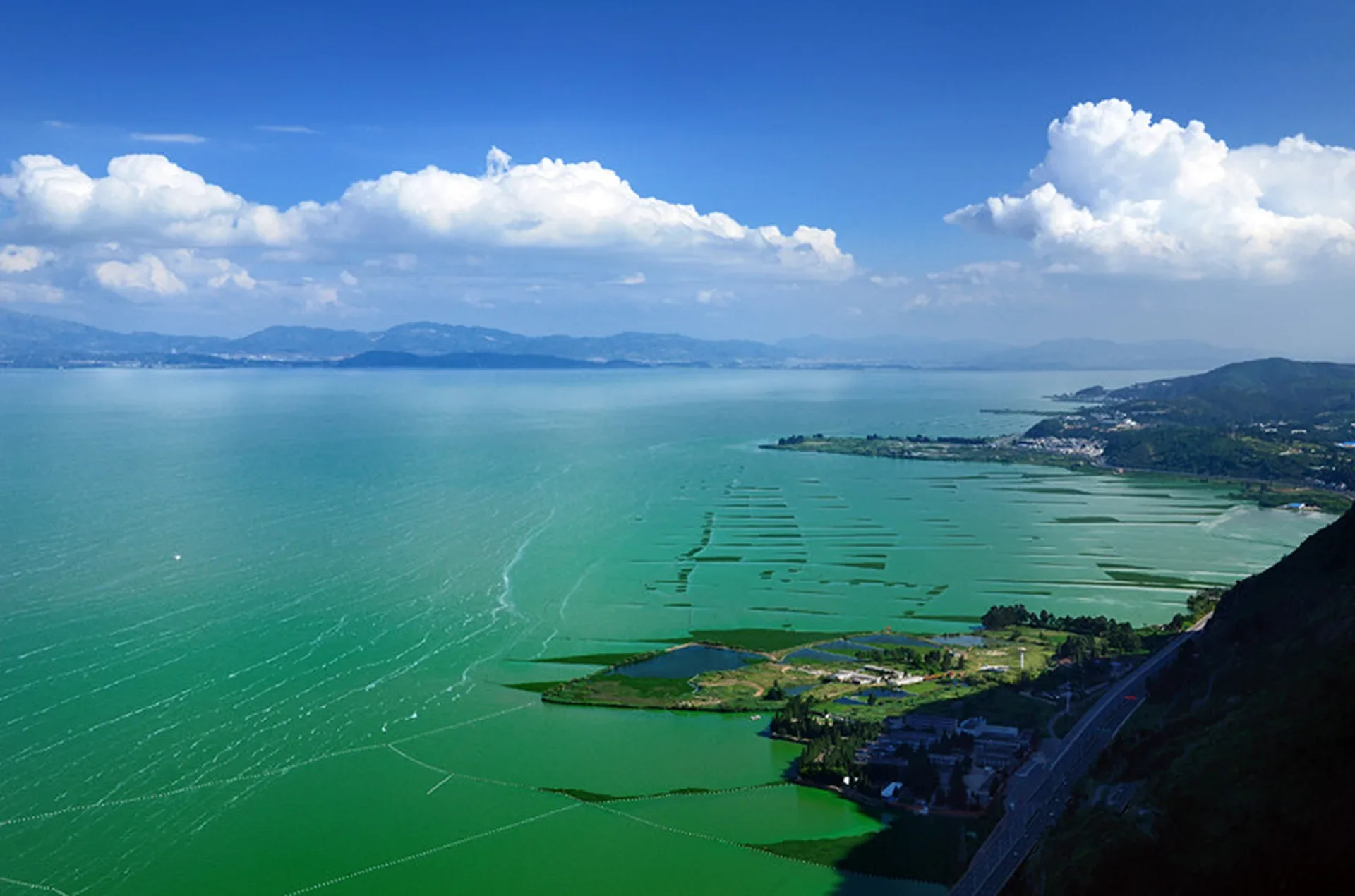
Dianchi is the largest lake in Yunnan, roughly 300 square kilometers, a fifteen-minute drive southwest of the center. Haigeng Dam, a long stone promenade along the northern shore, is where the city meets its lake. In winter the gull colony here is even larger than Green Lake's, with birds hovering along the embankment for feed; in other months the draw is the wide water view toward the Western Hills and the broad, flat light that the high plateau produces.
Be clear about one thing: Dianchi has a long documented history of algae pollution, and while water quality has improved substantially under cleanup programs since the 2010s, this is a landscape-view lake, not a swimming lake. The promenade, the gulls and the mountains behind them are the product; do not expect alpine water.
The dam costs nothing and takes 45 to 90 minutes at a stroll. From the dam area you can board the cable car that swings across the lake and up into the Western Hills, which combines two sights in one continuous arc. Reach Haigeng by bus along Dianchi Road or by taxi from the center; the nearest metro extension involves a walk at the far end, so a direct taxi or ride-hail is the practical choice.
The Stone Forest (石林)
The Stone Forest in Shilin County, about 85 kilometers southeast of the city, is a UNESCO World Heritage site (inscribed in 2007 as part of the South China Karst listing) and Yunnan's single most famous natural sight. The geology is genuine and old: a shallow Permian sea floor, some 270 million years old, lifted, fractured and dissolved into thousands of limestone pinnacles standing like a petrified forest. The main scenic area routes you through corridors of carved stone, past named formations, lakes and a hilltop pavilion with a panorama over the whole field.
Admission runs around 130 CNY, and pricing has moved in a 100-175 range over the past decade, so treat that as the planning band. Add the electric shuttle inside the park if you are short on time. Half a day inside is enough; the full circuit with the Minor Stone Forest, where the pinnacles are sparser and the crowds thinner, takes about four hours at an unhurried pace.
Getting there independently is straightforward. High-speed trains from Kunming South to Shilin West take around 20 minutes and cost roughly 20-40 CNY, followed by a 10-15 minute taxi ride to the gate. Buses from the East Bus Station take about 90 minutes and cost 30-45 CNY. Go early — by late morning the main trails near the entrance carry heavy tour-group traffic, while the far loops stay quiet. The area is home to the Sani branch of the Yi people, and the legend of Ashima, a Sani heroine turned to stone, is the story attached to the park's most photographed pillar.
Our verdict: yes, it is worth the price and the early start. It is touristy by Yunnan standards but geologically unlike anything else on a standard China route.
Western Hills and Dragon Gate (西山龙门)
The Western Hills are the ridge line you see from Haigeng Dam, and the Dragon Gate (龙门) is the reason to climb them. From the 18th century onward, Taoist monks and stonemasons cut shrines, staircases and walkways directly into the cliff face, finishing with a gate platform balanced over a sheer drop with the whole of Dianchi below. The grotto work, done by hand over decades, is the sight; the lake panorama is the reward.
The walk-up area of the forest park is free; the Dragon Gate circuit costs roughly 40-60 CNY, and cable cars and chairlifts up the hillside and across the lake add more. Expect a half day door to door from the center. Paths are stone steps, occasionally steep and often wet; wear real shoes. Our suggested pairing is a morning here followed by lunch back toward Haigeng, using the cross-lake cable car in one direction so you end at the dam.
Yunnan Ethnic Village (云南民族村)
The Ethnic Village, across the road from Haigeng on the Dianchi shore, is a purpose-built park reproducing villages, houses and performance spaces for over two dozen of Yunnan's ethnic groups, with staff from those communities running demonstrations of weaving, dancing and craft. Admission is around 90 CNY, and the park is large enough that you should commit three hours or skip it.
We will be direct about what this is: a curated, government-produced version of cultural diversity, not an ethnographic field site. Taken on those terms it works. For travelers heading onward into the province, it functions as an efficient primer — you will see Bai architecture in Dali and Dai Buddhism in Xishuangbanna with more context after two hours here. It is also the most family-friendly item on this list, and the best place to be during festival weeks, when the park stages Torch Festival and Water Splashing events that are otherwise held in far-flung counties.
Golden Horse and Jade Rooster Archways (金马碧鸡坊)
The two archways — Golden Horse on the east, Jade Rooster on the west — face each other across Jinbi Square at the heart of the commercial district. The site has anchored Kunming's main axis for centuries, though the arches you see today are 1990s reconstructions of the Qing structures; say so before someone else does. At night the arches are lit and the square fills with strollers, snack vendors and, on weekends, impromptu performances.
The archways themselves take ten minutes. The reason to come is the surrounding hour: the pedestrianized shopping streets immediately east, the late-night food vendors that set up nearby, and the ease of combining it all with dinner. We treat it as the default evening slot for a first night in the city — low effort, centrally located, and it closes out a day of lake and stone with ordinary city life.
Where to Stay
Kunming's hotel stock is generous and, outside holiday weeks, soft on price. Three areas cover the realistic options.
Green Lake (翠湖) — our default for first visits. The old center around the lake park is walkable, atmospheric and close to the university quarter and its cafes. Accommodation skews boutique and mid-range, with converted courtyard buildings and small design hotels, plus a scattering of hostels in the lanes north of the park. You trade some polish for location; the trade is worth it. Dorm beds run 50-120 CNY, comfortable doubles 250-500 CNY.
Nanjing Road / Dongfeng Square (downtown) — for connections and commerce. The grid around the Dongfeng Square metro interchange, a short walk south of Green Lake, carries the bigger hotels, the department stores and the chain restaurants. If your priority is a direct metro seat to the stations and the airport line, or you want predictable four-star comfort, sleep here. Doubles run 300-600 CNY, with international-brand properties at 600-1,200 CNY.
Chenggong (呈贡) — for early trains and flower markets. The new southern district around Kunming South railway station and the Dounan flower market is modern, cheap and, frankly, sterile — wide avenues, malls, few reasons to linger after dark. It is 40-60 minutes from the old center by metro but minutes from the high-speed platforms, which matters if you have a 7 AM train to Dali or Shanghai. Doubles from 200 CNY.
What to avoid: airport-area hotels unless you have a dawn flight (the airport is far northeast, and Line 6 makes an early start feasible from the center anyway), and unlicensed guesthouse listings around the stations. Book two to three weeks ahead for the October Golden Week and the Chinese New Year window; outside those, same-week booking usually finds inventory at fair prices.
Gastronomy
Yunnan cuisine, and Kunming's version of it, is the reason some of us come back. It is lighter than Sichuan, more sour and herbal than Cantonese, and built on ingredients — flowers, fresh cheese, uncatalogued mushrooms, pickled greens — that most visitors have never seen on a Chinese menu. Order widely; nothing here is expensive by big-city standards.
Crossing-the-bridge rice noodles (过桥米线). The signature dish, originating in Mengzi to the south. A bowl arrives as a pool of chicken broth capped with a layer of oil that keeps it near-boiling at the table; you slide in raw paper-thin meat, quail egg, vegetables and finally the noodles yourself, in that order. Done properly the broth cooks the meat as you stir. Restaurant versions run 20-60 CNY depending on the number of accompaniments. The dish is interactive and genuinely good, not just famous.
Steam-pot chicken (汽锅鸡). Chicken steamed in a distinctive pottery pot with a central chimney, so the soup condenses purely from steam — clear, salty in the right way, often with mushrooms or Chinese herbs added. Expect 60-120 CNY for a pot that serves two. In mushroom season the pot arrives loaded with whatever the market had that morning.
Wild mushrooms (野生菌), June to September. Yunnan's mushroom season is a genuine regional event; restaurants switch menus, hotpot counters appear, and markets sell matsutake, termite mushrooms (鸡枞), boletus (见手青) and the local favorite 干巴菌 by weight. Eat them — this is the best mushroom cooking in China — but eat them safely. Every season the province's hospitals treat hundreds of poisoning cases, almost all from home cooking or undercooked boletus. The rules: eat at licensed restaurants only, let the kitchen cook everything fully, never buy raw unknowns to cook yourself, and if your lips tingle or you feel nauseated, go to a hospital immediately. Follow those rules and the risk is small.
Flower cakes (鲜花饼). Shortcrust pastries filled with rose petal jam, sold everywhere in branded boxes. Fresh-baked ones from bakery chains such as Jiahua cost 5-15 CNY each and are superior to the airport shelf-stable versions. They make the standard edible souvenir; buy them in the city.
Everyday breakfast and street food. Grilled er kuai (饵块), rice cakes toasted over charcoal and brushed with sweet bean and chili sauces, are the local breakfast, 5-10 CNY from morning carts. Rushan (乳扇), a Bai-style fried cheese stretched on sticks and eaten with rose syrup, comes from street stalls around tourist areas. Pickled fruit, cold rice-noodle salads (米线 in a dozen local formats beyond the famous one) and night-market barbecue fill out the low end, where 15-25 CNY feeds you well.
Yunnan coffee. The province grows most of China's coffee in the hills around Pu'er and Baoshan, and Kunming's university quarter has turned into one of the country's better cafe scenes. A flat white from a serious roaster-cafe on Wenlin Street runs 20-40 CNY, often from beans roasted in the province. It is a short, cheap education in a coffee region almost nobody associates with coffee.
Practical Information
Visa
China's entry rules have loosened repeatedly, and as of 2026 they favor short visitors. Thirty-day visa-free entry applies to citizens of a long and growing list of countries — most of the EU, Australia, New Zealand and a widening set of others — and a 240-hour (ten-day) transit visa-free scheme covers travelers with confirmed onward tickets to a third country. The lists change several times a year, so verify the current position with your airline or the nearest Chinese consulate before booking, and bring the passport you will actually travel on: train tickets, hotels and park reservations are all tied to it.
Currency and Payments
The currency is the renminbi yuan (CNY), trading around 7.0-7.2 to the US dollar. Alipay and WeChat Pay both accept international cards and cover nearly everything, including street carts and metro turnstiles. Set up Alipay and verify your card before departure; that single step removes 90 percent of payment friction. Keep 200-500 CNY in cash as a buffer for very small vendors and the odd offline terminal. ATMs at ICBC and Bank of China branches take foreign cards; inside bank lobbies is safer than street machines.
Getting Around
Kunming's metro is compact but well aimed: Lines 1/2 run the north-south spine (including the main station), Line 3 crosses the center east-west, Line 4 loops through the south, Line 5 serves the northwest, and Line 6 connects Changshui International Airport to the East Coach Station, where you transfer to Line 3 for the center. Fares run 2-7 CNY; pay with an Alipay transit code or a rechargeable card. Trains run roughly 6:30 AM to 11 PM.
Two railway stations matter. Kunming Station, close to the center, carries conventional trains and some high-speed services. Kunming South, in Chenggong 25 kilometers southeast, is the high-speed hub: Shanghai in around 11 hours, Guiyang in about 2, Dali in about 2, and the international service toward Vientiane. Passport checks and security take time at both; arrive 45 minutes early for high-speed trains, more at holidays. Book via the 12306 app or website, or through Trip.com if you prefer an English interface.
Changshui Airport (KMG) is 25 kilometers northeast of the center. Line 6 plus a Line 3 transfer reaches downtown in about an hour for under 10 CNY; a taxi or ride-hail takes 40-60 minutes depending on traffic and costs roughly 80-120 CNY. Taxi flag-fall in the city is around 10 CNY, and Didi ride-hailing works with international cards through Alipay. Traffic outside rush hours is mild by Chinese standards; inside it (8-9:30 AM, 5:30-7:30 PM) it is not.
Best Time to Visit
There is no bad season, only different ones. November to March brings the gulls, the driest skies and the clearest lake views, with sunny days around 15-18 degrees and cold nights near freezing. April and May deliver spring flowers, pre-rain dust-free air and the Water Splashing Festival mid-month. June to September is mushroom season, worth traveling for, paid for in afternoon downpours. October brings Golden Week crowds in the first seven days and mild weather after. Avoid the national holiday weeks of early October and Chinese New Year unless crowds are the point; hotel prices double and every queue quadruples.
Cultural Considerations
Yunnan is home to 25 recognized ethnic groups, and Kunming — a Han-majority city — is the mixing bowl. Most residents you deal with will be Han Chinese, but Dai, Yi, Bai, Hui and Hani residents are all part of daily life, and festival weeks put minority cultures prominently on display. A few things worth knowing:
Photography. Ask before photographing individuals in ethnic dress, especially elders and especially at festivals and religious sites. The Ethnic Village stage environment is one thing; a random street grandparent is another. A smile and a raised camera gets consent more often than not, but wait for the nod.
Temples. Yuantong Temple in the center is an active Buddhist monastery with a token admission of a few yuan. Dress modestly, walk clockwise where others do, and keep your voice low in prayer halls. Photography inside halls is often prohibited even where the doorway shot is not; look for signs or follow the locals.
Everyday etiquette. Tipping is not expected anywhere, including restaurants and taxis. Littering is heavily frowned upon, and feeding the gulls anything other than the sanctioned feed draws immediate comment from the retirees who consider themselves the birds' custodians. Queue-jumping is rare here compared with the coastal megacities; repay the favor.
Practical norms. Tap water is not potable — hotel kettles and bottled water are the rule. The altitude is mild by Tibetan standards but real: hydrate more than usual, and expect the sun to bite through cloud cover. Political conversation, particularly around border regions and minority policy, is best left alone; you will not resolve anything and your hosts will become uncomfortable. Mandarin is universal; the local dialect is strong but mutually intelligible, and English stops at hotel desks and the biggest sights. A translation app covers the rest.
Two-Day Itinerary
Day 1 — the city and the lake. Start at Green Lake by 8:30 AM for the gulls, the morning market atmosphere and the willow-lined banks. Walk north through Yunnan University's old campus to Wenlin Street and settle into a cafe for a late breakfast or an early Yunnan coffee. Lunch on rice noodles in the lanes around the park. In the afternoon, taxi to Haigeng Dam (20-30 minutes), walk the promenade, and either cross into the Ethnic Village for three hours or ride the cable car partway up the Western Hills if your legs allow only one. Return via the center for dinner — this is the night for crossing-the-bridge noodles — then finish at the Golden Horse and Jade Rooster Archways and the pedestrian streets around them.
Day 2 — the Stone Forest. Take an early high-speed train from Kunming South to Shilin West (about 20 minutes), taxi to the gate, and be inside before 10 AM. Walk the full circuit at your own pace — main corridors, the hilltop pavilion, then the quieter Minor Stone Forest. Eat lunch at the park or back in Shilin town; the Sani-area restaurants do a competent goat cheese and a smoked-pork rice noodle. Return to the city mid-afternoon. Spend the evening at Dounan Flower Market if it is running its night session — flowers trading under floodlights is a stranger and better show than any bar street — or at a barbecue street for skewers and grilled er kuai.
Optional Day 3. A morning hike through the Western Hills and Dragon Gate, lunch at Haigeng, then the National Southwestern Associated University museum and an unhurried cafe afternoon around Green Lake before whatever train carries you onward. Travelers heading to Dali should book the mid-morning departure and treat Day 3 as a travel day with a museum attached.
Beyond the Highlights
National Southwestern Associated University Site (西南联大旧址)
During the Second Sino-Japanese War, Peking University, Tsinghua University and Nankai University evacuated and merged in Kunming, operating from 1938 to 1946 as the National Southwestern Associated University (Lianda) while their campuses were under occupation. The faculty and students of those eight years include a startling share of modern China's scientists and writers. The surviving campus gate, buildings and a well-made museum now sit inside Yunnan Normal University, a short walk west of Green Lake. Admission is free with ID; allow 60-90 minutes. It is the most consequential historical site in the city, and almost no foreign visitor goes.
Wenlin Street and the University Cafes (文林街)
The streets north of Green Lake, anchored by Wenlin Street, are where Kunming's students and its cafe culture overlap: independent roasters, secondhand bookshops, rice-noodle shops that have fed decades of undergraduates, and bars that are quieter than they look. Come for an unhurried morning or a writing afternoon. Prices run 15-40 CNY for coffee and half that for a bowl of noodles, and the people-watching — students, pensioners, guitar cases, dogs — is the actual attraction.
Guandu Ancient Town (官渡古镇)
A free-entry old town in the city's southeast, centered on a group of genuine Ming- and Qing-era temples and pagodas, including the distinctive Vajra Pagoda built in the 15th century across a crossroads. Guandu is where Kunming locals eat snacks on weekends: the namesake baba (官渡粑粑), a flat pastry with sweet fillings, sold from stalls that predate the tourism. It receives a fraction of the visitors of Dali or Lijiang's old towns precisely because it is a neighborhood rather than a spectacle, which we count as the recommendation. Half a day, reached by a short metro-plus-taxi hop.
Dounan Flower Market (斗南花卉市场)
Yunnan grows the bulk of China's commercial cut flowers, and Dounan, in Chenggong, is the continent's largest cut-flower trading market. By day the retail halls sell wrapped bunches for prices that make European florists weep — roses by the kilogram, a bundle of stems for the cost of a bus ticket. After dark the professional auctions take over, and the sight of thousands of flowers moving on trolleys under floodlights is the most Kunming-specific evening out there. Reach it via the Dounan metro station on Line 1. Entry is free; leaving empty-handed is nearly impossible.
Nightlife
Kunming is an early city and does not pretend otherwise. The bar clusters worth knowing are three. Around Green Lake and Wenlin Street, the drinking is low-key: wine bars, student pubs and a couple of livehouses that book provincial indie acts; this is where we would spend a first night. Around Jinbi Square and the pedestrian streets, the evening is snack-driven, with dessert shops and beer gardens running late. And in the new south, Chenggong's malls hold the standard KTV palaces and chain bars for group occasions.
The two genuinely local late activities are night-market barbecue and the flower market. Barbecue streets — the ones around the old northern neighborhoods are reliable — fire up after 9 PM and serve skewers, grilled tofu, fried potatoes and grilled er kuai until the crowd thins. Dounan's night flower trading, covered above, runs into the early hours and costs nothing to watch.
One practical note: last metro trains leave around 11 PM, and taxis thin out in the outer districts after midnight. Whatever you plan, plan to be moving back toward your bed by then; the city will not miss you.
Day Trips from Kunming
The Stone Forest
Covered in full under Top Attractions. As a day trip it is the default: about 40 minutes door to door each way by high-speed rail plus taxi, or 90 minutes by bus from the East Bus Station, and a half-day inside the park. Leave by 8 AM, return by mid-afternoon, and keep the evening free.
Fuxian Lake (抚仙湖)
An hour to an hour and a half south by road, Fuxian is one of the deepest and clearest freshwater lakes in China — over 150 meters at its deepest — and it behaves like it: the water along the northern shore runs transparent blue on sunny days. There is no rail link, so this is a drive, taxi or tour-bus trip; agree on a round-trip price or rent a car with a driver for the day (expect 500-800 CNY plus fuel for the hire market rate, and treat that as a band, not a quote). Around the lake, the attractions are simple: swimming beaches and lakeside walks in summer, and the local copper-pot fish (铜锅鱼) and copper-pot rice at the fishing villages. Locals treat it as the weekend escape; weekdays are quiet.
Dali by High-Speed Rail
Dali is two hours from Kunming by high-speed train (roughly 130-150 CNY second class), which puts it inside day-trip range: take a train around 7 AM, walk the ancient town and the shore of Erhai through the middle of the day, and return on an evening service. We would advise against compressing it, though. Dali rewards an overnight — the lake shore at dawn and the Bai minority villages around it are the part day-trippers miss — and trains sell out in holiday weeks. Treat the day trip as the floor, not the recommendation.
Honorable mentions: Jianshui, two hours south by rail, for its Ming-era Confucian temple, garden residences and grilled tofu; and the Dongchuan Red Land photography country to the northeast, best as a full-day drive with an early start and realistic only for committed photographers.
Events and Festivals
The Kunming calendar is anchored by natural events more than staged ones:
- Gull season (November to March): not a festival, but the city's defining annual event. Arrivals peak in December and January.
- Water Splashing Festival (泼水节), mid-April: the Dai New Year, at its most authentic in Xishuangbanna, but the Ethnic Village stages a full program with dancing and, yes, water. Expect to get wet if you go.
- Torch Festival (火把节), lunar 24 June, usually late July or early August: the Yi festival of fire, biggest in the Yi heartlands of Shilin and Chuxiong near the Stone Forest. In the city, the Ethnic Village holds torchlight events. If your dates line up with the real thing in Shilin, go there instead.
- Wild mushroom season (June to September): restaurants county-wide build menus around the harvest; mushroom hotpot counters peak in July and August. A culinary season rather than a festival, and reason enough to date a trip.
- Chinese New Year (January or February): the flower markets run at full tilt before the holiday, then the city empties as everyone goes home. Atmospheric if you have a booked dinner; logistically awkward otherwise.
- National Day Golden Week (October 1-7): to be avoided. Domestic travel peaks, hotel rates roughly double, and every sight on this list queues.
Shopping
Kunming's shopping is really three purchases and one warning.
Pu'er tea (普洱茶). Yunnan's signature export, sold as pressed cakes of raw (生) or ripened (熟) tea. Prices run honestly from 50 CNY for a drinkable everyday cake to thousands for aged material, and dishonestly everywhere in between. Buy at the tea wholesale markets on the north side of the city or from established brands with retail shops, taste before you pay, and treat any "ancient tree" cake at a souvenir price as fiction. A cake or two from a shop that lets you brew it first is a legitimate purchase; a sealed box at an airport is a gamble.
Flower cakes (鲜花饼). The standard gift. The city-center bakeries — Jiahua is the most ubiquitous chain — sell fresh-baked versions that beat the packaged airport boxes at lower prices. Buy on your last full day, not at the airport.
Flowers themselves. If your route allows carrying them, Dounan's retail halls sell wrapped bunches for 5-20 CNY that would cost ten times that in Europe. Bunches of roses travel surprisingly well for a day or two.
The jade warning. Kunming is a trading city for jade and gemstones, and the shops near the archways and in hotel arcades are calibrated to tourists. Unless you can grade jadeite yourself or are buying at prices where the risk is trivial, admire it and move on. If you do buy, insist on a national certifying certificate (证书) and keep it with the stone.
Smaller worthwhile buys: Yunnan coffee beans from the roasters around Wenlin Street; tie-dye and embroidery textiles, which originate with the Bai around Dali but are sold throughout the city; and dried mushrooms in sealed retail packaging, a legal and shelf-stable way to take the season home.
Decision Support
Map
Kunming's geography is simple. The old center — Green Lake, Dongfeng Square, the archways, most hotels and restaurants — occupies a compact grid you can cross on foot in 40 minutes. Dianchi and its shoreline sights (Haigeng Dam, Ethnic Village, Western Hills) sit 20-30 minutes southwest by taxi. Chenggong, 25 kilometers southeast, holds Kunming South station and Dounan on metro Line 1. The airport is 25 kilometers northeast on Line 6 with a transfer to Line 3 at the East Coach Station. Plan by cluster: one city day, one lakeside morning or afternoon, one out-and-back for the Stone Forest, and you have used the map efficiently.
Cost breakdown
Per person per day, realistic 2026 bands:
- Backpacker (150-300 CNY): hostel dorm 50-120, rice noodles and street food 50-80, metro and buses 10-20, free sights (Green Lake, Haigeng, the archways).
- Mid-range (500-900 CNY): hotel double 300-500 split or solo, restaurant meals 100-200, metro plus occasional taxis 30-60, one paid sight per day.
- Comfort (1,200+ CNY): international-brand hotel 600-1,200, better restaurants with mushroom and hotpot splurges 200-400, private drivers for lake days.
Big-ticket items: Stone Forest about 130 CNY admission plus 50-100 CNY transport; Ethnic Village about 90 CNY; Western Hills cable combinations 40-150 CNY depending on how much you ride. City parks are free. Trains price separately: Dali return roughly 260-300 CNY, Shilin return under 100 CNY.
When to go
Match dates to your priority. For the gulls, come November to March, accepting near-freezing nights. For flowers, dry air and comfortable everything, April-May, accepting pre-rain dust. For wild mushrooms, June-September, accepting afternoon showers and carrying a light rain shell. Skip the first week of October and the Chinese New Year fortnight unless crowds and doubled hotel rates are acceptable trade-offs. If you force us to pick one window: early December — gulls at peak, skies at their clearest, lake views at their best, and tourist traffic near its annual floor.
Practical
The pre-trip checklist that matters: install Alipay and bind an international card; download an offline map and a translation app; load a tourist eSIM or arrange roaming (Google, WhatsApp and Western social platforms are blocked in China, so set up any VPN before arrival if you need them); book Stone Forest day and any high-speed trains in advance through 12306 or Trip.com; carry your passport at all times, since stations, hotels and some museums require it. On the ground: sunscreen every morning, a layer for evenings that drop 10 degrees from daytime highs, bottled or boiled water only, and the numbers 110 (police), 120 (ambulance) and 12301 (national tourist hotline) saved offline.
Sources
- https://www.trip.com/travel-guide/kunming/ — Frequently updated English-language reference for tickets, opening hours and transport connections used to cross-check practical details.
- http://www.chinastoneforest.com/ — Stone Forest scenic area official site for admission pricing and schedules.
- https://whc.unesco.org/en/list/1248 — UNESCO World Heritage entry for the South China Karst, covering the Shilin (Stone Forest) component of the listing.