

Jixi at a Glance
Jixi (鸡西) is Heilongjiang's southeastern corner, a coal city of low hills and straight streets that most travellers meet for one reason: Xingkai Lake (兴凯湖), the enormous border lake it shares with Russia — 4,380 square kilometres in all, roughly 1/3 on the Chinese side — about 130 km out via Mishan. The lake is one of the largest freshwater surfaces in Asia, with a sand beach along the Chinese shore that behaves like a sea resort in July-August. Around the lake sit the older stories: the Xinkailiu archaeological site, where a 6,000-year shore fishing culture came out of the ground in 1972; Qilin Mountain's forest walks; and the city's own coal century, told in the Hengshan mining park and capped with the iced cold noodles the whole region eats in summer.
A mid-range day runs 500-1000 CNY per person on the roster's sheet — accommodation 300-600 CNY, food 100-200 CNY, transport 30-60 CNY, tickets 50-150 CNY — though Jixi sits at the value end of the northeast in practice. June-August is the lake season; December-February turns the region into ice and small-scale skiing.
Why Jixi
Jixi's argument is a combination nobody else offers in the province: a genuinely large border lake with beaches, a deep archaeological site, and a working coal-history town, all inside two hours of each other. It is also the value play — hotel and food prices run below Harbin's, and the summer air off the lake is the coolest in the region.
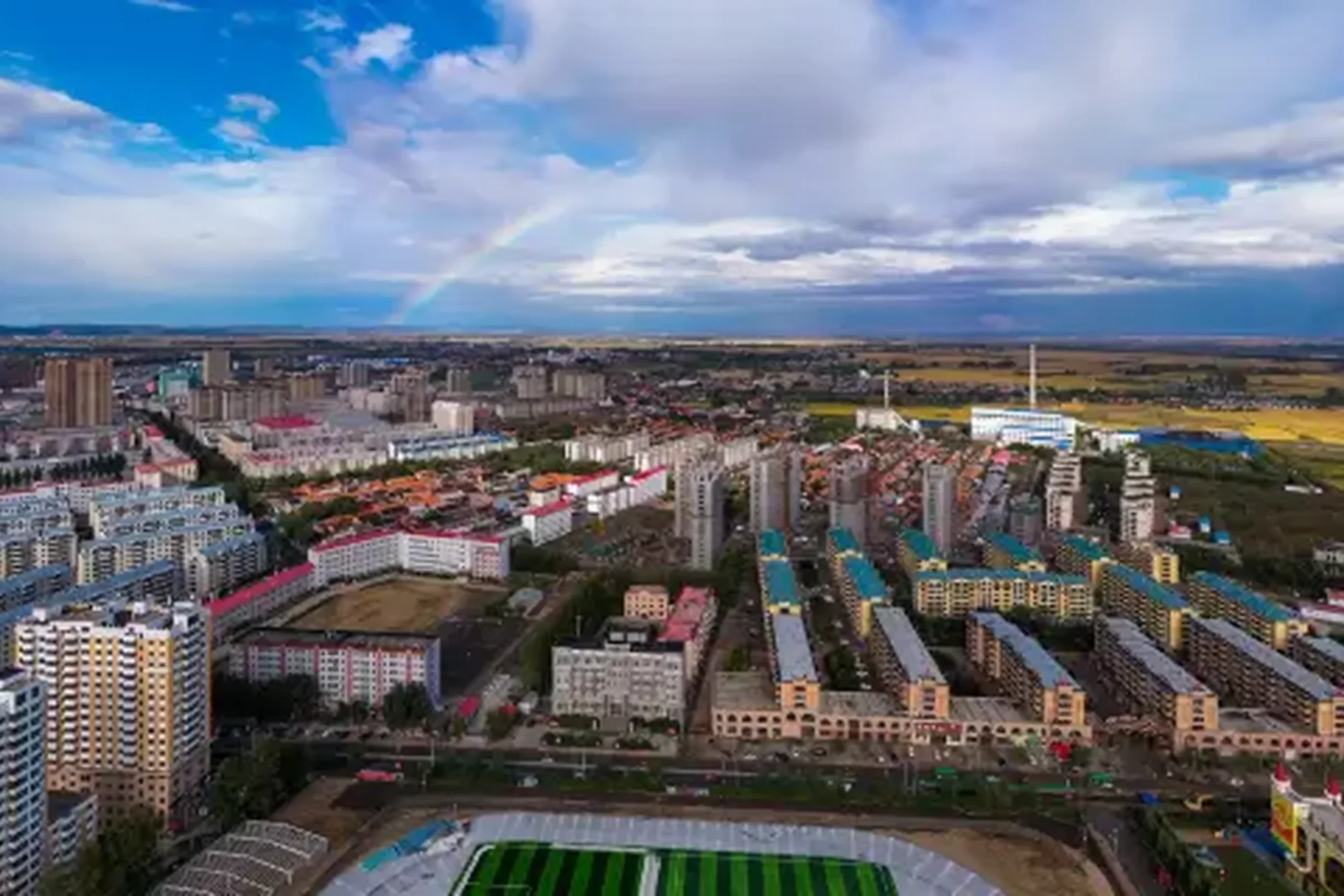
The honest trade-offs: this is a functional city, not a scenic one — the hero photo above is the town's real register, housing blocks and a stadium under a big sky; English signage is nearly absent; and the lake's headline sights spread over an hour of road. You come for the water and the noodles and the sense of standing at a border that most maps treat as a blue line.
Xingkai Lake: the Border Sea
Xingkai Lake (兴凯湖) is the trip. The lake runs 4,380 square kilometres in total across the border, with roughly 1/3 on the Chinese side; the Chinese shore holds the sand beaches, the wetland margins and the small resort strip. In July-August it behaves like a sea — swimmers in the shallows, wind in the pines, sunset over Russian water — and the shore road links the beach sections with the marshes where cranes nest in season.
The road out runs about 130 km via Mishan, roughly two hours by car or bus. Give the lake a full day; the beach strip has simple guesthouses if you want the sunrise.
Xinkailiu: the 6,000-Year Shore
At Xinkailiu, near the lake's northern neck, the shore archaeology of the region is on show: excavated in 1972, the site traced a fishing-and-hunting culture on this shore back 6,000 years, and the lakeshore museum walks through the finds. It is a small, quiet museum — 45-60 minutes — and it reframes the lake: the same shoreline people still fish in summer fed settlements older than the pyramids.
Pair it with the lake morning; the sites sit within a short drive of each other.
Qilin Mountain: the Forest Day
Qilin Mountain (麒麟山), in Jidong County about 40 minutes by car from the city, is the region's green break: forest trails and a small ski field. The walking season runs April-October; December-February the little ski area runs its lifts for the local weekend crowd. It is not a headline mountain — it is the place the city goes on a Sunday — and that is its charm.
Half a day, picnic lunches from town.
The Coal Century: Hengshan and the Museum
Jixi dug coal for a hundred years, and the Hengshan mining park walks you through the century — headframes, railwaybeds, the tools and the town that grew around them. The city museum fills in the region's story beside it. Together they take a half day and give the trip its second theme: this is a frontier that ran on fish before it ran on coal.
The Cold Noodles
The city's food signature is xianlengmian — iced cold noodles, a sour-sweet chili-dressed bowl the whole city eats through the summer, plus the northeast barbecue that accompanies it. Noodle shops are on every block; the best queue at lunch.
A Two-Day Plan (and a Third)
- Day 1 — the lake. Out early on the 130-km road via Mishan, beach morning, Xinkailiu museum after lunch, sunset over the water, back or overnight by the shore.
- Day 2 — the city. Hengshan mining park and the city museum, cold noodles for lunch, Qilin Mountain if the weather holds — or the ski field in winter.
Our 3-day Jixi trip builder lays this out hour by hour; the 5-day and 7-day versions fold in Mudanjiang and Jingpohu — the southeast Heilongjiang circuit runs lake-to-lake; the province-wide frame is in our Heilongjiang guide.
Getting There and Around
Jixi links to the rail network through Mudanjiang; the lake run is the one long road day.
| Route | Time | Notes |
|---|---|---|
| Jixi → Xingkai Lake via Mishan | about 130 km, 2 h | car or bus |
| City → Qilin Mountain (Jidong) | about 40 min by car | hiking Apr-Oct; ski Dec-Feb |
| City ↔ Hengshan mining park | short ride | pairs with the museum |
| Jixi ↔ Mudanjiang (train) | 1-2 h | times on 12306 |
| City museum ↔ cold-noodle streets | walk or short taxi | ¥10-15 |
Write destinations in Chinese — 兴凯湖, 新开流, 麒麟山 — and confirm lake buses outside the June-August season.
Where to Stay
Stay central, near the station and the noodle streets: mid-range rooms run about 300-600 CNY a night on the roster's sheet, and in this value-corner of the northeast the same money often buys a better room. Simple guesthouses line the lake strip for the sunrise crowd. Reserve 1-2 weeks ahead for the July-August beach weeks.
What to Eat
Cold noodles lead, northeast barbecue follows: the iced sour-sweet noodle bowls run all summer, the grill houses run all year, and lake fish appears on the tables near the water. Breakfast is the northeast standard — porridge, buns, pickles — and portions run large.
Eat where the queues are local, pay by Alipay or WeChat Pay linked to an international card, and carry 50-100 CNY in small notes for the market stalls that do not scan.
What a Day Costs
| Item | Price | Notes |
|---|---|---|
| Xingkai Lake beaches | free to modest | some sections ticketed in season |
| Xinkailiu museum | within the 50-150 CNY ticket band | 45-60 min visit |
| Qilin Mountain / ski field | within the 50-150 CNY ticket band | ski pass extra in winter |
| Hengshan mining park | within the 50-150 CNY ticket band | pairs with the city museum |
| Mid-range hotel | 300-600 CNY/night | central Jixi |
| Meals | 100-200 CNY/day | cold noodles to barbecue |
| Local transport | 30-60 CNY/day | taxis; the lake day is car fare |
The mid-range total of 500-1000 CNY per person per day is the roster's ceiling for the city — in practice Jixi runs below it, and a backpacker day holds near 40 CNY.
When to Go
June-August is the lake season — swimmable, green, and the cold-noodle months. December-February is the second season: the lake locks into ice, the little ski field runs, and the city turns its barbecue indoors. Spring and autumn are thin. Avoid the national holiday weeks — early May and the first week of October — when the beach and the museum queue.
Practical Tips
- Payment: link an international card to Alipay or WeChat Pay before arrival; keep 50-100 CNY in small notes for noodle stalls and lake vendors.
- eSIM: a tourist data eSIM (about 5-30 USD) avoids the phone-shop passport queue; install a VPN before you fly, since Google, WhatsApp and Instagram are blocked on the mainland.
- Border sense: the lake is a frontier zone — carry your passport for hotels and ticket checks, as is routine in border counties.
- Distance discipline: the lake day is 130 km each way; start early and do not stack it with the mountain.
- Emergencies: police 110, ambulance 120, fire 119, national tourist hotline 12301.
Frequently Asked Questions
How many days do I need in Jixi?
Two is the working shape: the lake day (130 km out via Mishan, with Xinkailiu) and the city day (mining park, museum, cold noodles, optionally Qilin Mountain). A third buys the beach sunrise or a winter ski morning.
What is Xingkai Lake?
One of Asia's largest freshwater lakes, 4,380 square kilometres shared with Russia — roughly 1/3 on the Chinese side — with the sand-beach resort strip on the Chinese shore, about 130 km from Jixi via Mishan.
Is the border area open to visitors?
The Chinese shore, the beaches and the museum receive ordinary visitors, with your passport as identification at hotels and checkpoints — routine in border counties. Access rules can tighten without notice; reconfirm locally in the season you travel.
When can you swim at the lake?
July-August, in the designated beach sections. The water is fresh, cool and shallow over sand; outside those months it is a walking shore, and in winter it is an ice road.
What do I eat in Jixi?
Iced cold noodles — the city's sour-sweet signature — plus northeast barbecue and lake fish. The noodle streets sit centrally; queues mark the good ones.
How do I combine Jixi with the region?
By rail through Mudanjiang, with Jingpohu next door for the second lake — the southeast circuit runs lake-to-lake, framed in our Heilongjiang guide, and the 5-day and 7-day itineraries thread it.
Do I need cash in Jixi?
Mostly no: Alipay or WeChat Pay linked to an international card covers the city. Keep 50-100 CNY in small notes for noodle stalls and the lake strip.
Useful Phrases
| Chinese | Pinyin | Meaning |
|---|---|---|
| 你好 | nǐhǎo | hello |
| 谢谢 | xièxie | thank you |
| 多少钱 | duōshǎo qián | how much |
| 鸡西 | Jīxī | Jixi |
| 兴凯湖 | Xīngkǎi Hú | Xingkai Lake |
| 新开流 | Xīnkāiliú | Xinkailiu site |
| 麒麟山 | Qílín Shān | Qilin Mountain |
| 冷面 | lěngmiàn | cold noodles |
Final Notes
Every figure above — the lake's 4,380 square kilometres and its roughly 1/3 share, the 6,000-year shore culture excavated in 1972, the 130-km road via Mishan, Qilin Mountain's 40-minute approach and its April-October and December-February seasons — was checked in October 2026 against our trip-days data for the city. Prices move; reconfirm within a fortnight of travel.
- Source: China National Tourism Administration — policy and seasonal notices.
- Source: Trip.com — live transport and hotel listings for cross-checks.
Last verified 2026-10-16.