Summary
Macao (澳门) is a Special Administrative Region of China, a former Portuguese territory administered from Lisbon until the 1999 handover and run ever since under its own basic law, its own currency, and its own border controls. The territory is small: about 35 square kilometres split between a peninsula and the islands of Taipa and Coloane, stitched together by reclaimed land called Cotai. Roughly 700,000 people live here permanently, which makes Macao one of the most densely populated places on earth. You can travel from the mainland border in the north to the southern tip of Coloane in well under an hour by bus.
That compactness is the main reason we keep recommending Macao to travellers who want intensity without logistics. In a single morning you can climb the stone steps of a seventeenth-century church facade, eat a warm Portuguese egg tart, and wander through a casino resort the size of a small town, all without ever consulting a train timetable. The territory's two faces — the UNESCO-listed Historic Centre on the peninsula and the integrated resorts of the Cotai Strip — sit about twenty minutes apart, usually connected by a free shuttle bus.
This guide reflects how we plan Macao trips after several visits, most recently in 2025. We cover what we consider the right length of stay (two full days for a first visit, three if you want Coloane at a relaxed pace), where to base yourself, what food and hotels actually cost in patacas, and the entry rules that catch visitors out — the documents required differ sharply depending on whether you arrive from mainland China, Hong Kong, or a third country. Prices are quoted in Macao patacas (MOP) as 2025-2026 ranges; treat anything mission-critical as worth a quick re-verification before departure.
Read the guide top to bottom if you are planning from scratch. If you only need the numbers, jump straight to the Decision Support section near the end: a map orientation, a cost breakdown, timing advice, and the practical essentials compressed into one place.
Why Macao
Most first-time visitors arrive expecting a casino city and leave surprised by how much of Macao has nothing to do with gambling. The territory spent more than four centuries as a Portuguese trading post, and the legacy runs deeper than postcard architecture: Portuguese remains an official language alongside Chinese, street signs are bilingual, the legal tradition follows Portuguese civil law, and the hillsides mix southern European baroque churches with Cantonese shopfronts and working Chinese temples. In 2005, UNESCO inscribed the Historic Centre of Macao on the World Heritage List — more than twenty monuments, squares, churches, and temples concentrated in a walkable core between Guia hill and the Inner Harbour. In 2017, the city joined UNESCO's Creative Cities network as a City of Gastronomy, recognising a food culture that exists nowhere else on the planet.
The other face of Macao is newer. After the gaming market opened to foreign operators in 2002, reclaimed land between Taipa and Coloane became the Cotai Strip, and Macao grew into the largest casino market in the world by revenue — several times the size of Las Vegas. The Venetian, the Londoner, the Parisian, Galaxy, Wynn Palace, and City of Dreams stack hotels, theatres, shopping malls, and gaming floors into single climate-controlled complexes. The replicas are unapologetic: a half-scale Eiffel Tower, a Venetian canal with singing gondoliers, a Westminster clock face. You may find them absurd or delightful; either way, they are a genuine piece of contemporary China worth seeing with your own eyes.
Our honest pitch is this: Macao is the easiest place in Asia to experience both European colonial history and twenty-first-century Chinese consumerism in a single weekend, with a food scene that justifies the trip on its own. Equally, be clear about what Macao is not. It is not a beach destination, not a hiking destination, and not much of a nightlife city beyond the casino floors. Come for the contrast and the kitchens, not for adventure.
Two practical consequences of its status deserve emphasis. First, Macao maintains its own immigration: entering from mainland China or Hong Kong counts as crossing a border, and the documents required differ by nationality and direction of travel. Second, it has its own currency, the pataca, although Hong Kong dollars circulate freely everywhere. Both points shape the practical sections below.
Top Attractions
These are the five places we send people to first, in the order we would visit them. All five can be covered in two full days if you start early; three days makes the pace humane.
Ruins of St. Paul's (大三巴牌坊)
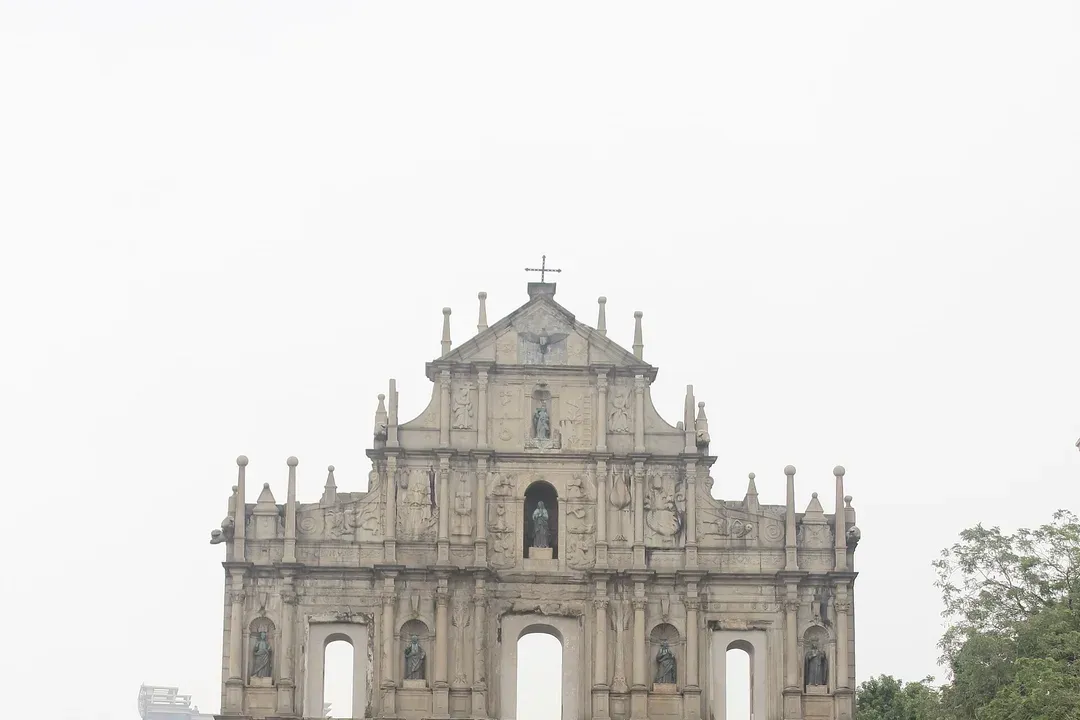
The stone facade of the Church of Mater Dei, completed in 1640 and orphaned by the fire of 1835 that destroyed the church behind it, is Macao's single most recognisable image. A wide flight of 68 steps rises to the baroque facade, whose carvings mix Jesuit symbolism with Chinese lions and chrysanthemums — a genuine artifact of cultural encounter rather than a modern replica. Behind and beside the facade sit the small Na Tcha temple and a stretch of the old city wall, a reminder that temples, churches, and cannon shared the same hill for centuries.
Come before 9 AM or after 5 PM; between those hours the steps are a solid crowd. Behind the facade, Monte Fort holds the Macao Museum (a modest admission fee of roughly 15 MOP), whose rooftop cannons look out over the whole peninsula. The alleys descending from the ruins — Rua de S. Paulo and Rua de Santa Antonio — are lined with pastry shops offering free samples of almond cookies and jerky, which is a perfectly acceptable way to build a lunch. The ruins themselves are free and always open.
Senado Square and the Historic Centre (议事亭前地)
Senado Square is the civic heart of the UNESCO zone: a gently sloping plaza paved with the black-and-white wave-patterned calçada stones that Portuguese stonemasons laid across the colonial world. From here you can walk the entire Historic Centre in a loop of under two kilometres: the baroque St. Dominic's Church, the Holy House of Mercy with its small museum, the Cathedral, and then downhill past traditional Chinese shophouses to A-Ma Temple at the Inner Harbour. Founded in 1488 and dedicated to the sea goddess Mazu, the temple reputedly gave Macao its name — fishermen called the bay A-Ma Gau, "the bay of the goddess," and Portuguese ears turned it into Macau.
Our advice: do this walk in the early morning, when the pavement photographs without strangers and the temple courtyards smell of incense rather than sunscreen. The Lilau Square and the Mandarin's House in São Lourenço, at the southwestern end of the loop, are the quietest and, in our opinion, the most atmospheric corners of the whole inscription. Allow half a day with coffee stops.
Macao Tower (澳门旅游塔)
At 338 metres, the tower on the Nam Van waterfront is the tallest structure in the territory, with viewing decks around the 61st floor — roughly 230 metres above sea level. On a clear day you can see the whole peninsula, the Cotai resorts, the Pearl River delta, and the hills of Hong Kong. Standard deck admission runs roughly 195-225 MOP depending on season and package; adventure add-ons from AJ Hackett — the Skywalk around the outer rim, the tower bungy, one of the highest commercial jumps on earth — cost considerably more, often several thousand patacas for the bungy. Book adventure options in advance online; deck-only tickets can usually be bought on the spot.
Our recommendation is to time your visit for the hour before sunset: you watch the delta glow, then the city lights, then the casino signs. Combine it with dinner in the NAPE district at the tower's foot, which has some of the best local-value restaurants on the peninsula.
Taipa Village and Rua do Cunha (官也街)
Taipa Village is the surviving old core of the island of the same name, a grid of low lanes now bookended by the megaresorts of Cotai. Its spine is Rua do Cunha, a pedestrian street of snack shops that functions as an edible walking tour: pork chop buns from Tai Lei Loi Kei (the decades-old originator, expect 40-60 MOP), almond cookie bakeries pressing samples into your hands, jerky stalls, and pudding shops selling serradura, the "sawdust" pudding of crushed biscuits and cream. At the top of the village stands the pastel Our Lady of Carmel Church, next to a garden terrace looking down over the Taipa wetlands toward the casino skyline — the single best photo of old-and-new Macao in one frame.
Come hungry in the late afternoon, eat your way down the street, and finish at one of the village's Portuguese or Macanese dining rooms. Two hours is enough; the village is small, and that is the point.
Coloane Village (路环村)
Coloane, the island at the southern end of the territory, is what Macao was before the casinos: a fishing village of one-storey houses, a small waterfront square, and a chapel. The Chapel of St. Francis Xavier, a whitewashed 1928 building with a scalloped facade, faces the square where old men play chess under banyan trees. The village's global claim to fame is Lord Stow's Bakery, opened in 1989 by an Englishman named Andrew Stow, whose Portuguese egg tarts — puff pastry, warm custard, blistered caramel top — acquired a devoted following across Asia. Expect a queue and a price of about 13-15 MOP per tart.
From the village you can walk or take a short bus ride to Hac Sa, the black-sand beach (the sand has greyed over the years with replenishment, but the promenade and pine woods remain), and to the trails of Coloane hill. Fernando's, the long-running Portuguese restaurant near the beach, is still worth the pilgrimage for grilled sardines and clams. Coloane is the slow half-day of any Macao itinerary; do not schedule it back-to-back with a busy morning.
Where to Stay
The first decision is peninsula versus Cotai, and it is genuinely a decision, because the two areas deliver different trips.
Peninsula (historic core and NAPE). Staying near Senado Square or along the Outer Harbour puts you inside the UNESCO zone: you can walk to Ruins of St. Paul's before the crowds and reach the tower and A-Ma Temple on foot or a short bus ride. Options range from boutique properties in restored townhouses to business towers; Wynn and MGM both run full-scale resorts on the peninsula's eastern edge. Weekday mid-range rooms typically run 500-900 MOP, rising on weekends. This is the right base for first-time visitors and anyone whose priority is heritage, food, and walking.
Cotai (the Cotai Strip, 金光大道). The integrated resorts — Venetian, Londoner, Parisian, Galaxy, Wynn Palace, City of Dreams, Studio City, Grand Lisboa Palace — are destination hotels where the building itself is the attraction. Rooms are enormous by any standard, pools and food courts are extensive, and families get more infrastructure per dollar. The trade-off is distance: the Historic Centre is 20-30 minutes away by shuttle or taxi. Weekday rates can surprise on the upside (900-1,500 MOP for five-star rooms); weekends, concert nights, and the Grand Prix push prices sharply higher. This is the right base for resort loungers, families, and anyone with casino plans.
Coloane. A handful of quiet options, including one longstanding low-rise resort above Hac Sa beach, suit travellers who want village calm and don't mind the 40-minute commute to the sights. We recommend it only for second visits or slow trips.
Practical notes for all areas: true hostels barely exist in Macao, so budget travellers end up in small guesthouses on the peninsula from around 350-500 MOP. Book at least a month ahead for October-December weekends, and much earlier for the November Grand Prix, when rooms citywide sell out and rates can double. Weekday stays (Sunday-Thursday) are the single biggest saving available in Macao.
Gastronomy
Macao's food justifies the trip independently of any sightseeing, which is not something we say about many cities. Three traditions overlap here: Cantonese cooking of the highest standard, Portuguese home food transplanted across the world, and Macanese cuisine — the centuries-old fusion created in Portuguese kitchens by cooks from Goa, Malacca, and Africa, now recognised as one of the world's oldest fusion traditions.
Portuguese egg tarts (pastéis de nata). The two pilgrimages are Lord Stow's in Coloane and Margaret's Café e Nata in central Macao — opened by a formerly married couple, Andrew Stow and Margaret Chan, whose friendly rivalry splits local opinion to this day. Our verdict: both are excellent; Lord Stow's edges it for the caramelised top, Margaret's for the pastry. At 13-15 MOP each, the correct order is two, eaten warm, standing up.
Pork chop bun (猪扒包). A thin-marinated pork chop, pan-fried and stuffed into a crisp roll, best from Tai Lei Loi Kei on Rua do Cunha (40-60 MOP). It is Macao's sandwich answer to the hamburger, and the correct lunch between sights. Any stall with a queue of locals is a safe bet.
Portuguese and Macanese restaurants. A Lorcha near A-Ma Temple, Litoral off Senado, O Santos in the residential lanes, and Fernando's by Hac Sa beach form the classics circuit. Order garlic clams (ameijoas), grilled sardines in season, and African chicken — the Macanese standard of chicken in a piri-piri-and-peanut sauce that traces its lineage to Mozambique. Try minchi, the Macanese hash of minced pork and potato that locals call the territory's true national dish. Dinner at these places runs roughly 250-450 MOP per person with wine.
Water crab congee (水蟹粥). The Cantonese counterweight: whole fresh water crab cooked into congee at dedicated congee houses on Rua do Cunha and around the Inner Harbour. A pot built for two runs about 200-350 MOP depending on the crab, and it is the single dish we would choose for a last meal in Macao.
Beyond the headline dishes: Michelin-starred Cantonese dining rooms concentrate in the Cotai resorts and book out days ahead; cha chaan teng diners do breakfast sets of noodles and milk tea for 40-60 MOP; and every bakery sells gift tins of almond cookies (try the still-warm ones straight off the press rather than the boxed version). Budget 100-150 MOP a day for eating well at street level, or 400-600 MOP with one proper restaurant dinner.
Timing matters as much as choice. Congee houses open at dawn and wind down by early afternoon; the egg tart bakeries pull hot trays from mid-morning; pork chop bun counters peak at lunch; resort dining rooms serve non-stop; and the congee-and-noodle joints around the Inner Harbour feed the casino shift change after midnight. In our experience the eating rhythm of the city — breakfast noodles, an 11 AM tart, a 3 PM cookie sample circuit, a proper dinner — is itself half the pleasure of a Macao trip, so plan the sights around the meals rather than the reverse.
Practical Information
Visa and Entry
Macao runs its own immigration, and the rules differ by where you come from. Mainland Chinese residents need the Exit-Entry Permit for Travelling to and from Hong Kong and Macao (往来港澳通行证) with a valid endorsement — the document, not a passport, is what gets stamped. Hong Kong residents have their own arrangement. Holders of most foreign passports — several dozen countries — may enter visa-free for periods that vary by nationality, commonly up to 30 or 90 days, but the list and durations are policy matters and have shifted repeatedly in recent years, so verify your own case with the Macao Government Tourism Office or your carrier before booking. Note also that arriving via mainland China, or adding a Zhuhai side trip, involves mainland China's separate visa rules — see the Day Trips section.
Currency and Money
The currency is the Macao pataca (MOP), informally the macauca, pegged to the Hong Kong dollar at roughly 1.03 MOP to 1 HKD. In practice Hong Kong dollars are accepted everywhere at close to par, and change usually comes back in patacas; casinos price and pay in HKD. Chinese renminbi is widely accepted but at poor effective rates — avoid paying in it when you can. Cards work in all resorts and most restaurants; street food and buses want cash, a Macau Pass stored-value card, or mobile payment (Alipay and WeChat Pay both work, including with linked international cards). ATMs are everywhere. We suggest withdrawing patacas once and carrying small notes: egg tart queues move faster with exact change.
Transport
Macao rewards travellers who exploit its free infrastructure. The casino shuttle buses are the best transport deal in Asia: complimentary coaches connect the major resorts with both ferry terminals, the airport, the Border Gate, and the Hengqin port, no ticket or casino play required. Routes get trimmed and restored, so confirm at your hotel desk. Public buses charge a flat fare of about 6 MOP (less with a Macau Pass) and cover everything the shuttles skip. A driverless light metro (LRT) serves Taipa, Cotai, the airport, and — following recent extensions — the Seac Pai Van quarter and the Hengqin border; fares run roughly 6-12 MOP, but the peninsula itself still relies on buses, shuttles, and feet. Taxis are metered and honest but scarce at peak; expect queues at ferry terminals and resort forecourts. Honestly, the peninsula's historic core is best walked end to end — it takes forty minutes — and that is the correct way to see it.
Best Time to Visit
October to December is the prime window: dry, sunny, and around 20-28°C, with the caveat that hotel prices peak and the November Grand Prix fills the city. March to April is the second-best choice, mild with occasional humidity and drizzle. May to September is hot, humid, and typhoon-prone; when the number 8 signal goes up, everything — ferries, buses, casinos' doors, the lot — closes until it drops, so build a flexible day into any summer itinerary. Avoid the mainland Golden Week holidays in early October, early May, and Lunar New Year, when visitor volumes overwhelm the peninsula.
Cultural Considerations
Macao society is Cantonese at its base, Portuguese at its edges, and pragmatic in the middle. Locals switch between Cantonese, Mandarin, Portuguese, and English with an ease that surprises visitors; you will get by in English in every tourist context, but a greeting in Cantonese (nei5 hou3) buys warmth.
At temples — A-Ma, Kun Iam, Na Tcha — dress modestly, keep your voice low, and ask before photographing worshippers; incense is provided and cheap, and offering three sticks is normal practice, not a tourist trap. At Catholic churches, mass times are posted at the door; visiting between services is fine, wandering in during one is not. On casino floors the rules are strict and enforced: minimum age 21, passport or entry permit required at the door, photography of gaming areas forbidden, and smart-casual dress expected at the premium rooms. If the tables do not interest you, walking through the public mall areas of the resorts is free and unregulated.
Tipping is not customary — restaurants add a 10% service charge, and adding more is optional and noticed rather than expected. Queuing is orderly and taken seriously, especially at bus stops and egg tart counters. Smoking is banned in nearly all indoor public space, including casinos outside designated lounges; use the marked zones. During typhoon signals, follow the locals' lead and go indoors — the signals are announced hours in advance in English on local media. Sunday afternoons in Coloane village and the inner lanes close early; plan siesta-time relaxation rather than errands.
Two-Day Itinerary
This is the itinerary we give friends. It assumes an early ferry or bus arrival, comfortable shoes, and the willingness to eat six times a day.
Day 1 — the peninsula.
- 8:00: Walk from Senado Square up to the Ruins of St. Paul's before the tour groups arrive (60-90 minutes, free).
- 9:30: Macao Museum and the Monte Fort cannons for orientation; sample your way down the snack alleys.
- 11:00: Historic Centre loop at your own pace: St. Dominic's, the Cathedral, São Lourenço, down to A-Ma Temple and the Mandarin's House near Lilau Square.
- 13:00: Lunch at a Macanese room near the Inner Harbour — Litoral or A Lorcha; African chicken and minchi (250-450 MOP).
- 15:00: Coffee and a pastel de nata, then the NAPE district; or squeeze in the Grand Prix Museum if motorsport appeals.
- 17:30: Macao Tower for sunset (195-225 MOP), dinner afterwards in NAPE or a congee house.
- 21:00: Casino floor wander if curious — the Venetian-style spectacle is easier to stomach sober and with pockets zipped.
Day 2 — Taipa, Cotai, and Coloane.
- 8:30: Free shuttle or LRT to Taipa; breakfast pork chop bun on Rua do Cunha when the shops open.
- 10:00: Taipa Houses-Museum and the wetland boardwalk viewpoint; walk from the village into the resort zone to feel the scale change.
- 11:30: Pick one resort and explore it properly — the Venetian's canals, the Parisian's tower, or Galaxy's gardens. These complexes are vast; one is a morning.
- 13:30: Resort food court or a proper lunch, then shuttle or bus 25/26A toward Coloane.
- 15:00: Coloane village: chapel square, Lord Stow's egg tarts, the waterfront.
- 17:00: Hac Sa beach and Coloane hill viewpoint, or an early Portuguese dinner at Fernando's.
- 20:30: Return to Cotai for a show, the light displays, or a quiet night.
With a third day, add the Guia hill morning, deep Coloane hiking trails, or a Hong Kong or Zhuhai crossing. Two days covers the essentials without rushing only if you start early; three is comfortable.
A note on pacing: Macao punishes over-scheduling more than most cities, because its density means everything takes longer than the map suggests — a 300-metre walk through Senado passes four snack stops and two churches. Build in the unplanned hour. The itinerary above deliberately leaves the late afternoon soft; that is where the best of Macao happens, in a wet-market lane or a bakery queue you did not plan to join.
Beyond the Highlights
Once the headline sights are done, these are the places that make our repeat visits worthwhile.
Taipa Houses-Museum (龙环葡韵). Five sea-green colonial villas from the 1920s, fronting a wetland garden facing the Cotai skyline. Inside: restored domestic interiors of the Macanese middle class a century ago. The contrast — garden, reeds, and casinos in one frame — is Macao's whole story in a single view. Entry is cheap, and the short walk from Taipa Village takes ten minutes.
Guia Hill and lighthouse (东望洋灯塔). The 1865 lighthouse on Guia hill was the first western-style lighthouse on the Chinese coast, and it still works. The hilltop complex includes a chapel with well-preserved frescoes and old military tunnels; the short cable car up from Flora Garden costs a few patacas, or you can walk. From the top, the entire peninsula — heritage rooftops, casino towers, the bridges to Taipa — reads as one map. We think the walk up through the Flora Gardens at 8 AM, with locals doing morning exercise, is the best hour of the peninsula.
Lou Lim Ieoc Garden. A Suzhou-style scholar's garden of ponds, bamboo, and a nine-turn bridge, dropped between apartment blocks. Twenty quiet minutes, free, and usually empty of visitors.
Camoes Garden and the Lilau quarter. Morning tai chi under the banyan trees at Camoes, then coffee in São Lázaro district's yellow colonial square, where the octagonal church of St. Lazarus anchors a small gallery-and-crafts quarter that most itineraries skip entirely.
Kun Iam Ecumenical Centre. The 20-metre bronze statue of the goddess of mercy gazing across the Pearl River from the Outer Harbour causes arguments (some say it looks like a foreign woman), but the waterfront promenade beside it is where the peninsula exhales at sunset, and the centre's small museum explains the blend of Buddhist tradition and local devotion.
Nightlife
Macao after dark is honest about what it is: a casino town with a respectable layer of bars on top. The gaming floors run 24 hours (entry at 21, documents at the door), and they are the default late-night entertainment — free to watch, expensive to join. The big resorts rotate resident shows, arena concerts, and theatrical productions; the lineup changes season by season and recent years have seen long-running favourites close and new ones launch, so check current schedules on resort sites while planning rather than trusting anything you read, including this.
For drinks with a view, the peninsula's rooftop options cluster around the NAPE and Outer Harbour strip — Sky 21 has held the classic slot for years — and hotel bars like Vida Rica at the Mandarin Oriental deliver the polished version. In Cotai, the resort bars are lavish and priced accordingly. Around Senado and the historic lanes, small pubs and wine bars pour until late; in Taipa village, the atmosphere is dinner-focused and sleepy by 11 PM.
Our practical read: Macao nightlife is best treated as an extension of dinner — a good restaurant, then a rooftop nightcap, then the casino spectacle walked rather than played. If clubbing until dawn is your priority, Hong Kong is an hour away and does it better; Macao's late night is about the tables and the lights.
One honest note: don't drink and gamble. The floors are engineered for your worst decisions, and the ATMs are placed accordingly. Set the night's limit in cash, leave the cards upstairs, and treat the whole spectacle as theatre with an optional ticket price.
Day Trips
Macao sits in the middle of the Pearl River delta, and two neighbours make easy add-ons.
Hong Kong. Three ways across: the HZMB "golden bus" over the Hong Kong-Zhuhai-Macao bridge runs 24 hours, takes about 40 minutes, and costs around 65 HKD/MOP — the best combination of price and reliability; book Golden Bus seats ahead on holiday weekends. The ferry from the Outer Harbour to Sheung Wan takes under an hour and costs roughly 170-230 HKD depending on class and time; it is faster from door to door than it looks, but suspends in bad weather. Helicopters exist for expense-account travellers. Remember that Hong Kong is a separate immigration area with its own rules; most foreign passport holders get visa-free entry, but verify your own case. A same-day Hong Kong loop — morning dim sum, the Star Ferry, Victoria Peak — is entirely doable from a Macao hotel.
Zhuhai and Hengqin. The Border Gate (Portas do Cerco) in the north opens directly into Gongbei, Zhuhai's downtown, on foot. Hengqin port, reached via the Lotus checkpoint, serves the new district including the Chimelong Ocean Kingdom theme park, a major family draw. The critical caveat: mainland China applies its own visa policy to most foreign passports, and a same-day return from Zhuhai generally does not qualify for visa-free transit arrangements — confirm your eligibility before committing, because being turned back at the bridge is a bad way to spend a morning. Mainland residents, of course, cross freely with the right endorsement.
With more time, Guangzhou is two-plus hours away by high-speed rail from Zhuhai, and Shenzhen reachable via Hong Kong. A sensible regional loop for a ten-day trip is Hong Kong (3 nights), Macao (2-3 nights), and Zhuhai or Guangzhou (2 nights), crossing each border once in each direction and checking the visa implications of every crossing for your passport before you commit. Our advice for a first Macao visit, though, is simpler: skip the add-ons and spend the time in Coloane instead. The delta will still be there next trip.
Events and Festivals
Macao's calendar has one giant and a supporting cast.
The Macao Grand Prix (November). Since 1954 — with a pandemic gap in 2020 — the peninsula's streets close for a weekend of car and motorcycle racing on the 6.1-kilometre Guia circuit, the only street track that combines tight second-gear corners with a full mountain section. The racing is genuinely serious; the atmosphere transforms the whole city. Hotels sell out and double their rates for race weekend; grandstand and stand tickets are sold through the official GP site and should be booked months ahead. Even without tickets, the roar over the rooftops is free.
International Fireworks Display Contest (September-October). Several Saturday nights across late September and early October, national teams fire themed displays over the seafront between the Nam Van Lake and the tower. Locals stake out the waterfront hours early; join them with takeaway and beer. Free, and in our opinion the territory's most photogenic night of the year.
Lunar New Year (January-February). The parade along the peninsula, fireworks over the river, and every hotel lobby dressed to the theme. Crowds are heavy; the payoff is atmosphere rather than access.
Spring and autumn arts. The Macao Arts Festival lands in late spring; the Macao International Music Festival runs in autumn, with the finale traditionally in the Ruins of St. Paul's square — classical music under a baroque facade, one of the territory's signature evenings.
Neighbourhood feasts. The Catholic Procession of the Passion winds from St. Augustine's in late February or March; the Feast of Na Tcha behind the Ruins fills the little temple's lane with opera and incense in early summer; dragon boat races churn Nam Van Lake around the June festival; and the December light festival strings projections through the heritage streets. Dates follow lunar and liturgical calendars, so check the tourism office's events page for the current year.
Shopping
Macao shopping divides cleanly in two, and knowing which half you want saves an afternoon.
The resort half is luxury retail at scale: the Shoppes at the Venetian, Four Seasons, and Londoner complexes form one of the largest concentrations of flagship boutiques in Asia, all indoors, all connected, all priced at international levels. Macao levies no sales tax on most goods, so prices sit close to Hong Kong's; the real advantage is density — you can compare six boutiques without going outside. Watches, jewellery, and cosmetics are the serious categories here. If a purchase matters, know the model and the home price before you fly; impulse comparisons on a casino floor rarely end well.
The local half is more fun and lighter on the wallet. San Ma Lo (Avenida de Almeida Ribeiro) and the lanes around Senado carry the old-style gold shops, herbalists along Rua dos Ervanários, and tailor shops. Rua do Cunha in Taipa is the edible-goods strip: tins of almond cookies from Koi Kei or the local specialists, jerky vacuum-packed for travel, egg-roll biscuits, and serradura kits. Prices are set, bargaining is not part of the culture, and free samples are generous to the point of being lunch.
Our recommendation: buy food, not electronics. The gadget markets that once made border cities famous have converged on the same online prices, while a warm tin of almond cookies is still something you cannot order. Budget 100-300 MOP for gifts that will actually be eaten, and check customs limits for meat products (jerky especially) before flying home — Australia, the US, and others confiscate them.
Decision Support
Map
Orient yourself with three horizontal bands. The peninsula in the north: the Border Gate at the top, the Historic Centre (Ruins, Senado, A-Ma Temple) in the middle band around a 30-minute walking loop, the tower and NAPE dining along the southern waterfront. The middle band: Taipa village and Rua do Cunha on the old island's hill, the airport and ferry terminal beside it, and the Cotai Strip's resort blocks on reclaimed land between. The south: Coloane village, Hac Sa beach, and the hiking hill. The three bands connect via the bridges (buses and taxis), the casino shuttles, and the LRT; Google Maps covers Macao adequately, and the free tourism-office paper map marks every UNESCO site.
Cost breakdown
Per person per day, in patacas, 2025-2026 ranges. Budget: guesthouse 350-500, street food 100-150, buses 20-30, sights 0-100 — total roughly 500-800 MOP. Mid-range: peninsula hotel 700-1,500, one restaurant dinner plus casual meals 250-400, shuttles plus occasional taxi 50-100, sights and tower 200-300 — total roughly 1,200-2,300 MOP. Resort tier: Cotai room 1,500-4,000, resort dining 500-800, shows and spa 300-1,000 — total from 3,500 MOP upward. Note what Macao does not charge for: the shuttle network, the heritage exteriors, the temples (a few expect a small offering), and the beaches. A couple travelling mid-range should plan around 2,000-3,500 MOP per day all-in, less midweek.
When to go
First choice: October-December — dry, warm, and event-rich, at the price of peak hotel rates and Grand Prix congestion in November. Second: March-April, milder and greener, with occasional fog and drizzle. Avoid: June-September for typhoon risk and sauna-level humidity unless cheap rooms are the goal; the Golden Week holidays in early October, early May, and Lunar New Year for shoulder-to-shoulder crowds; race weekend unless the race is the point. For a first visit optimised for comfort, we would pick a Tuesday-Thursday stay in late October or early November, after the typhoon season and before the Grand Prix.
Practical
Entry: your passport plus Macao's visa rules by nationality, or the Exit-Entry Permit for mainland residents — verify before booking. Money: patacas, with HKD accepted at par everywhere and change returned in MOP; carry small notes. Connectivity: mainland and Hong Kong SIMs roam as international here — buy a Macao/HK eSIM or check roaming before crossing; the territory is small enough that offline maps suffice. Payments: Alipay and WeChat Pay work widely; cards work in resorts; cash still rules at snack counters. Health: tap water is treated but locals boil or bottle it — do the same. Emergencies: dial 999; the tourism hotline is +853 2833 3000. Plugs: British-style three-pin sockets at 220V with some European two-pin leftovers — bring one universal adapter. Pharmaceuticals: pharmacies are plentiful; bring your own prescriptions with documentation. Finally, keep your entry slip: you need it to exit, and losing it means paperwork at the border.
Sources
- https://www.macaotourism.gov.mo — the Macao Government Tourism Office's official site: events calendar, transport guides, entry-policy updates, and the current visitor numbers.
- https://whc.unesco.org/en/list/1110 — the UNESCO World Heritage entry for the Historic Centre of Macao, listing every inscribed monument and square with background documentation.
- https://www.dsat.gov.mo — the territory's transport authority (DSAT), with bus routes and fares, LRT lines, and border-crossing status.