Harbin · specialty museum
Harbin Jewish History Museum (哈尔滨犹太历史文化博物馆, Hā'ěrbīn Yóutài Lìshǐ Wénhuà Bówùguǎn)
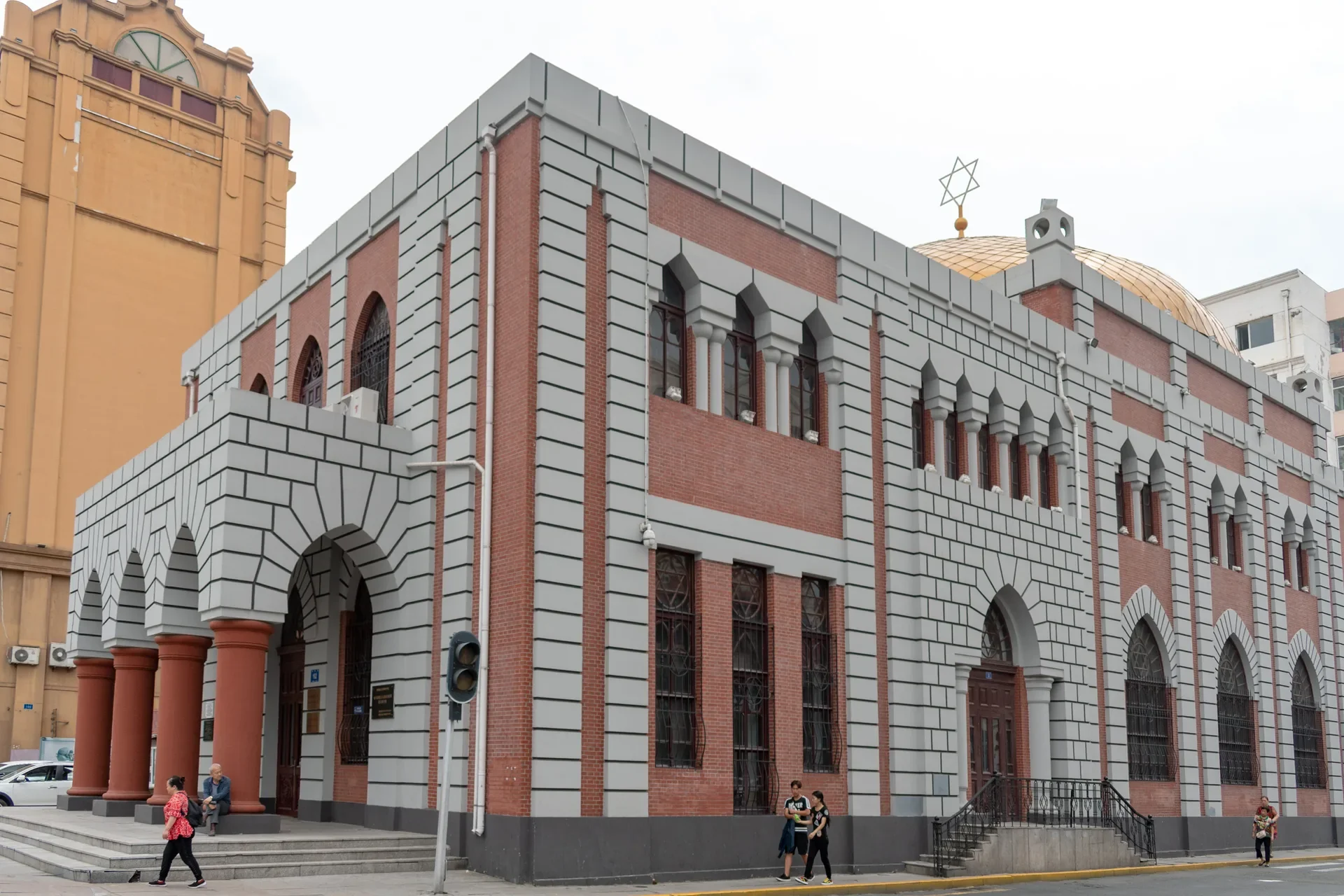
"\"The Harbin Jewish History Museum occupies the main sanctuary of the old Main Synagogue, built in 1909 by the Sephardic Jewish community. The museum documents the extraordinary story of Harbin's Jewish community: Russian Jews fleeing pogroms in the 1880s–1900s, Central European refugees arriving in the 1930s (including 12,000+ Polish Jews), and the community's eventual dispersal in the 1950s–60s. Harbin was briefly the largest Jewish city in East Asia outside Shanghai, with synagogues, schools, hospitals, banks, and a daily Jewish newspaper in Russian and Chinese.\".".
Last updated:
Quick Answer
Is Harbin Jewish History Museum worth visiting?
Documents the 20,000-strong Jewish community that flourished in Harbin 1898–1960s. Inside the old Main Synagogue. Free, 1 hour.
Quick facts
| Category | specialty |
|---|---|
| Ticket | Free. |
| Hours | 9:00–17:00 (closed Mondays). |
| Recommended duration | 1 hour |
| Best time to visit | Morning. 1 hour. |
| How to get there | Metro Line 1 to Xinjing Street. Walk 10 minutes. DiDi ¥20 from Central Street. |
| English signage | yes |
Why visit
It is a remarkable, almost unknown story. Most travelers visit Harbin for the Ice Festival; few know that this Manchurian city was a major Jewish cultural center for 60 years. The synagogue is original (not rebuilt), the photos and artifacts are personal, and the bilingual signage is excellent. I went in expecting a small museum and spent 90 minutes.
Collection highlights
- The synagogue sanctuary itself — original 1909
- Photos of Jewish life in 1920s Harbin — shops, schools, orchestras
- The story of the Shanghai visa — Ho Feng-Shan, the Chinese consul in Vienna, issued 2,000+ visas to Jewish refugees in 1938–1940, many of whom transited through Harbin
- Personal artifacts — menorahs, tefillin, clothing
Tips
- Combine with a walking tour of Harbin's Jewish architectural sites (synagogue, Jewish school, Jewish hospital, Jewish cemetery)
- The 1938 story of Ho Feng-Shan's "Shanghai visas" is one of the great WWII rescue stories — there is a film about him ("Harbin: The 1000 Lives")
- Allow 1.5 hours if you walk the Jewish sites too
Frequently asked questions
Why was there a Jewish community in Harbin?
Three waves: 1) Russian Jews 1880s–1900s fleeing pogroms, settling in the Russian-built railway city. 2) Central European (Polish, German, Austrian) Jewish refugees 1930s–40s, especially after the 1938 Anschluss. 3) Stateless refugees from the Soviet Far East in 1945. The community peaked at ~20,000 in the 1920s.
What happened to the community?
After 1949 (Mao's revolution), most Jewish residents fled to Israel, the US, or Australia. The synagogue was closed in the 1950s and the building was used for various non-religious purposes. In 2004, it was restored and reopened as this museum. The last Jewish resident in Harbin died in 1985.
Is this connected to the Shanghai Ghetto?
Yes — most Jewish refugees in Harbin eventually transited to or communicated with the Shanghai Jewish community, which sheltered 20,000+ refugees from 1938–1945. The two stories are deeply linked. Ho Feng-Shan, the Chinese consul in Vienna who issued 2,000+ "Shanghai visas" saving Jewish lives, is honored in both cities.
Read next
Other things to do in Harbin
Central Street
A 1.45-km cobblestone pedestrian avenue of 71 European-style buildings (1898-1925) running from Harbin's old quarter to the Songhua River — free, open 24 hours, and walkable end-to-end in 30-40 …
Siberian Tiger Park
A 144-hectare drive-through reserve on Harbin's north bank holding 500+ Siberian (Amur) tigers, viewed from a wire-mesh caged bus.…
St. Sophia Cathedral
Harbin's 1907 Russian Orthodox cathedral — green onion dome, red-brick walls, 2,000-seat interior — now a small architectural museum.…
Sun Island
"A roughly 38 km² river-island park that hosts the Harbin Snow Sculpture Expo every winter; allow a half-day in summer, a full day during snow season (December–February).".