Guilin · Visitor Guide
Reed Flute Cave (芦笛岩, Lúdí Yán)
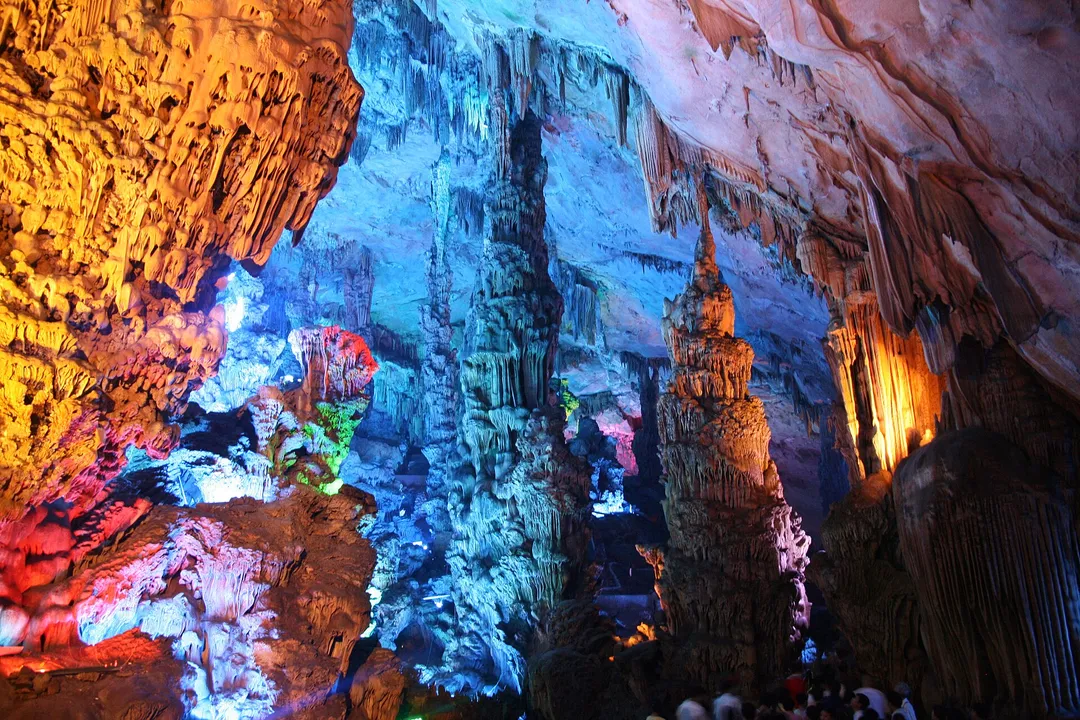
"\"The Reed Flute Cave (Lúdí Yán) is a naturally formed limestone cavern 5 km northwest of Guilin's city centre, named for the reeds that grow at its entrance (used historically to make musical flutes). The cave system is approximately 240 million years old and contains over 70,000 individual stalactite and stalagmite formations, the largest concentration of any show cave in China. A 1-km illuminated path (about 540 m underground) winds through six chambers, each named for its dominant formation: the Crystal Palace, the Dragon's Pagoda, the Virgin Forest. The lighting is deliberately theatrical — the cave is at its best when the formations are lit in colour against pitch-black backgrounds.\".".
Last updated:
Quick Answer
Is Reed Flute Cave worth visiting?
"\"A 240-million-year-old limestone cave system with the world's largest collection of illuminated stalactites and stalagmites. ¥90–120. Audio guide essential. 1–1.5 hours.…\".".
Quick facts
| Ticket | ¥90 (as of 2026), online booking ¥85. Children under 1.2m free, under 1.4m half price. Audio guide ¥30 (bilingual, essential for understanding formations). |
|---|---|
| Hours | 08:00–17:30 (April–October), 08:30–17:00 (November–March). Last entry 45 minutes before closing. |
| Recommended duration | 1–1.5 hours for the full illuminated path walk-through. |
| Best time to visit | Any time of year — the cave climate is constant (16–18°C, 85% humidity). Summer provides contrast with Guilin's heat outside. Avoid Chinese public holidays (Golden Week, May Day) when queues are long. |
| How to get there | Bus 3 or 58 from Guilin city centre (Zhongshan Road) to Reed Flute Cave terminus (芦笛岩终点站), 30 minutes. A DiDi from central Guilin costs ¥25–35 / 25 minutes. The cave is on the way to the airport; combining a cave visit with a direct airport drop-off is practical. |
| English signage | yes |
| Wheelchair accessible | no |
| Cave age | ~240 million years (Carboniferous period) |
| Path length | ~540 m of illuminated path through 6 chambers |
| Temperature | Constant 16–18°C year-round |
| Formations | 70,000+ stalactites and stalagmites |
| Discovered | Over 1,000 years ago; first record in Tang dynasty |
| Depth underground | 150 m at maximum; illuminated path goes to ~90 m |
What to expect
The Reed Flute Cave is not a geological curiosity — it is a world-class show cave by any standard. The 540-m illuminated path winds through six named chambers, each with its own acoustic and visual character. The largest, the Crystal Palace (水晶宫), is a cathedral-scale hall 18 m high where a single column of water-calcified formations reaches from floor to ceiling in a column 30 m in circumference — the largest in the cave system. The Dragon's Pagoda chamber features a formation that, when illuminated from below, looks exactly like a pagoda in profile. The Virgin Forest section has a field of slender stalagmites resembling a grove of ancient trees.
The cave has been open to the public since 1959 and was visited by foreign dignitaries including Canadian Prime Minister Trudeau. The lighting system was upgraded in 2016 with LED technology that allows 16 million colour combinations — the effect is deliberately theatrical and some formations change colour as you watch. The audio guide (¥30, essential) provides bilingual commentary on each chamber and explains the geological processes (mostly calcium carbonate deposition from mineral-rich water dripping through limestone over millennia).
The cave environment is strictly controlled: no more than 600 visitors inside at once, humidity maintained at 85%, temperature constant at 16–18°C. Bring a light jacket even in summer. The path is well-maintained but has stairs in places — flat shoes are essential. Photography is permitted without flash; the low ambient light and theatrical colour lighting make for challenging but rewarding shots with a tripod or phone with night mode.
How to get there
Bus 3 or 58 from Zhongshan Road (Guilin city centre) to the Reed Flute Cave stop, 25–35 minutes. The bus terminates at the cave entrance. A DiDi from central Guilin costs ¥25–35 / 20–30 minutes. For those heading to the airport afterward, the cave is on the way — arrange your DiDi to stop at the cave (30 minutes) before continuing to the airport (another 20 minutes from there).
Best photo spots
- The Crystal Palace chamber — the massive central column photographed with the LED lighting creating coloured halos around the formations
- The Virgin Forest section with its dense field of stalagmites — best shot at eye level to give a sense of scale
- The stalactite "curtains" in the final chamber, lit deep red and purple — the most romantic and most-photographed single formation
- Looking back toward the entrance as you exit the cave — the shaft of daylight through the entrance door is a powerful compositional element
Tips
- Rent the audio guide (¥30) — the formations are meaningless without the commentary, and the bilingual narration adds enormous value
- Wear a light jacket or long sleeves — the cave is maintained at 16–18°C year-round, and the contrast with Guilin's summer heat outside is a shock
- Go early in the day (08:30–09:30) to avoid the tour groups that arrive from 10:00 onwards; the cave photography is better without crowds
- Combine with a visit to the nearby Daxu Ancient Street (大圩古镇) — the cave is on the way and Daxu is one of Guangxi's best-preserved historic market towns
- The cave is not accessible for wheelchairs — the path has steps throughout and is not negotiable for mobility devices
Scams to avoid
- "Porters" at the entrance offering to carry your bags through the cave for ¥20 — there is nowhere to go except through with everyone; decline
- Vendors selling "cave crystals" and "stalactite fragments" outside the entrance — these are not from the Reed Flute Cave and are overpriced by 10×
- Unlicensed "photography guides" claiming to know the best angles — the best angles are obvious with the audio guide commentary; save your money
Frequently asked questions
Is the Reed Flute Cave worth visiting?
Yes — it is one of the most impressive show caves in China and among the top such caves globally. The formations are genuinely impressive and the lighting is theatrical. Budget 1.5 hours. If you have any interest in geology or natural wonders, this is a must.
What should I wear?
A light jacket regardless of the season — the cave interior is 16–18°C year-round. Flat shoes are essential. Bring a camera with low-light capability.
Is the cave wheelchair accessible?
No. The path has steps throughout and is not negotiable by wheelchair. Mobility device users cannot enter.
Can I take photos?
Yes, personal photography without flash is permitted throughout. A smartphone in night mode works surprisingly well given the controlled LED lighting. Tripods are technically not allowed but are tolerated for personal use.
How cold is it inside the cave?
A constant 16–18°C year-round — comfortable with a light jacket, too cold for shorts and t-shirt in winter.
Read next
Other things to do in Guilin
Daxu Ancient Town
"\"An 800-year-old commercial town on the Li River — the best-preserved ancient town near Guilin, with 4.5 km of Ming and Qing Dynasty architecture. Free to walk. 2–3 hours.\".".
Li River Drift (Dilong Tour)
"\"Bamboo raft drift through the Li River's most scenic stretch — the 精华河段 between Yangdi and Xingping with famous karst peaks. ¥200–400 per raft (2-person max). 2–3 hours.\".".
Elephant Trunk Hill
Guilin's skyline icon — a karst peak with a natural arch resembling an elephant drinking from the Li River. Free to view from the riverside park; ¥100 to enter the scenic zone. 1–2 hours.…
Fuliang Yin
"\"A hidden karst valley and underground river system near Yangshuo — cave diving, kayaking, and natural swimming pools in an unspoiled canyon. ¥30. Half to full day.\".".
Guilin Merry Land (Merry Land Theme Park)
"\"Guangxi's largest theme park — 4 themed zones, 100+ rides, a water park, and a golf course on 6.7 km² of manicured grounds. ¥150 (weekday), ¥200 (weekend/holiday). Full day.\".".
Li River
The most famous landscape in China — 83 km of karst peaks rising from emerald water between Guilin and Yangshuo. The 4-hour bamboo-raft or cruise-boat journey is the essential Guilin experience.
Seven Star Park
"\"Guilin's largest urban park — 137 hectares with seven karst peaks, a ancient rock art site, a zoo, and the Guilin Civilization Museum. Free/¥55. 2–3 hours.\".".
West Street
"\"Yangshuo's 1,400-year-old pedestrian street — 1.5 km of bars, restaurants, shops, and hostels. Free to walk. Open all day, liveliest 18:00–23:00.\".".
Yao Mountain
"\"Guilin's highest peak within city limits at 909 m — panoramic karst views, the largest Buddha statue in Guangxi, and a cable car to the summit. ¥60 (park), ¥80 (cable car). Half day.\".".