West Street西街
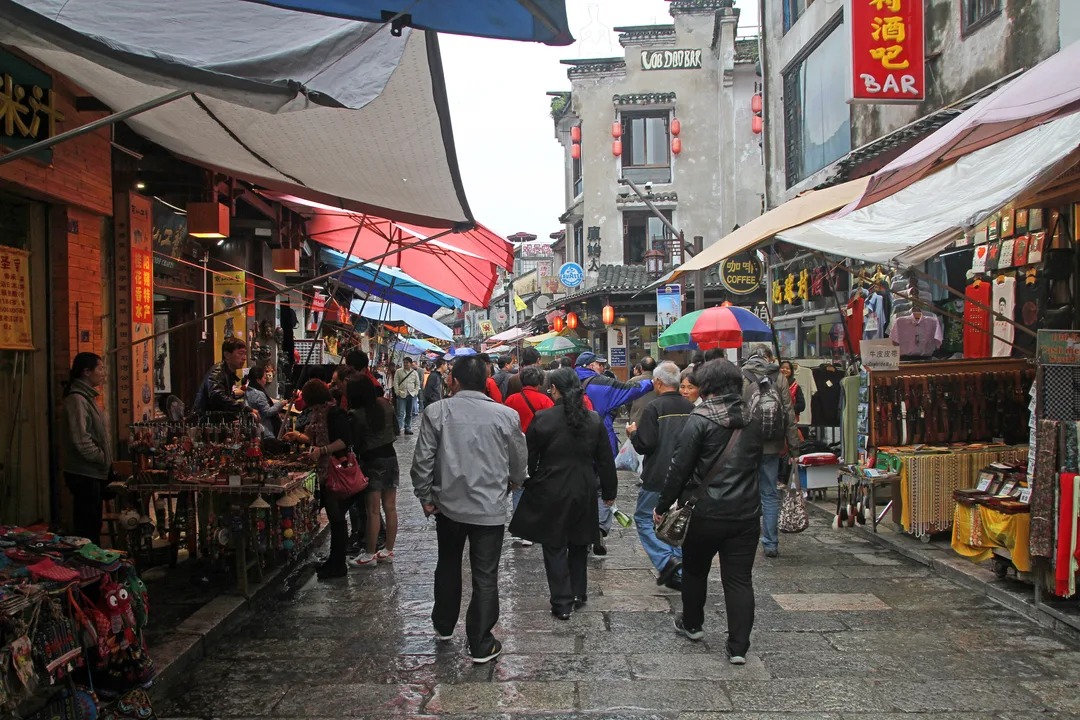
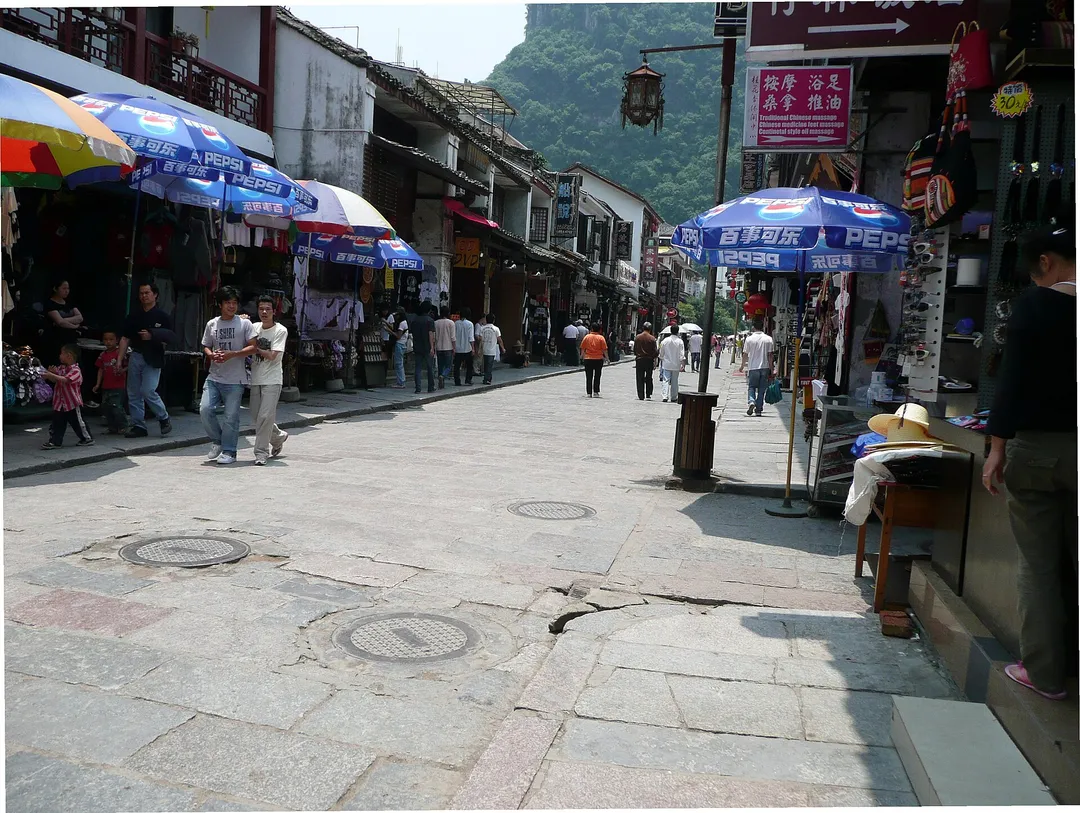
West Street (西街) is Yangshuo's main commercial drag — a 1.5-km stone-paved pedestrian street in the town center that has been a travelers' hub since the 1990s and now draws millions of visitors annually. The street has evolved from a backpacker strip of cheap hostels and noodle shops into a polished tourist destination while retaining much of its original character. By day it is a shopping street; by night it transforms into an open-air bar with live music, lantern light, and crowds that can feel more like a Chinese theme park than a small Guangxi county town. The street is at its best early morning (quiet, local shopkeepers setting up) or late evening (the lights come on and the street buzzes until midnight).
Yangshuo · Visitor Guide2026-10-18
Quick Answer
Is West Street worth visiting?
Yangshuo's 1,400-year-old pedestrian street — 1.5 km of bars, restaurants, shops, and hostels. Free to walk. Open all day, liveliest 18:00–23:00.
Quick facts
| Ticket | Free to walk. Shopping, food, and drink are paid separately. |
|---|---|
| Hours | Shops: 8:00–22:00. Bars: 18:00–02:00. Restaurants: 7:00–23:00. Street at its liveliest 18:00–23:00. |
| Recommended duration | 1–3 hours. Most visitors spend 1–2 hours walking the street in the evening. You can spend a full day eating and shopping your way through at a relaxed pace. |
| Best time to visit | Weekday evenings (19:00–22:00) for atmosphere without crushing crowds. Avoid Chinese holidays (West Street becomes dangerously crowded — the street has been known to temporarily close to new entries during National Week). Early morning (7:00–9:00 AM) for a completely different experience — local breakfast vendors, old men playing chess, no tourists. |
| How to get there | West Street is in the center of Yangshuo town, walking distance from the bus station (5 minutes) and most hotels. From Guilin: bus to Yangshuo Bus Station (¥65, 90 min), then walk or DiDi ¥5 to West Street. From Guilin Airport (Liangjiang): bus to Yangshuo ¥40, 90 minutes. |
| English signage | Yes |
| Wheelchair accessible | Partial |
| Length | 1.5 km (stone-paved pedestrian street) |
| Age | Over 1,400 years old (established in 590 AD during the Sui Dynasty) |
| Annual visitors | ~10 million (as of 2024 estimates) |
| Bars | 200+ bars and pubs along the street |
| Language | English widely spoken — one of the few places in Guangxi where English is common |
| Location | Center of Yangshuo town, walking distance from Yangshuo Bus Station |
What to expect
West Street is mischaracterized by many first-time visitors. The reputation for being "overly touristy" is deserved in part — the street has more massage parlors, "Irish pub" knockoffs, and Exit Incense shops than anyone needs — but it also has some genuinely excellent local restaurants, the best coffee in Guangxi (Rock'n'Coffee, since 2012), a concentration of excellent climbing gyms (Blue Lion, to the irritation of competitors), and a social atmosphere that is genuinely hard to replicate. The trick is to walk past the first 200 meters of the densest tourist trap zone (near the east entrance) and find the restaurants and shops tucked into the side alleys and second-floor spaces that the tour groups never find.
The street was a Silk Road trading post during the Tang and Song dynasties (Sui Dynasty 590 AD establishment). The name "West Street" dates to the Ming Dynasty when foreigners (primarily Arab and Indian traders) lived in the western part of the street, giving it the name that stuck. The current buildings are a mix of late Qing Dynasty (traditional southern Chinese shopfronts with dark wood and curved eaves) and modern tourist-oriented renovation — the original architecture was largely rebuilt in the 1990s tourist boom.
Practical notes: West Street is safe at any hour — the crowds keep petty crime near zero. However, the street gets extremely crowded on Chinese holidays (National Week in particular) — consider visiting at off-hours. The side alleys (especially 桂花路, Osmanthus Lane, and the small lane behind the 工商银行) are quieter and more interesting. The street is fully pedestrianized but bicycles and electric scooters occasionally sneak through.
How to get there
West Street is in central Yangshuo, walking distance from the bus station (5 minutes south on 蟠桃路, Pantao Road). From Guilin: bus to Yangshuo Bus Station (¥65, 90 min), then walk or DiDi ¥5. From Guilin Airport: direct bus to Yangshuo (¥40, 90 min). From the Li River cruise dock in Yangshuo: DiDi ¥10.
Best photo spots
- West Street at night — the illuminated shopfronts and lanterns reflect on the wet stone in rain
- Early morning (7:00–8:00 AM) — empty street with local breakfast vendors and old men playing chess
- East entrance archway (西街入口) — the traditional arch with "West Street" calligraphy, the classic arrival photo
- Side alley (桂花路, Osmanthus Lane) — quieter, traditional atmosphere away from the main crowd
Tips
- Walk past the first crowded section near the east entrance — the best shops, restaurants, and coffee shops are in the middle and west sections of the street
- Go in the morning (7:00–9:00 AM) for a completely different West Street — no tourists, local life only
- Rock'n'Coffee (near the west end) has the best coffee in town and is a good resting point mid-afternoon
- Blue Lion Climbing Gym (蓝狮攀岩) at the west end has day passes for ¥80 and is a good escape from the street
- Bargain on shopping — the first price quoted is always inflated by 2–4x; 30–50% of the asking price is a fair offer
Scams to avoid
- Fake "designer" clothing and bags — West Street is full of counterfeit goods; if the price seems too good to be true, it is fake
- Massage parlor touts — the "99-yuan massage" ads are bait-and-switch; the real price is ¥200+ and the service quality is inconsistent
- Street vendors selling "designer" watches and sunglasses — all counterfeit; do not attempt to bargain thinking you are getting a deal
- "Free" paper umbrella samples that turn into a ¥20 charge — politely decline or check the price before accepting anything
Frequently asked questions
Is West Street worth visiting or is it too touristy?
It is touristy but worth visiting for the atmosphere, food, and people-watching. The key is to go at the right time (early morning or late evening) and to walk past the most crowded entrance section. The street has excellent rice noodles (桂林米粉), good coffee, a concentration of climbing and outdoor gear shops, and a genuinely fun bar scene. It is not an "authentic" Chinese experience, but it is a very good tourist-oriented street with 1,400 years of history behind it.
Can I eat good local food on West Street?
Yes — some of the best. Try 桂林米粉 (Guilin rice noodles) at 老娘私房菜 or 大师傅米粉 (near the west end, ¥8–15 per bowl). Yangshuo beer fish (阳朔啤酒鱼) is a local specialty — 鱼香酒楼 (at the east end) and 佬佬啤酒鱼 are reputable options (¥60–100 per person). The further from the east entrance, the better and cheaper the food.
Is West Street safe at night?
Yes — extremely safe. The crowds persist until midnight and the street is well-lit. Yangshuo has a large police presence on West Street, particularly on weekends. However, as with any busy tourist area, watch for pickpockets in the densest crowds.
How crowded does it get?
Very crowded on Chinese holidays (National Week, Labor Day, Chinese New Year). During National Week the street has been temporarily closed to new entries due to overcrowding. On normal weekends it is busy but walkable. On weekday mornings it can be nearly empty. If you are visiting during a Chinese holiday, go early morning or accept the crowds.
What should I buy on West Street?
Climbing gear (if you are heading to Yangshuo's world-class climbing areas), local minority embroidery (Zhuang and Yao cross-stitch from the Yao women sitting outside), and rice wine (漓泉啤酒 or 桂林三花酒). Do not buy jade, pearls, or "antique" furniture unless you are an expert — the market is flooded with fakes.
Read next
Other things to do in Yangshuo
Daxu Ancient Town
An 800-year-old commercial town on the Li River — the best-preserved ancient town near Guilin, with 4.5 km of Ming and Qing Dynasty architecture. Free to walk. 2–3 hours.
Li River Drift (Dilong Tour)
Bamboo-raft drift down the Li River's most scenic stretch between Yangdi and Xingping, past the famous karst peaks; 200-400 yuan per raft (max 2 people), 2-3 hours.
Elephant Trunk Hill
Guilin's skyline icon — a karst peak with a natural arch resembling an elephant drinking from the Li River. Free to view from the riverside park; ¥100 to enter the scenic zone. 1–2 hours.
Fuliang Yin
A hidden karst valley and underground river system near Yangshuo — cave diving, kayaking, and natural swimming pools in an unspoiled canyon. ¥30. Half to full day.
Guilin Merry Land (Merry Land Theme Park)
Guangxi's largest theme park — 4 themed zones, 100+ rides, a water park, and a golf course on 6.7 km² of manicured grounds. ¥150 (weekday), ¥200 (weekend/holiday). Full day.
Li River
The most famous landscape in China — 83 km of karst peaks rising from emerald water between Guilin and Yangshuo. The 4-hour bamboo-raft or cruise-boat journey is the essential Guilin experience.
Longji Rice Terraces (Dragon's Backbone)
650-year-old rice terraces cascading down mountainsides at 300-1,100 m elevation - Zhuang and Yao minority villages, sunrise over flooded paddies. ¥80. 2 hours from Guilin. Half to full day.
Reed Flute Cave
A 240-million-year-old limestone cave system with the world's largest collection of illuminated stalactites and stalagmites. ¥90–120. Audio guide essential. 1–1.5 hours.
Seven Star Park
Guilin's largest urban park — 137 hectares with seven karst peaks, a ancient rock art site, a zoo, and the Guilin Civilization Museum. Free/¥55. 2–3 hours.
Yao Mountain
Guilin's highest peak within city limits at 909 m — panoramic karst views, the largest Buddha statue in Guangxi, and a cable car to the summit. ¥60 (park), ¥80 (cable car). Half day.