Green Lake Park翠湖公园
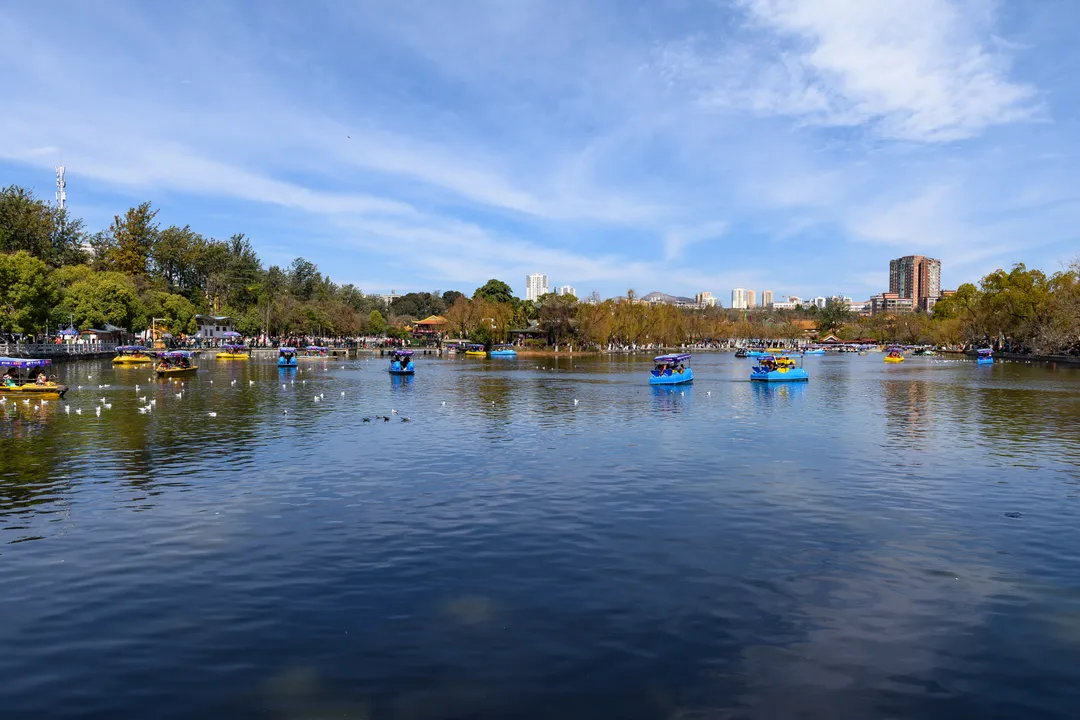
Green Lake Park (Cuihu) is the social centre of Kunming — a free public park of willow-lined causeways, stone bridges, tea houses, and pavilions built around a lake in the Wuhua District. It matters less as a 'sight' than as the place where the city actually lives: morning tai chi, water calligraphy on the paving stones, and, from November to March, tens of thousands of red-beaked black-headed gulls that fly in from Siberia. For most travellers it is a relaxed hour between Yuantong Temple and the old street, not a destination in itself.
Kunming · Visitor Guide2026-10-27
Quick Answer
Is Green Lake Park worth visiting?
Kunming's free city-centre lake park, famous for the ~3,000 km migration of black-headed gulls from Siberia each November–March (a phenomenon dating to 1985).
Quick facts
| Ticket | Free — no admission fee (as of 2026) |
|---|---|
| Hours | Open daily, roughly 06:00–24:00 as a free public park (verify exact hours; some tea houses close earlier) |
| Recommended duration | 1–2 hours (about 1 hour for a lake circuit; 2 hours if you stop for tea) |
| Best time to visit | November–March for the Siberian gulls; mornings 07:30–09:00 year-round for tai chi, opera singers, and water calligraphers |
| How to get there | Metro Line 3 to Huashan West Road or Panjiawan station (5–8 min walk, verify exits); DiDi from the airport ¥80–120/40–60 min, from Kunming South ¥60–80/40 min; metered taxi flag ¥8 first 3 km. |
| English signage | Partial |
| Wheelchair accessible | Partial |
| Ticket | Free — no admission (as of 2026) |
| Established | Public park since the 1950s; pavilions date to the Qing dynasty, Daoguang era (c. 1820s–30s) (verify) |
| Size | approx. 21 hectares, about 15 ha of water (verify) |
| Gulls | Black-headed gulls migrate ~3,000 km from Siberia; arrive November, depart March; phenomenon since 1985 |
| Best time | 07:30–09:00 for morning activity; November–March for the gulls |
| District | Wuhua District, central Kunming |
What to expect
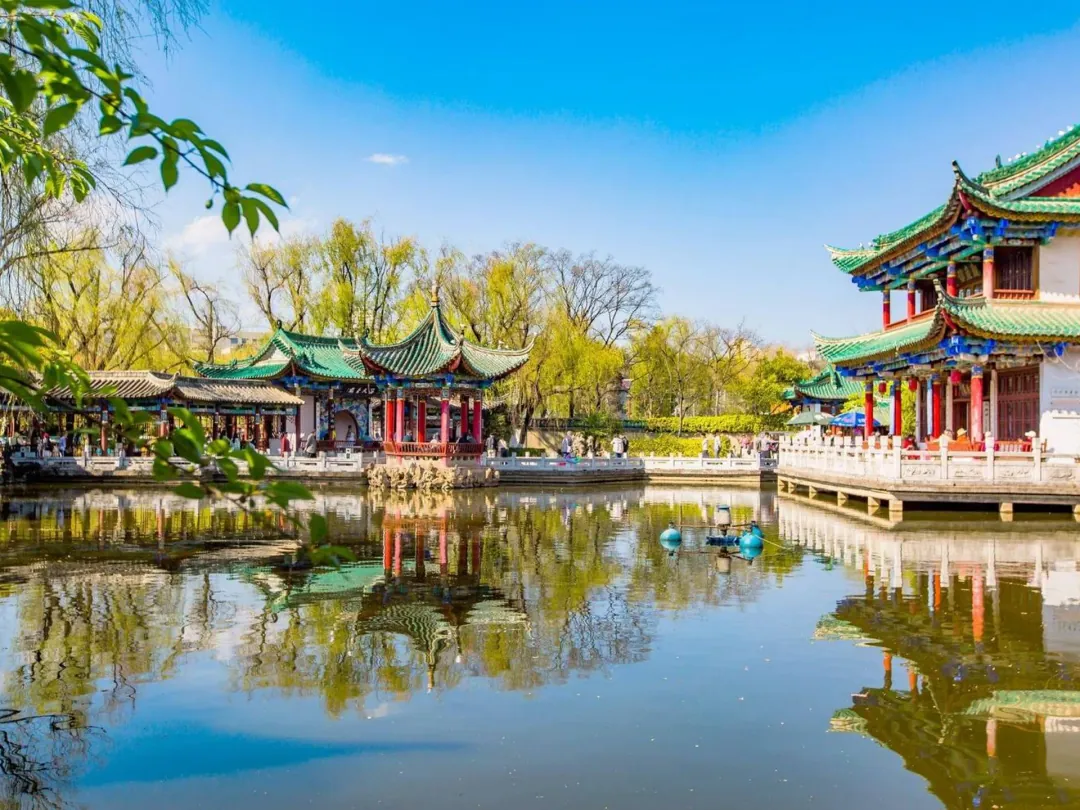
Green Lake is really four small lakes stitched together by arched stone bridges and willow-shaded causeways, with pavilions and tea houses at the junctions. There is no grand entrance or ticket gate — you walk in off Cuihu South Road and you are on the water. Mornings are the show: clusters of retirees do tai chi and sword forms, opera singers rehearse under the trees, and calligraphers paint giant characters on the paving stones with water brushes that evaporate by midday. The lotus pond on the south side blooms through summer; the bamboo grove near the east gate is the quietest corner. Plan a slow loop of about an hour, or two if you stop for tea.
The lake predates the park by centuries — it was a reservoir and scenic water body on the edge of the old Ming city grid, later ornamented in the Qing dynasty when officials such as Ruan Yuan added pavilions and gardens in the 1820s–30s. It became a formal public park in the 1950s. But the park's modern identity was sealed in 1985, when a small flock of black-headed gulls (红嘴鸥, hóng zuǐ ōu) turned up from Siberia for the winter and came back in larger numbers every year after. The flock now runs into the tens of thousands, and the gulls have become Kunming's unofficial winter mascot — locals buy gull food (鸥粮, ōu liáng) and bread from park stalls and the birds will snatch it mid-air.
Most guidebooks send you here in winter for the gulls, and they are right, but they send you at 10 or 11am, which is the worst time — that is when the feeding scrum is loudest and the paths are choked with selfie sticks. Go at 07:30 instead: the gulls are just as active and hungry, the light is better, and you share the park with tai chi groups and water calligraphers rather than tour buses. A second contrarian note: if you are here in summer, drop the gull narrative entirely — the lake can look a little green with algae in July and August — and come for the lotus bloom and the morning opera singers, who are the actual reason locals love this park. It is free, it is central, and it is the easiest 'real Kunming' experience in the city.
How to get there
Green Lake sits in Wuhua District, central Kunming, with no single ticketed gate — you can walk in from Cuihu South, East, West, or North Road. By metro, take Line 3 (the line that serves the city centre); the closest stations are Huashan West Road (华山西路) and Panjiawan (潘家湾), each roughly a 5–8 minute walk to the lake (verify exact exits locally — station signage is bilingual). From Kunming Changshui Airport, Metro Line 6 to the city centre takes about 30 minutes (¥8), then transfer to Line 3; a DiDi or metered taxi from the airport to Green Lake runs ¥80–120 and 40–60 minutes. From Kunming South HSR Station, a DiDi to Green Lake is ¥60–80 and around 40 minutes; from the older Kunming Station it is only ~¥20–30 and about 15 minutes. Metered taxis flag at ¥8 for the first 3 km. Shared bikes (Meituan Bike, HelloRide via Alipay, ~¥1.5 per 30 min) are ideal for the flat streets around the lake. Several city buses stop at the Cuihu (翠湖) stops, but English route information is scarce — use the metro or DiDi unless you read Chinese.
Best photo spots
- The arched stone bridge on the east causeway at 07:30–08:00, with gulls wheeling against low morning light.
- Water calligraphers painting characters on the paving stones near the south gate — shoot from the side, not overhead.
- The lotus pond (south lake) in July–August, early morning before the wind picks up.
- The willow-framed view across the central lake from the Yuebo (月波楼) pavilion area at dusk.
Tips
- Arrive 07:30–09:00 — the gulls are active, tai chi is out, and tour groups have not arrived. By 11:00 the feeding area is a scrum.
- It is free with no gate, so there is no 'last entry' to race. Combine it with Yuantong Temple (15 min walk east) and the Flower-and-Bird Market for a free morning loop.
- If you want to feed the gulls, buy gull food (鸥粮, ōu liáng) from park stalls (~¥5–10) rather than bread — it is what the birds actually need and what locals use.
- Skip the park during the first week of May and first week of October (national holidays) — wall-to-wall domestic tourists ruin even the gull experience in season.
- Do not plan lunch inside the park. The tea houses are pleasant for a pot of tea (¥30–60) but food is tourist-priced; walk 10 minutes to Nanping Street or the Muslim Quarter for a real meal.
Scams to avoid
- Gull-food sellers near the gates sometimes quote inflated prices to tourists (¥20+ for a small bag). The going rate is about ¥5–10; confirm the price before paying, or use Alipay/WeChat so the amount is visible on screen.
- Photo-tout pressure: people in 'traditional' costume offering to pose with you for a picture, then demanding ¥20–50. Decline firmly and walk on — this is more common on the adjacent tourist strips than inside the park itself.
- Taxi drivers at the airport or station quoting a flat ¥200+ to 'Green Lake' instead of using the meter. Insist on the meter (should be ¥80–120 from the airport) or just book a DiDi, where the fare is fixed upfront.
Frequently asked questions
Is Green Lake Park free to enter?
Yes. Green Lake is a free public park with no admission fee and no ticketed gate (as of 2026). You can walk in from any side — Cuihu South, East, West, or North Road.
When can I see the seagulls at Green Lake?
The black-headed gulls arrive from Siberia (a roughly 3,000 km flight) in November and stay until March. They are present daily and most active in the morning, 07:30–09:00. The migration has happened every winter since 1985 and the flock now runs into the tens of thousands.
How do I get to Green Lake Park by metro?
Take Kunming Metro Line 3; the closest stations are Huashan West Road (华山西路) and Panjiawan (潘家湾), each about a 5–8 minute walk to the lake (verify exact exits locally — signage is bilingual). Fares are ¥2–7.
How much time should I spend at Green Lake?
About 1–2 hours. A leisurely circuit of the lake takes roughly an hour; add another 30–60 minutes if you stop for tea at a lakeside tea house.
What is the best time of day to visit?
Early morning, 07:30–09:00. The gulls (in winter) are most active then, the tai chi and water-calligraphy practitioners are out, and the light is best. By late morning the park fills with tour groups and the feeding area gets loud.
Can I feed the gulls?
Yes, and it is the main winter activity. Buy gull food (鸥粮, ōu liáng) from park stalls for about ¥5–10 rather than bread — it is what the birds are used to and better for them. The birds are bold and will snatch food from the air or your hand.
Is Green Lake Park wheelchair accessible?
Partially. The main causeways around the lake are flat and paved, but some pavilions and the smaller stone bridges have steps. Wheelchair users can do most of the lake circuit; bring someone to help with the occasional step.
Are there places to eat or drink inside the park?
There are tea houses where you can get a pot of tea (roughly ¥30–60). Food options are limited and tourist-priced, so most visitors eat outside the park — Nanping Street and the Muslim Quarter are about a 10-minute walk away.
Is Green Lake worth visiting in summer when there are no gulls?
Yes, with adjusted expectations. Summer brings the lotus bloom (June–August) on the south pond, and the morning opera singers and calligraphers are still out. Note the lake can look green with algae in peak rainy season (July–August); early mornings are still pleasant.
How far is Green Lake from Yuantong Temple and the old street?
Yuantong Temple is about a 15-minute walk east of the lake. The Flower-and-Bird Market and Kunming Old Street (Nanping Street area) are roughly 10 minutes south on foot. All three pair easily into a free half-day walking loop.
Read next
Other things to do in Kunming
Dianchi Lake
Kunming's 300-sq-km lake on its southern edge — the largest in Yunnan and the 8th biggest freshwater lake in China. Haigeng Park on the northeast shore is free and the best viewpoint.
Shilin Stone Forest
270-million-year-old limestone karst formations — UNESCO South China Karst. 90 km from Kunming. ¥175 entry. 3–4 hours walking. Maze-like paths through towering grey pinnacles.
Western Hills and Dragon Gate
Taoist grottoes, tunnels, and clifftop pavilions hand-carved into a 2,500-metre ridge above Dianchi Lake — 72 years of chiselling that began in 1781.
Museums in Kunming
Kunming City Museum
Dian Kingdom bronzes from 2,000 years ago — a lost civilization discovered in the 1950s. Cowrie shell containers with intricate battle and ritual scenes. Free.
Kunming Natural History Museum
Home of the Chengjiang Cambrian fossils — 518-million-year-old creatures preserved in exquisite detail. The Cambrian explosion in shale. Free. A pilgrimage site for paleontology enthusiasts.
Yunnan National Museum
Note: this slug is an alias for the Yunnan Provincial Museum in Kunming; see the yunnan-provincial-museum entry for full details, verified in 2026.
Yunnan Nationalities Museum
Kunming's museum of Yunnan's 25 ethnic minorities — costumes, religious art and village reconstructions across four floors. Free with ID; allow 2 hours, mornings are quietest.
Yunnan Provincial Museum
China's most ethnically diverse museum - covering 25 ethnic minorities across Yunnan province, plus the famous Dianchi culture (2,000-year-old bronze drums and the "King of Dian" copper cof.