Kunming · science museum
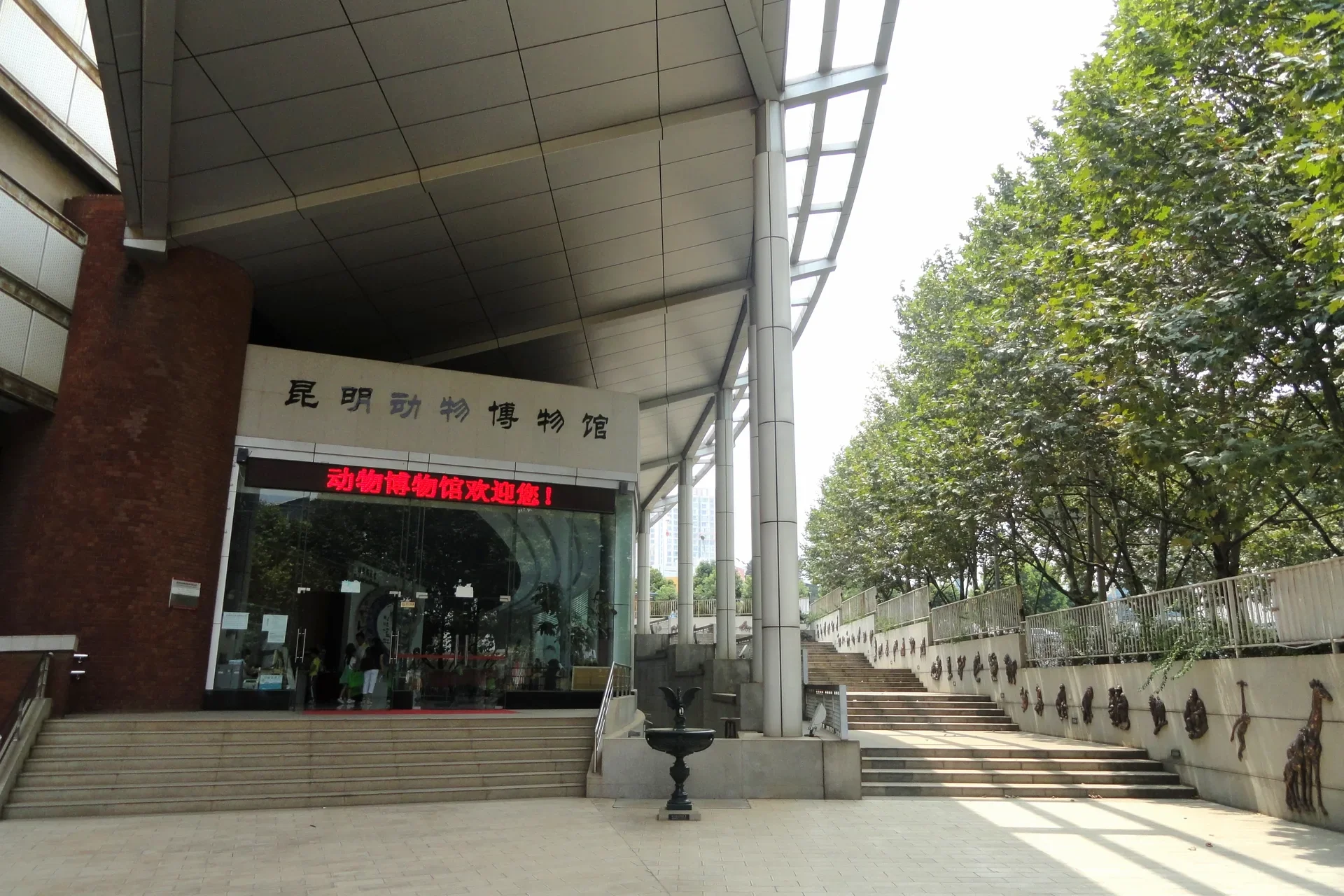
Kunming Natural History Museum (昆明动物博物馆, Kūnmíng Dòngwù Bówùguǎn)
"'The Kunming Natural History Museum (formally the Kunming Zoology Museum of the Chinese Academy of Sciences) is the primary exhibition venue for the Chengjiang Biota (澄江生物群) — one of the most important fossil deposits ever discovered. The Chengjiang site in Yunnan Province preserves Cambrian-era organisms from 518 million years ago in extraordinary detail: soft-bodied creatures including the earliest known vertebrates (Myllokunmingia), the bizarre five-eyed Opabinia-like predator Anomalocaris, and hundreds of species that represent the \"Cambrian explosion\" — the sudden appearance of nearly all modern animal body plans in the fossil record. The museum displays hundreds of these fossils on split shale slabs, each one revealing a creature that lived half a billion years ago with tentacles, eyes, guts, and nerve cords preserved in pinkish-brown against gray stone. The Chengjiang site was designated a UNESCO World Heritage Site in 2012.'.".
Last updated:
Quick Answer
Is Kunming Natural History Museum worth visiting?
"Home of the Chengjiang Cambrian fossils — 518-million-year-old creatures preserved in exquisite detail. The Cambrian explosion in shale. Free. A pilgrimage site for paleontology enthusiasts.".
Quick facts
| Category | science |
|---|---|
| Ticket | Free. Passport required. Register at the entrance — reservations not typically needed. |
| Hours | 9:00-17:00 (last entry 16:30). Closed Mondays. |
| Recommended duration | 1.5-2 hours. |
| Best time to visit | Weekday mornings. The museum is rarely crowded — it is a specialist institution that does not attract large tour groups. Kunming's year-round spring climate makes any season pleasant. |
| How to get there | Metro Line 2 to Dongfeng Square (东风广场), Exit H. Walk north 10 minutes on Qingnian Road to the museum. Or bus routes 1, 3, 4, 59, 63, 91, 129, A2 to Kunming Natural History Museum stop. DiDi from central Kunming costs ¥12-20. |
| English signage | partial |
Why visit
Standing in front of a 518-million-year-old fossil of the earliest known fish — smaller than your thumb, with a notochord, gill slits, and muscle bands clearly visible — is one of the most profound experiences in any natural history museum. This is a direct window into the moment when our own vertebrate lineage first appeared on Earth.
Collection highlights
- Myllokunmingia Fossil — the earliest known vertebrate (518 million years old), a 2.8 cm fish-like creature with a notochord, gill slits, segmented muscle blocks (myomeres), and possible heart impressions. This fossil is one of the most important in the history of paleontology
- Anomalocaris — the largest Cambrian predator (up to 1 m), with stalked compound eyes, a circular mouth of serrated plates, and two grasping frontal appendages. The museum has several complete specimens
- Hallucigenia — a bizarre worm-like creature with seven pairs of stilt-like legs and two rows of dorsal spines, so strange that when it was first described the animal was reconstructed upside-down
- Chengjiang Arthropod Diversity — hundreds of species of early arthropods (trilobites, bivalved forms, and types with no living relatives) on split shale slabs
- Cambrian Sponges and Cnidarians — the ancestors of modern jellyfish, corals, and sponges, exquisitely preserved in soft tissue detail
- Modern Yunnan Biodiversity Gallery — specimens of Yunnan's extraordinary living biodiversity (Yunnan holds 50% of China's plant and animal species) including Yunnan snub-nosed monkeys, clouded leopards, and tropical birds
Tips
- The Chengjiang fossil hall is on the 3rd floor — go directly there. The fossils are small (many 2-10 cm) and displayed flat in glass cases — bring reading glasses and be prepared to lean in close
- The English signage in the Chengjiang hall is improving but inconsistent — the museum provides a free English booklet (ask at the information desk) that describes the key fossils in detail
- I found myself entirely alone in the Cambrian fossil hall on a Tuesday afternoon in June 2026 — this museum is dramatically under-visited relative to its scientific importance
- The museum is run by the Chinese Academy of Sciences (CAS) and feels more like a research institution than a tourist attraction — the scientific rigor is high, but the presentation is less polished than Shanghai's natural history museum
- Combine with a visit to the Yunnan Provincial Museum (云南博物馆, 8 km south in the new Guandu district) for the broader history of Yunnan
- Kunming's elevation (1,890 m) and subtropical latitude produce a year-round spring climate — the museum is comfortable without heating or heavy air conditioning
Frequently asked questions
What is the Chengjiang Biota and why is it important?
The Chengjiang Biota is a fossil deposit near Kunming, Yunnan, preserving Cambrian-era organisms from 518 million years ago. It is one of the most important fossil sites on Earth because it preserves soft-bodied creatures — not just hard shells and bones, but eyes, guts, nerve cords, muscles, and gills. It documents the "Cambrian explosion," the geologically sudden appearance of nearly all major animal body plans in a ~20-million-year window. The Chengjiang fossils include the earliest known vertebrates (our own ancestors), making it a site of unparalleled importance for understanding the origin of animal life.
Can I visit the actual Chengjiang fossil site?
The Maotianshan Shale site near Chengjiang (澄江, 70 km south of Kunming) is a protected UNESCO World Heritage Site. The original excavation pit (Maotianshan, 帽天山) has limited public access — you need to arrange a permit in advance through the museum or a registered tour. Most visitors see the fossils at the museum rather than visiting the site itself. The museum's display is comprehensive and accessible.
How does the Kunming museum compare to the Shanghai Natural History Museum?
The Shanghai museum is a world-class general natural history museum with impressive architecture, interactive exhibits, and broad coverage of the history of life. The Kunming museum is smaller, less polished, and more specialized — its Chengjiang fossil collection is globally significant in a way that no other Chinese museum can match. For paleontology enthusiasts, Kunming is the essential destination; for families seeking an entertaining museum day, Shanghai is the better choice.
What is the earliest known vertebrate?
Myllokunmingia fengjiaoa, a tiny (2.8 cm) fish-like creature from the Chengjiang Biota, 518 million years old, is among the earliest known vertebrates. It has a notochord (the precursor to a spinal column), gill slits, and segmented muscle blocks that indicate it swam actively. Its discovery in 1999 pushed back the known origin of vertebrates significantly and made the Chengjiang site famous worldwide.
Does the Kunming museum have dinosaur fossils?
No — the Chengjiang fossils are from the Cambrian Period (518 million years ago), which predates dinosaurs by over 300 million years. The museum focuses on the Cambrian explosion and modern Yunnan biodiversity. For dinosaur fossils in Yunnan, visit the Lufeng Dinosaur Museum (禄丰恐龙博物馆, 100 km west of Kunming), which has hundreds of Jurassic dinosaur skeletons.
What else should I see in Kunming?
The Yunnan Provincial Museum (云南博物馆, modern building opened 2015, excellent coverage of Yunnan's multi-ethnic history), the Green Lake Park (翠湖公园, Kunming's central park with tea houses and birdwatching), the Yuantong Temple (圆通寺, 1,200-year-old Buddhist temple), and the Stone Forest (石林, 90 km east, UNESCO World Heritage karst formations). Kunming is also the jumping-off point for Dali, Lijiang, and Xishuangbanna.
Read next
Other things to do in Kunming
Dianchi Lake
Kunming's 300-sq-km lake on its southern edge — the largest in Yunnan and the 8th biggest freshwater lake in China. Haigeng Park on the northeast shore is free and the best viewpoint.…
Green Lake Park
Kunming's free city-centre lake park, famous for the ~3,000 km migration of black-headed gulls from Siberia each November–March (a phenomenon dating to 1985).…
Shilin Stone Forest
"270-million-year-old limestone karst formations — UNESCO South China Karst. 90 km from Kunming. ¥175 entry. 3–4 hours walking. Maze-like paths through towering grey pinnacles.".
Stone Forest
"\"A 270-million-year-old karst limestone formation stretching 400 km² near Kunming, with towering stone pillars that resemble a petrified forest. UNESCO World Heritage Site. ¥130–175.…\".".
Western Hills and Dragon Gate
Taoist grottoes, tunnels, and clifftop pavilions hand-carved into a 2,500-metre ridge above Dianchi Lake — 72 years of chiselling that began in 1781.…
Museums in Kunming
Kunming City Museum
"Dian Kingdom bronzes from 2,000 years ago — a lost civilization discovered in the 1950s. Cowrie shell containers with intricate battle and ritual scenes. Free.".
Yunnan National Museum
"'Note: This is an alternative slug for the Yunnan Provincial Museum (云南省博物馆). See the yunnan-provincial-museum entry for full details.'.".. 2026 verified.
Yunnan Nationalities Museum
yunnan-nationalities-museum in Kunming: "China's largest ethnic minority museum — 25 cultures under one roof with handwoven textiles, silver headdresses, and live craft demonstrations, free and un...