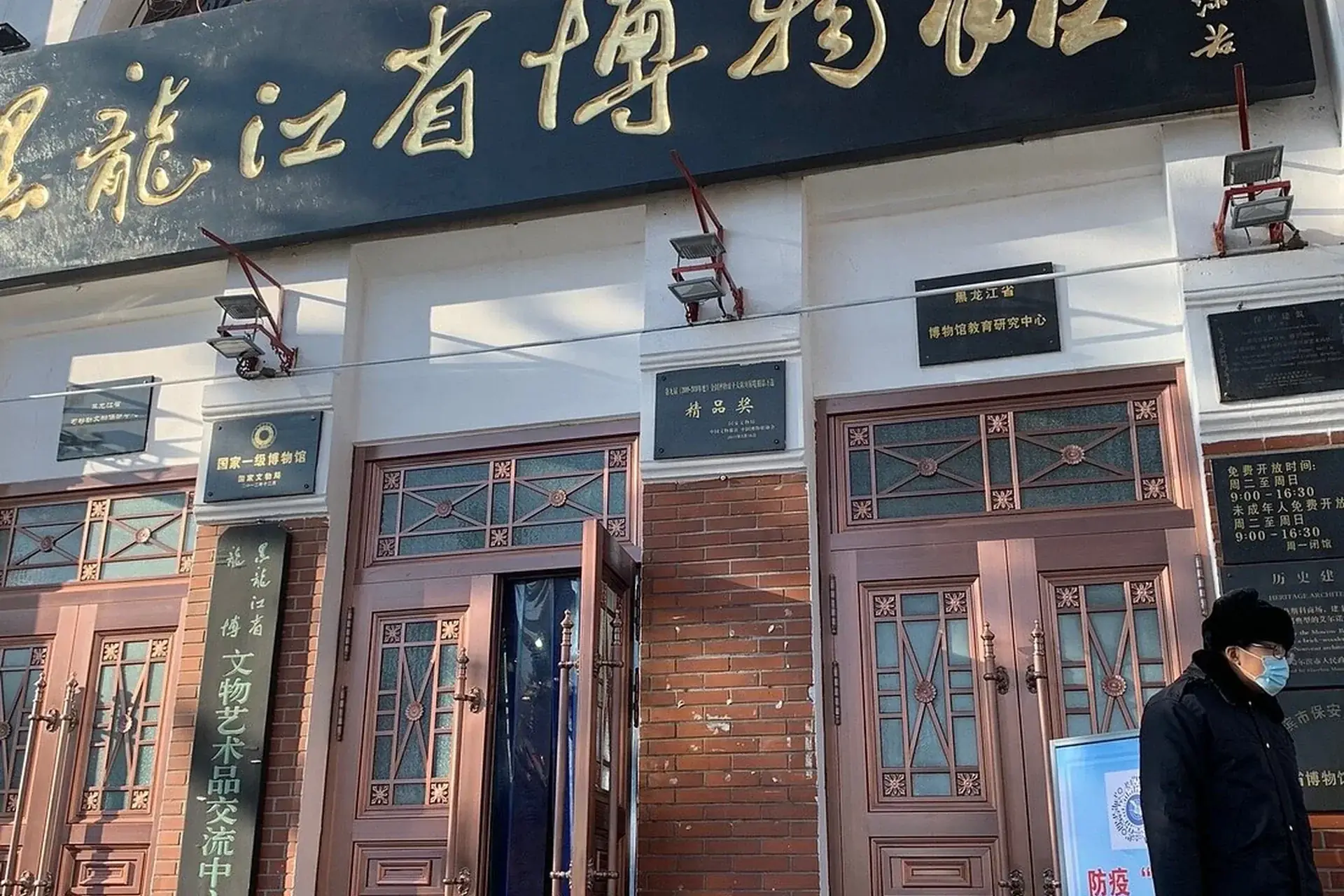
Heilongjiang Provincial Museum
The Heilongjiang Provincial Museum (黑龙江省博物馆) is located in Harbin's central Daoli District and is the principal museum for China's northernmost province. Heilongjiang (黑龍江, Amur River) borders Russia to the east and north, giving the province a unique multicultural history shaped by Manchu, Hezhe (also called Manchu Hezhe), Russian, and Japanese cultures. The museum's collections span: (1) the Hezhe (赫哲) and Manchu minority cultures — fish-skin clothing, boat building, and shamanic objects from the indigenous peoples of the Amur basin; (2) the Russian colonial and Japanese occupation period — documents, photographs, and objects from Harbin's extraordinary 1900-1945 period as a Russian-built treaty port; (3) the "Heilongjiang Man" archaeology — stone tools and hominid fossils from the famous 32,000-year-old "Heilongjiang Man" site; (4) the Daqing Oil Fields geology — objects documenting the discovery and development of China's largest oil field.
Harbin · history museum2026-10-18
Quick Answer
Is Heilongjiang Provincial Museum worth visiting?
Northeast China's northernmost provincial museum — documenting the Amur river frontier, Manchu culture, and the Russian border trade. Free with passport; 1.5–2.5 hours.
Quick facts
| Category | history |
|---|---|
| Ticket | Free. Passport required. Walk-in from the south entrance. |
| Hours | 9:00-16:00 (last entry 15:00). Closed Mondays. |
| Recommended duration | 1.5-2.5 hours. |
| Best time to visit | January-February (Harbin International Ice and Snow Sculpture Festival — the museum is near the famous ice sculpture festival venue). Harbin has extreme winters (-25°C to -10°C in January) and warm summers (20-30°C in July-August). The ice festival (January 5-February) is impressive but the museum itself is fully heated. |
| How to get there | Metro Line 2 to Zhongyang Dadao Station (中央大街站), Exit 3, then walk 10 minutes. Bus routes 2, 8, 13, 15, 20, 42, 64, 74, 91, 101, 102, 118 to Heilongjiang Museum stop. From Harbin Railway Station by foot: 15 minutes. From Harbin Taiping International Airport: ¥50-70 by DiDi. |
| English signage | Partial |
Why visit
Harbin's Russian and Japanese colonial history is unique in China — no other Chinese city has a comparable European colonial architectural legacy. The museum's documentation of Harbin's 1900-1945 period as a Russian railway hub, including the Chinese Eastern Railway era, is the essential context for understanding why Harbin looks the way it does today.
Collection highlights
- Hezhe fish-skin clothing collection — the complete traditional clothing made from salmon and sturgeon skin worn by the Hezhe (Manchu Hezhe) people of the Amur River basin, an extremely rare and endangered craft tradition
- Harbin Russian colonial period archive — photographs, architectural drawings, and documents from Harbin's period as a Russian railway city (1898-1945)
- "Heilongjiang Man" archaeology — 32,000-year-old stone tools and hominid fossils from the famous Heilongjiang Man archaeological site, some of the oldest human artifacts in Northeast China
- Manchu shamanic ritual objects — drums, costumes, and implements used in Manchu shamanic ceremonies in the Amur River region
- Daqing Oil Fields geological specimens — core samples, fossils, and documentation of China's largest oil field discovery in 1959
- Japanese occupation period objects — documents, photographs, and personal objects from Harbin's period as the capital of Japanese-occupied Manchukuo (1932-1945)
Tips
- The Harbin International Ice and Snow Sculpture Festival (January 5-February) is one of the world's great winter spectacles — combine the museum with the festival at Sun Island (太阳岛) and the Ice and Snow World (冰雪大世界)
- Harbin's Central Street (中央大街, 1km from the museum) is the main tourist street — filled with Russian-influenced architecture, ice lanterns, and food stalls in winter
- The museum is a 15-minute walk from Harbin Railway Station — the most convenient location in the city
- The Russian colonial section is the most distinctive — prioritize it
- Harbin is a major Russian Orthodox religious heritage site — combine with the Saint Sophia Cathedral (圣索菲亚教堂) which is on the way to Central Street
Frequently asked questions
What was Harbin's Russian colonial period?
Harbin was essentially built by Russians. In 1898, the Russian Empire began constructing the Chinese Eastern Railway (中东铁路) connecting the Trans-Siberian Railway to Vladivostok, using Harbin as the administrative center. By 1903, Harbin had 40,000 Russian residents and a full European-style urban plan. Russian engineers, merchants, and aristocrats built the city's central architecture. After the 1917 Russian Revolution, many White Russians fled to Harbin, further deepening the Russian influence. Japanese occupation from 1932-1945 added another layer.
Who are the Hezhe people?
The Hezhe (赫哲族), also called the Manchu Hezhe, are an indigenous minority of Heilongjiang province living along the Amur (Heilongjiang) and Songhua rivers. With a population of only about 5,000, they are one of China's smallest recognized ethnic groups. They traditionally lived by fishing and fish-skin clothing production. Their fish-skin clothing technique (鱼皮衣) is unique in the world and the Heilongjiang Museum has the most important collection.
Is Harbin's ice festival worth visiting?
Unquestionably. The Harbin International Ice and Snow Sculpture Festival (哈尔滨国际冰雪节, January 5-February) is the largest ice sculpture event in the world. The Ice and Snow World (冰雪大世界) venue has enormous illuminated ice sculptures that must be seen to be believed. Combine with Sun Island (太阳岛) snow sculpture park in the daytime and Central Street ice lanterns at night.
Does Heilongjiang Museum have English signage?
Partial — the Russian colonial and Hezhe cultural sections have some English. The archaeology and Japanese occupation sections are mostly Chinese-only. No English audio guide as of 2026.
How does this museum compare to the Jilin Provincial Museum?
Liaoning Museum is the strongest for ancient Liao Dynasty Buddhist art. Jilin Provincial Museum in Changchun focuses more on the Korean ethnic minority culture and Japanese occupation history (Changchun was the capital of Manchukuo). Heilongjiang Museum is most distinctive for the Hezhe/Manchu indigenous culture and the Russian colonial period.
Read next
Other things to do in Harbin
Central Street
Century-old Russian-style pedestrian street in Harbin, 1450 m long, built in 1898 with 71 historic buildings; free to stroll, shops 10:00-22:00, best in winter for ice sculptures.
Harbin International Ice and Snow Festival
The world's largest ice and snow art festival — open from January 5 to late February, best over 2-4 days, drawing tens of millions of visitors.
Harbin Polar Park
China's first polar aquarium, opened in 2005; adults CNY 160. The original beluga show, Ocean Love, runs about 15-20 minutes and is genuinely moving. Allow 2-3 hours.
Harbin Ice and Snow World
The world's largest ice-and-snow theme park in Harbin, founded in 1999 using 120,000+ cubic metres of ice each winter; tickets 298-499 yuan, open 11:00-22:00, mid-December to mid-February.
Saint Sophia Cathedral
Harbin's largest Orthodox church, completed in 1907 with a dome 53.35 m high; entry 20 yuan, students 10 yuan, open 8:30-17:00, a 5-minute walk from Shangzhi Dajie metro station.
Songhua River
The Songhua River, Harbin's mother waterway, runs 1927 km with about 70 km through the city; free riverside, boat rides 60-120 yuan, ice over 1 m thick in winter.
Harbin Railway Station
A living relic of the Chinese Eastern Railway, built in 1899 in Art Nouveau style — about 70,000 sq m, 8 platforms, 14 tracks and some 100,000 daily passengers. Free and open around the clock.