nihaovisit

Lhasa · Visitor Guide

Sera Monastery (色拉寺, Sèlā Sì)

One of the three great Gelug-school university monasteries around Lhasa (alongside Drepung and Ganden), Sera was founded in 1419 and at its peak housed over 5,000 monks studying Buddhist philosophy across three colleges. What makes it the most visited of the three today is the daily afternoon monk debate — a physical, theatrical dialectic exercise you can watch from the sidelines. It is a working monastery, not a museum, and the debates are a genuine training practice rather than a performance staged for tourists.

Last updated:

Sera Monastery travel photo

Quick Answer

Is Sera Monastery worth visiting?

Sera Monastery (色拉寺, Sèlā Sì) is one of the three great Gelug-school monasteries of Lhasa, founded in 1419 by Jamchen Chojey, a disciple of Tsongkhapa. The reason most visitors come is the monk debate (辩经), held Monday to Saturday from 15:00 to 17:00 in the debate courtyard — ¥50 entry (as of 2026), allow 2–3 hours including the chapels.

Quick facts

Ticket¥50 (as of June 2026). For foreign visitors this is arranged as part of your Tibet tour package through a registered agency — you cannot buy a ticket independently because the Tibet Travel Permit (入藏函) is required to enter the Tibet Autonomous Region. Photography of the debates is permitted (no flash); photography inside chapels is usually prohibited.
HoursMonastery grounds roughly 9:00–17:00 daily. The monk debates run Monday to Saturday, 15:00–17:00 (no debate on Sundays or during certain religious holidays — confirm with your guide). Arrive by 14:30 to claim a spot in the courtyard before debates start.
Recommended duration2–3 hours. About 60–90 minutes for the chapels and assembly halls, plus 90–120 minutes for the debate session (you can leave early). Combine with Drepung Monastery for a full monastery day.
Best time to visitAfternoon, timed around the 15:00 debate — that is the whole reason to come. March–October has the best weather; winters (November–February) are cold but uncrowded and the light on the whitewashed walls is sharp. Avoid Sundays — no debate. During Losar (Tibetan New Year, Feb/Mar) a giant thangka is unfurled here, but foreigner access is often restricted; confirm with your operator.
How to get thereDiDi or taxi: ¥20–35, 15–20 minutes from central Lhasa (Barkhor/Potala area). City buses run (routes change often — ask your hotel; fare about ¥2). No metro in Lhasa. Most tour packages include a driver. Sera pairs well with Drepung Monastery for a half-day loop north of the city.
English signagepartial
Wheelchair accessiblepartial
Founded1419, by Jamchen Chojey (Sakya Yeshe), a disciple of Tsongkhapa
SizeThree colleges (Sera Mey, Sera Jey, Ngagpa); over 5,000 monks at peak, a few hundred today
UNESCONot separately inscribed — the Potala/Jokhang/Norbulingka ensemble (1994) does not include Sera
Best timeAfternoon, for the 15:00 monk debate (Mon–Sat)
Ticket¥50 (as of June 2026)

What to expect

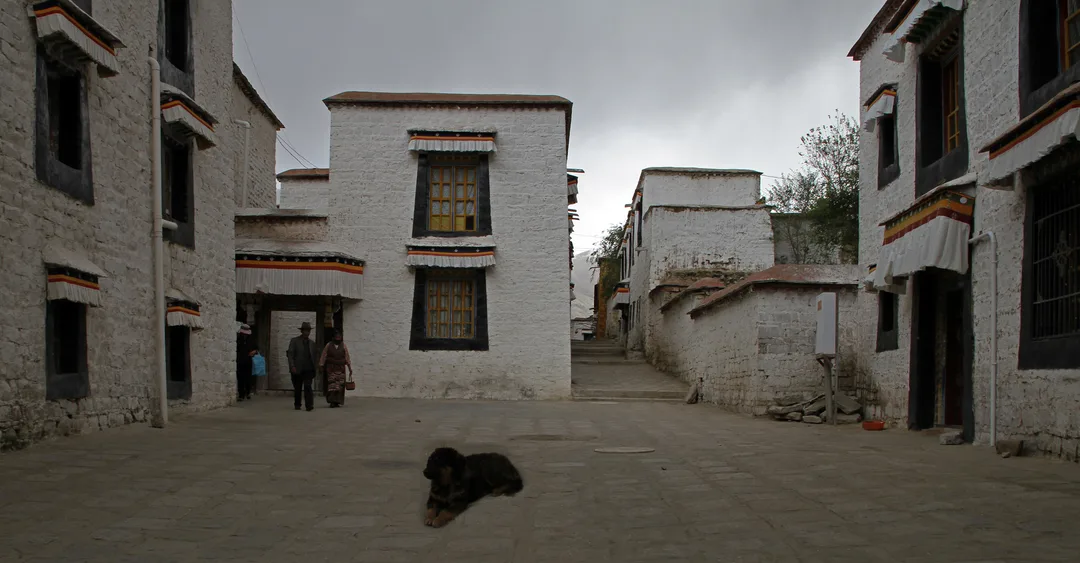
You enter through a gate at the foot of Tatipu hill and walk up a pilgrim path past whitewashed walls, prayer wheels, and juniper smoke. The complex holds three colleges — Sera Mey, Sera Jey, and Ngagpa — plus several assembly halls, including the Tshomchen with its Maitreya statue. Most visitors skip the deeper college halls and head straight for the debate courtyard, a walled open space where, from 3 PM, monks pair off: one stands and claps loudly as he puts a question, the other sits and answers. It is loud, physical, and genuinely part of their training. You watch from the edges and the monks ignore you. Plan about 90 minutes for the chapels first, then the debates.

Founded in 1419 by Jamchen Chojey (Sakya Yeshe), a leading disciple of Tsongkhapa, Sera became one of the three great Gelug-school university monasteries of the Lhasa region, alongside Drepung and Ganden. The name Sera is usually glossed as wild rose, from the roses that grew on the hillside, though some sources tie it to hailstones (ser) said to have fallen at the founding. At its height the monastery housed over 5,000 monks across three colleges training in logic, philosophy, and tantra. Like the other great monasteries, Sera was badly damaged during the Cultural Revolution and rebuilt from the 1980s onward; today a few hundred monks study here, and the debates are the most public face of that living tradition.

Most guidebooks treat the debates as a tourist show, but they are not — they are a graded examination method the monks have used for centuries, and visitors are tolerated, not catered to. Stay quiet, use no flash, and do not step into the debate circle. There is little shade in the courtyard, so a hat and water matter in summer. The grounds are uneven stone paths at 3,700 m; pace yourself, especially on the first day in Lhasa. Chapels close for lunch and sometimes without notice. Carry small cash for offerings if you wish. As with all of Lhasa, the Tibet Travel Permit governs your whole visit — you cannot arrive independently.

How to get there

Sera sits about 5 km north of central Lhasa at the base of Tatipu hill. There is no metro in Lhasa. DiDi or a regular taxi is the standard: ¥20–35 and 15–20 minutes from the Barkhor or Potala Palace area, ¥30–45 from the Lhasa Railway Station. Insist on the meter for taxis or book DiDi, which shows the fare upfront. City buses also serve the route (numbers change often — routes 16, 24, and 25 have historically run toward Sera, but ask your hotel for the current one; fare about ¥2). Most foreign visitors come on a package tour and the driver drops you at the entrance. If you are pairing it with Drepung Monastery (哲蚌寺), note both are north of the city and a single driver can do both in a half-day loop. Remember: you need the Tibet Travel Permit to be in Lhasa at all — your guide and driver are arranged by your agency.

Best photo spots

  • The debate courtyard itself — standing monks mid-clap, seated monks answering; late-afternoon light rakes across the walls.
  • The whitewashed entrance gate and pilgrim path lined with prayer wheels, shot looking up toward the monastery.
  • The Tshomchen assembly hall exterior with the Maitreya chapel and gold roof against the hillside.
  • The hillside path above the monastery for a wide shot of the complex against the Lhasa valley.

Tips

  • Arrive by 14:30 to claim a spot in the debate courtyard; by 15:15 the good angles are taken.
  • Skip Sundays — there is no debate, and Sera without it is just a quieter, lesser chapel walk.
  • Pair it with Drepung Monastery (哲蚌寺, ¥60) in the morning for a full monastery day; both are north of the city and one driver can do both.
  • Bring a hat and water — the courtyard has almost no shade and the UV at 3,700 m is intense.
  • Photography of the debates is allowed without flash; inside chapels it is usually not — watch for the signs or ask your guide before shooting.

Scams to avoid

  • Touts near the entrance offering 'special debate access' or guided prayer-wheel blessings for a fee — the debates are free to watch once you have your ticket; ignore anyone selling extras.
  • Taxi drivers quoting inflated flat fares back to the city instead of using the meter; insist on the meter or book DiDi, which shows the fare upfront (¥20–35 is normal from the Barkhor area).

Frequently asked questions

When are the monk debates at Sera Monastery?

Monday to Saturday, 15:00–17:00 (no debate on Sundays or certain religious holidays). Arrive by 14:30 to get a good spot in the courtyard before it starts.

How much does it cost to visit Sera Monastery?

¥50 entry (as of June 2026). For foreign visitors this is arranged as part of a Tibet tour package — you cannot buy a ticket independently because the Tibet Travel Permit is required to enter the Tibet Autonomous Region.

How long should I spend at Sera?

2–3 hours: roughly 60–90 minutes for the chapels and assembly halls, plus 90–120 minutes watching the debates (you can leave early). Many travelers combine it with Drepung Monastery for a full day.

Can I take photos of the monk debates?

Yes, photography in the debate courtyard is permitted without flash. Inside the chapels, photography is usually prohibited — check the signs or ask your guide before shooting.

How do I get to Sera Monastery from central Lhasa?

It is 5 km north of central Lhasa at the base of Tatipu hill. DiDi or taxi is ¥20–35 and 15–20 minutes from the Barkhor/Potala area. City buses run but routes change often; ask your hotel. There is no metro in Lhasa.

Is Sera Monastery a UNESCO World Heritage Site?

No — Sera is not separately inscribed. The UNESCO Historic Ensemble of the Potala Palace, Lhasa (1994, extended in 2000 and 2001) covers the Potala Palace, Jokhang Temple, and Norbulingka, not Sera. Sera is still one of the three great Gelug monasteries of the Lhasa region.

What is the history of Sera Monastery?

Founded in 1419 by Jamchen Chojey (Sakya Yeshe), a disciple of Tsongkhapa, as one of the three great Gelug-school university monasteries near Lhasa (with Drepung and Ganden). At its peak it housed over 5,000 monks across three colleges. Badly damaged in the Cultural Revolution, it was rebuilt from the 1980s and today has a few hundred monks.

Is Sera wheelchair accessible?

Partially. The entrance and debate courtyard are reachable on mostly level ground, but the upper chapels involve stone steps and uneven paths at 3,700 m. The debate courtyard — the main draw — is the most accessible part.

What should I wear to Sera Monastery?

Dress modestly — shoulders and knees covered, hats off inside chapels. In summer, bring a hat and water for the unshaded courtyard; in winter, dress warmly since the halls are unheated. Wear shoes with grip for the stone paths.

Is it worth visiting Sera if I have already seen Drepung?

Yes, if only for the debates — Drepung does not have the public afternoon debate session that Sera is known for. If you are short on time and can do only one, Sera's debates are the more memorable experience; Drepung has the larger scale and the Sho Dun thangka unveiling.

Read next

Other things to do in Lhasa

Potala Palace

13-story Tibetan palace, 3,700m altitude, 1,000+ rooms, tombs of 8 Dalai Lamas. Tibet permit required. Book weeks ahead. 1 hour inside (enforced).

Mount Kailash

Tibet's holiest peak at 6,638m — sacred to four religions. 3-day kora (52 km) around the mountain. Permit required. Remote, high-altitude, deeply spiritual.

Jokhang Temple

Tibet's holiest temple, built around 647 CE, holds the Jowo Sakyamuni — the most sacred Buddha image in Tibetan Buddhism. Budget 1.5-2 hours inside plus the Barkhor kora around it.

Drepung Monastery

Drepung Monastery (哲蚌寺, Zhébàng Sì), founded in 1416, was once the largest monastery in the world — housing up to 10,000 monks before 1959 — and still clings to a steep hillside 8 km west of Lhasa. Entry is ¥50 CNY (as of 2026); budget 2-3 hours for the climb, the Ganden Podrang palace, and the assembly halls.

Barkhor Street

A 1 km clockwise pilgrim circuit ringing Jokhang Temple, walked by Tibetans for over 1,000 years and now lined with thangka and turquoise stalls. Allow 1-2 hours, and go at dawn to see real kora devotion before the crowds.

Yamdrok Lake

A sacred turquoise lake at 4,441 m and one of Tibet's three holy lakes, reached by a 2.5-hour drive from Lhasa over the 4,794 m Kamba La pass. Plan a half-day; the postcard turquoise only appears in direct sun, so it's a gamble in monsoon cloud.

Namtso Lake

At 4,718 m, Namtso is one of the highest large lakes on Earth and Tibet's largest saltwater lake; the run from Lhasa is about 240 km each way and eats a full 12-hour day, so leave before dawn.

Norbulingka

The Dalai Lamas' summer garden-palace covers 36 hectares next to the Potala Palace and rewards 2–3 hours of unhurried walking — go in summer to catch the Sho Dun festival.

Museums in Lhasa

Sources