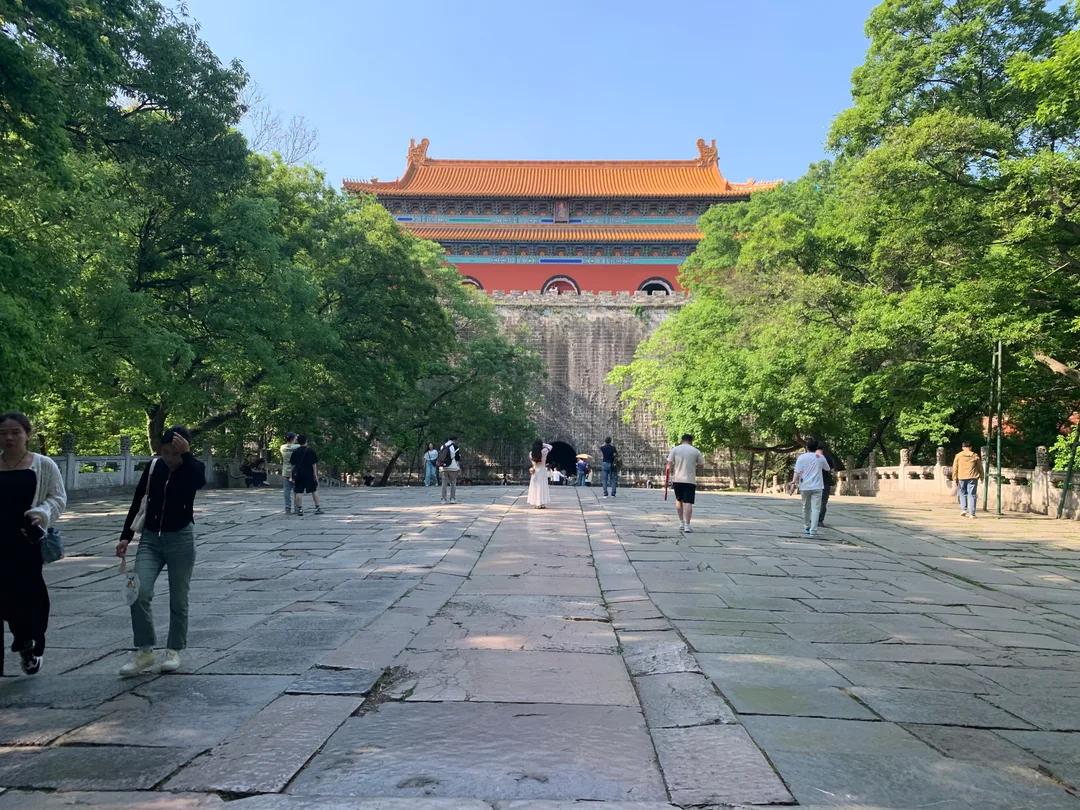
Ming Xiaoling Tomb明孝陵
Ming Xiaoling is the mausoleum of the Hongwu Emperor (Zhu Yuanzhang), founder of the Ming dynasty, and his empress Ma. It is the largest and most complete of the Ming imperial tombs, built over 25 years beginning in 1381, and forms the anchor of the Ming Xiaoling Mausoleum scenic area on Purple Mountain. The mile-long spirit way (shendao) lined with Ming-era stone animals and officials is one of the finest surviving pieces of Ming ceremonial sculpture. A UNESCO World Heritage Site since 2003.
Nanjing · Visitor Guide2026-10-18
Quick Answer
Is Ming Xiaoling Tomb worth visiting?
The tomb of the Hongwu Emperor (founder of the Ming dynasty, d. 1398) and his empress Ma. The largest imperial Ming tomb in China, with a 600-year-old stone avenue of elephants and lions.
Quick facts
| Ticket | ¥70 (as of 2026); combined ticket with Sun Yat-sen Mausoleum ¥100. Children under 1.4m and seniors over 70 free with ID. |
|---|---|
| Hours | 06:30–18:30 (April–September), 07:00–17:30 (October–March). Last entry 30 minutes before closing. |
| Recommended duration | 1.5–3 hours — the spirit way takes 30–40 minutes to walk slowly; the tomb mound and附属建筑 another 60–90 minutes. |
| Best time to visit | Late October for the ginkgo canopy along the spirit way. Weekday mornings year-round for empty photographs. Avoid weekends in October (ginkgo season) when Nanjing's photographers crowd the avenue. |
| How to get there | Metro Line 2 to Ming Xiaoling (明孝陵) Station, Exit 2, then 10-minute walk. Bus G5 scenic route stops at the Ming Xiaoling entrance. From Xinjiekou, a DiDi takes 40 minutes and costs ¥45–60. |
| English signage | Yes |
| Wheelchair accessible | Partial |
| Tomb of | Hongwu Emperor (Zhu Yuanzhang, 1328–1398) and Empress Ma |
| Construction | 1381–1405 (25 years) |
| UNESCO status | World Heritage Site since 2003 (part of Ming Xiaoling Mausoleum tomb complex) |
| Spirit way length | ~2.6 km total, including the famous stone animal and official procession |
| Stone animals | 12 pairs of lions, elephants, cavalry, and officials — carved from a single quarry |
| Visitors | ~5 million annually |
What to expect
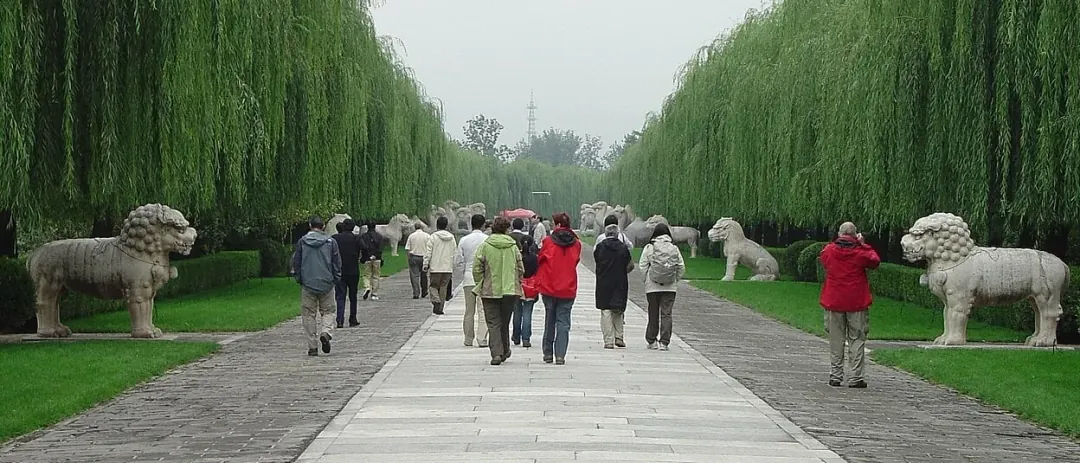
The visit to Ming Xiaoling follows the same spirit-way ritual the Ming court performed for official ceremonies: you pass through a memorial gate into a long avenue flanked first by standing stone officials (wenren — civil officials) and then by recumbent stone animals — camels, elephants, horses, and lions — all carved in the early Ming period and still remarkably sharp after six centuries. The avenue is slightly curved, a feng shui principle meaning the tomb's qi cannot be seen from the gate. In late October, the entire eastern section of the spirit way turns golden as the ginkgo trees overhead reach peak colour — the single most photographed autumn scene in Nanjing.
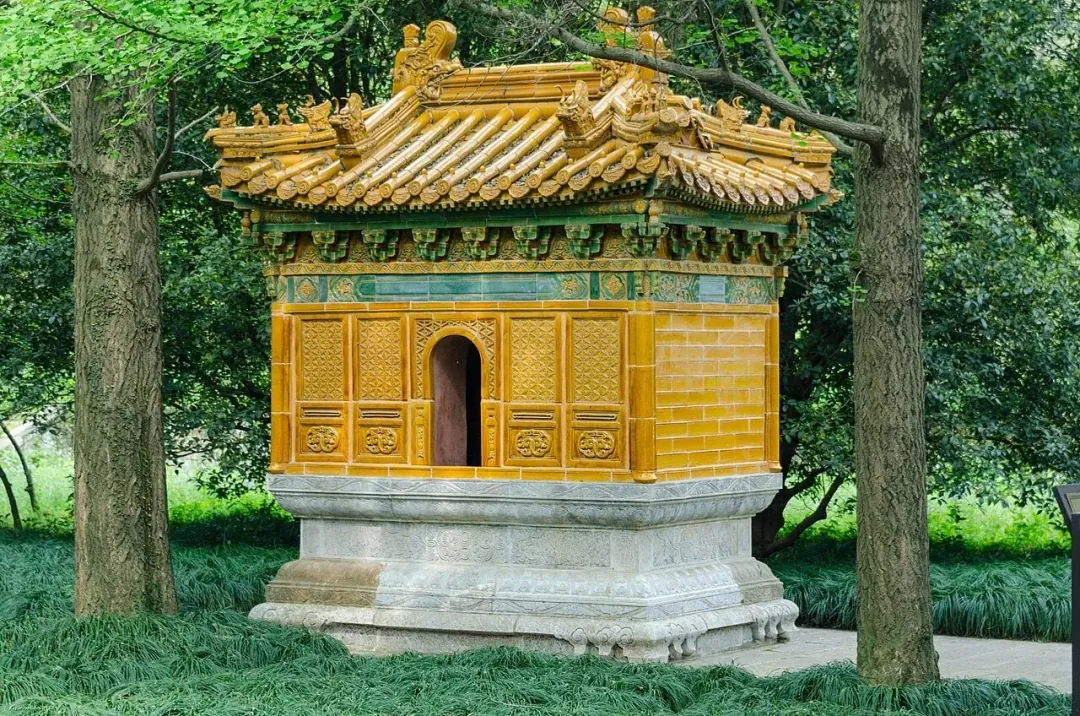
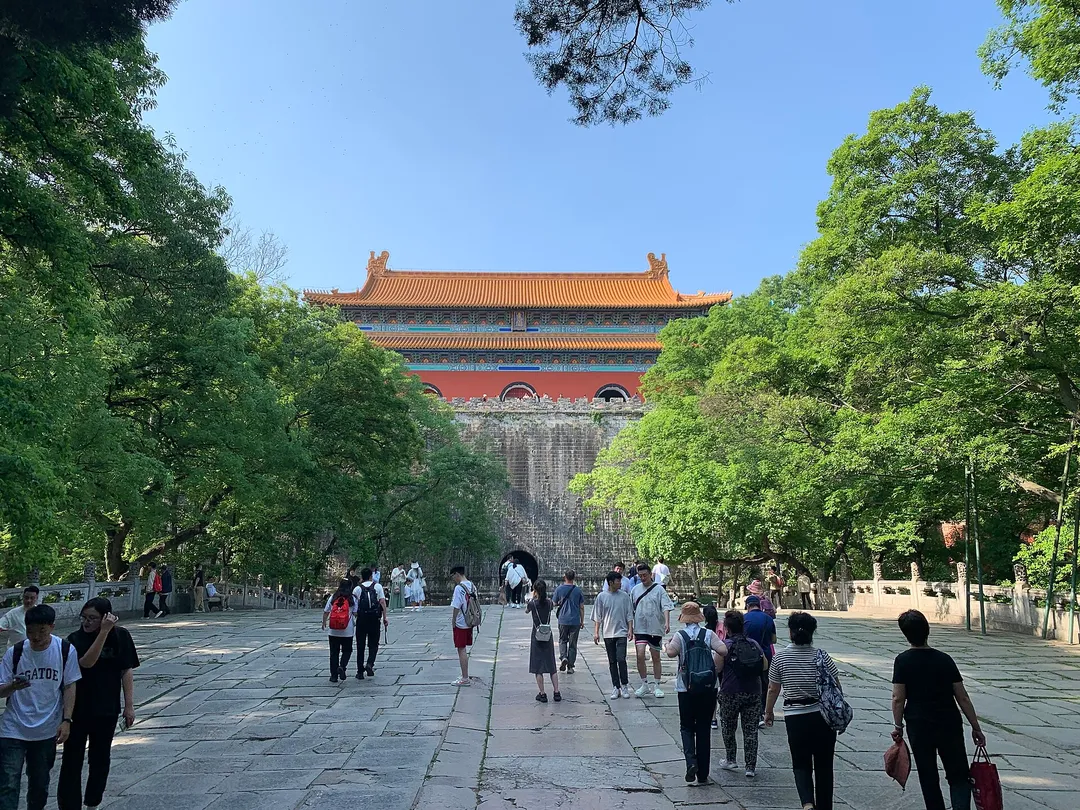
Beyond the spirit way, a second gate (ling'emen) opens to the Mingling complex proper: a courtyard with a spirit way exhibition hall (small, bilingual), the burial mound (the Hongwu Emperor's mound is 400 m across and 70 m high, a hill within the complex), and the stone pavilion where the memorial tablet once stood. The actual tomb chamber is not open to the public — Ming tombs typically sealed the underground chamber permanently at burial. What you see is the above-ground ceremonial architecture: platforms, pavilions, and walls arranged according to Ming geomantic principles.
The site is large enough that many visitors rent a golf-cart buggy (¥300 for the family, negotiated at the gate) to cover the 2.6 km from entrance to tomb mound and back. The walking paths are well-maintained stone and concrete, shade-free in summer, and slightly hilly. The on-site museum near the main gate has English labels and displays artifacts recovered from the tomb complex, including imperial tiles and a full-size reconstruction of the spirit way procession. Allow at least 90 minutes; the last third of the walk (the burial mound and its surrounds) is the least crowded.
How to get there
Metro Line 2 to Ming Xiaoling (明孝陵) Station, Exit 2 — follow signs and walk 10 minutes to the main gate. The scenic tourist bus (G5) runs from Nanjing Railway Station along the Purple Mountain scenic road, stopping at both Ming Xiaoling and Sun Yat-sen Mausoleum gates. From central Xinjiekou, a DiDi takes 35–50 minutes in non-rush hour traffic.
Best photo spots
- The stone elephant pair at the midpoint of the spirit way, framed by the overhanging ginkgo canopy — best in late October mid-morning
- The curving spirit way viewed from the main gate — shows the classic feng shui slight S-curve and the procession of animals receding into distance
- The burial mound from the pavilion behind the spirit way — the hill is deliberately left natural, covered in cypress, and looks ancient
- The fallen stone camel near the eastern section — one of the most photographed single sculptures for its weathered patina
Tips
- Combine Ming Xiaoling with Sun Yat-sen Mausoleum on the same visit — the combined ticket (¥100) is better value than buying separately, and the 10-minute walk through the ginkgo forest between them is one of Nanjing's best outdoor experiences
- The ginkgo avenue is most beautiful in the last week of October — if you are visiting in that window, arrive at opening time to get photos without people
- Rent a golf cart if you have mobility limitations or are visiting with young children — the site is 2.6 km from gate to tomb mound
- The museum near the main gate is often skipped but worth 20 minutes for the bilingual spirit way history display
- Buy water before entering — there are no vendors inside the spirit way section, only near the gate and at the tomb mound area
Scams to avoid
- "Professional photographers" near the spirit way offering to take your photo on a stone elephant for ¥30 — the stone is off-limits to climbing and the "service" is a scam
- Vendors selling "600-year-old ginkgo nuts" near the gate at inflated prices — the nuts are real ginkgo but the age claim and the ¥20–40 price are both inflated; same product at local markets costs ¥8–10
- Unlicensed guides from the metro station — decline politely; the site is fully navigable with the English signage
Frequently asked questions
What is the difference between Ming Xiaoling and Sun Yat-sen Mausoleum?
Ming Xiaoling (Ming Xiaoling) is the 14th-century tomb of the Hongwu Emperor (founder of the Ming dynasty). Sun Yat-sen Mausoleum is the 1929 memorial to Sun Zhongshan, the founder of the Republic of China. They are different people, different dynasties, and different sites — though both are on Purple Mountain and often visited together.
Is the underground tomb chamber open to visitors?
No — the tomb chamber of the Hongwu Emperor was sealed at burial and has never been opened. Visitors see the above-ground spirit way, courtyards, and burial mound, but not the underground chamber.
How long does it take to walk the spirit way?
30–40 minutes at a leisurely pace with photography stops. The full site (spirit way + tomb mound + museum) takes 1.5–3 hours depending on how thoroughly you explore.
When is the best time to visit for autumn foliage?
Late October (usually the last week) for peak ginkgo colour along the spirit way. Early November for the larch and maple. Weekdays are essential in October — the weekend crowds transform the atmosphere from serene to carnival.
Is Ming Xiaoling wheelchair accessible?
Limited. The main spirit way is a wide paved road accessible by wheelchair, but the unpaved paths near the tomb mound and the museum interior have steps. The tourist shuttle bus can accommodate wheelchairs.
Read next
Other things to do in Nanjing
Chaotian Palace
Ancient Ming dynasty palace complex now housing the Nanjing Municipal Museum. Best-preserved ceremonial architecture in southeast China; free-roaming peacocks in the courtyard. 600+ years old.
China Imperial Examination Museum (Gongyuan)
Ancient examination halls where scholars competed for imperial civil service positions over 600+ years. Now a world-class museum with reconstructed cubicles, artifacts, and immersive exhibits.
Confucius Temple (Fuzimiao)
A riverside temple complex turned lively pedestrian district — Confucian shrine, Qinhuai River boats, and Nanjing's best snack street. Temple ¥30, area free. 2–3 hours.
Zhonghua Gate Castle
The world's largest surviving ancient city gate complex, part of Nanjing's Ming dynasty wall. Three-tiered瓮城 (wengcheng/retreat defense) with 27藏兵洞 (hidden troop caves).
Memorial Hall of the Victims of the Nanjing Massacre
One of China's most significant war memorial museums, built on the site of a mass grave of Nanjing massacre victims (1937–38). Solemn, powerful, and essential. Free admission.
Nanjing Museum
China's third-largest museum by collection size, with 1.2 million+ artifacts spanning 5,000 years. Exceptional jade, porcelain, Ming dynasty artifacts, and an outstanding digital civilization exhibit.
Stone City Park
Urban park built along a 300-meter stretch of Ming dynasty city wall, featuring the famous 'Stone City' cliff formation where the ancient wall is exposed.
Presidential Palace
Nanjing Presidential Palace historic site - served as Taiping Heavenly Kingdom headquarters, Qing provincial office, Sun Yat-sen 1912 office, and Chiang Kai-shek 1948 inauguration.
Purple Mountain (Zijinshan)
Nanjing's central mountain, home to Sun Yat-sen Mausoleum, Ming Xiaoling Tomb, and the Purple Mountain Observatory. Free area entry; allow a full day (5–8 hours) for the sites.
Qinhuai River
Nanjing's famous cultural river, 110 km long, flowing through the historic Confucius Temple district.
Sun Yat-sen Mausoleum
The 392-step blue-tile mausoleum where the founder of modern China rests. Free with national park ticket. The staircase is one of the most dramatic pieces of Republican-era architecture in Asia.
Xuanwu Lake Park
Nanjing's central lake park, 4.7 km² of islands, pavilions, lotus fields, and walking paths. Free entry, excellent for sunset walks and boat rides. Urban oasis with 2,000+ years of history.
Yongle Temple
Historic Buddhist temple on Purple Mountain's southern slope, founded 1455 during Ming dynasty. Famous for pink peach-blossom gardens in spring and traditional architecture.
Zhangfuyuan Historical District
Nanjing historic residential quarter near Confucius Temple, Ming-Qing courtyard houses, 15th-century Wanmin Bridge stone arch. Free to walk district. Metro Line 1 Zhangfuyuan Station (Exit 1).
Museums in Nanjing
Jiangsu Provincial Museum
Note: Jiangsu's primary museum is the national-level Nanjing Museum in Nanjing, not a standard provincial museum; treat this entry as reference only (2026).
Memorial Hall of the Victims in Nanjing Massacre by Japanese Invaders
One of China's most significant war memorial museums — documenting the 1937 Nanjing Massacre when Japanese forces killed 300,000 Chinese civilians and soldiers.
Nanjing Museum
China's third-largest museum after the Palace Museum and National Museum of China — a combined history and art museum with strong Han/Tang collections. Free with passport; 4–6 hours.