Summary
Nanjing (南京), capital of Jiangsu province, is the city where Chinese history sits closest to the surface. Four times it served as the capital of a Chinese state — under the Six Dynasties between the 3rd and 6th centuries, as the founding capital of the Ming dynasty, briefly as the seat of the Taiping Heavenly Kingdom, and as the capital of the Republic of China from 1927 to 1937 and again from 1946 to 1949. The name itself means "southern capital," the counterpart to Beijing's "northern capital." Few cities of its size pack so many layered eras into a two- or three-day visit: a Ming emperor's tomb under UNESCO protection, a 35-kilometre Ming city wall you can still walk on, a mausoleum for the father of modern China, and a museum district that documents the 20th century with unusual honesty.
We wrote this guide for travelers who want to make decisions, not read superlatives. Below you will find what each major site actually costs in 2026, how to reach it by metro, when it is closed (Mondays matter more in Nanjing than in most Chinese cities), which neighborhoods make the best base, and how to eat well beyond the tourist strip along the Qinhuai River. Our bias is practical: we would rather tell you that the Sun Yat-sen Mausoleum requires an online reservation than describe another sunset.
Plan on two to three days. Two days cover the Purple Mountain tombs, the Nanjing Museum, the Presidential Palace, and an evening at the Confucius Temple quarter. Three days add the memorial hall, the city wall, the old villa streets, and a high-speed side trip to Yangzhou.
Why Nanjing
Nanjing earns its place on an itinerary for three reasons, and none of them is scenery alone.
First, density of history. Within one scenic area, Purple Mountain (紫金山) east of downtown, you can visit the tomb of Zhu Yuanzhang — the Ming dynasty's founding emperor, who ruled from here before his son moved the capital to Beijing — and the mausoleum of Sun Yat-sen, built in the late 1920s. On the way down, the Meiling Palace tells the story of the Soong family. Downtown, the Presidential Palace compresses 600 years into one compound: a Ming princely residence, the office of the Qing governor-general, the palace of the Taiping kings, and the offices where the Republic of China was administered. The city does not curate this history gently. The Nanjing Massacre memorial hall, documenting the Japanese occupation of December 1937, is one of the most affecting museums in the country and is treated below with the seriousness it deserves.
Second, livability at visitor scale. Nanjing has more than nine million residents and a metro system with over a dozen lines, yet the areas visitors care about cluster into four walkable zones, all connected by Lines 1, 2, and 3. The tree-lined streets — plane trees planted in the late 1920s along the funeral procession route for Sun Yat-sen — give the city center a canopy that Shanghai and Beijing largely lack. A large student population (Nanjing University, Southeast University, and a dozen others) keeps prices for food and coffee moderate.
Third, position. Nanjing sits on the Beijing–Shanghai high-speed corridor about 60 to 75 minutes from Shanghai Hongqiao and 3.5 to 4.5 hours from Beijing South, with frequent trains to Hangzhou, Hefei, and Yangzhou. It is the easiest "second city" add-on in eastern China, and a comfortable base for the lower Yangtze region.
Nanjing is not the city for skyscraper spectacle or nightlife until dawn — Shanghai and Chengdu win there. It is the city for travelers whose main interest is history, museums, and food rooted in a specific place.
Top Attractions
The six sites below justify the trip. We list them in the order most visitors find efficient, with 2026 prices, reservation requirements, and the closest metro stations. Note a pattern: nearly every major museum and historic site in Nanjing closes on Mondays, so plan arrival days accordingly.
Sun Yat-sen Mausoleum (中山陵)
The mausoleum of Sun Yat-sen, completed in 1929 on the southern slope of Purple Mountain, is the city's most visited site and its most demanding stair climb: 392 granite steps rising about 70 metres to a memorial hall at the top. The architecture is deliberately severe — white walls, blue-glazed tile roofs, the colors of the Republic flag — and the view back over the plane-tree avenues toward downtown explains why this hillside was chosen.
Admission is free, but a real-name reservation is required through the scenic area's official WeChat account (中山陵园风景区); bookings open several days ahead and can sell out during Chinese public holidays, so reserve as early as your plans allow. Bring your passport — it is checked at the entrance. The site closes on Mondays. Reach it via Metro Line 2 to Muxuyuan (苜蓿园) station, then either walk 20 to 25 minutes along the forest road or take the scenic-area shuttle for about 10 CNY. Go before 9:30 AM or after 3 PM; midday queues at the steps can stretch past an hour in peak season. Budget two hours round trip from the gate, more if you walk both ways.
Ming Xiaoling Mausoleum (明孝陵)
The tomb of Zhu Yuanzhang (reigned 1368–1398) lies in the forest west of the Sun Yat-sen Mausoleum and has been a UNESCO World Heritage site since 2003, listed among the imperial tombs of the Ming and Qing dynasties. The burial mound itself is an unexcavated earthen hill behind a monumental square tower — the architect's refusal to show off is part of the point — but the approach is superb: the 1,800-metre Sacred Way (石象路), lined with paired stone animals in six species, including elephants, camels, and the mythical qilin, each rendered life-size in Ming-era granite.
In late November and early December, the ginkgo and maple canopy above the Sacred Way turns gold and red, and this single lane becomes the most photographed strip of pavement in Nanjing. If you visit in autumn, come at 8 AM when the site opens; by 10 AM the road is a queue of tripods. Admission is around 70 CNY in peak season and 60 CNY off-season. Allow two hours. The nearby Meiling Palace (美龄宫), the 1930s villa built for Chiang Kai-shek and Soong May-ling, costs about 30 CNY and is famous for the "necklace" pattern its ring of plane trees forms when seen from above — the viewing deck on the roof makes the design visible.
Confucius Temple and Qinhuai River (夫子庙·秦淮河)
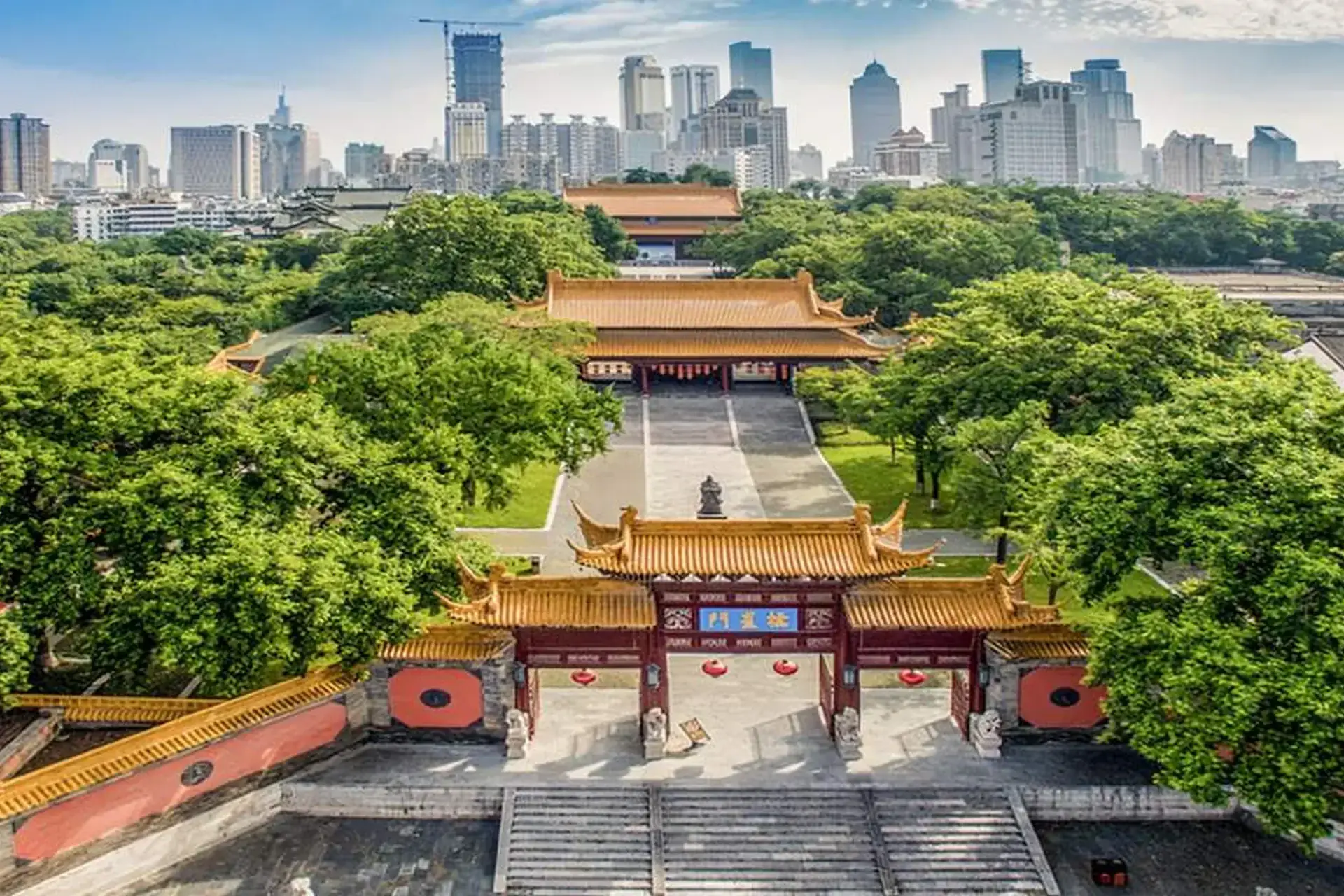
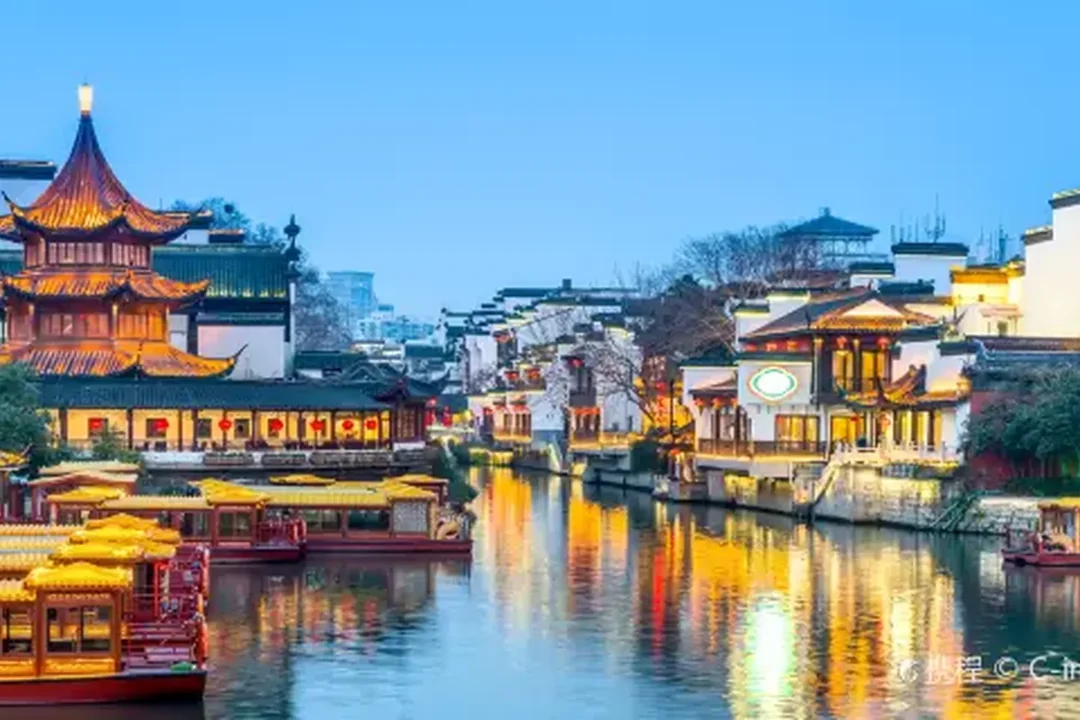
The Confucius Temple quarter on the Qinhuai River is Nanjing's historic entertainment district — a rebuilt temple-and-lantern landscape of white walls, black tile roofs, and water. During the imperial era this was the heart of the Jiangnan examination compound, where thousands of candidates sat the civil service exams in cells that still exist. The temple itself (Dacheng Hall) costs about 30 CNY to enter; the Imperial Examination Museum built into the old compound is the better spend at around 50 CNY, leading you down into a sunken circular courtyard ringed with exam-cell cubicles.
The area is free to wander and best visited after dark, when the lanterns along both banks light the river the way woodblock prints have shown it for centuries. The boat cruise (roughly 60–100 CNY depending on boat class and departure time, night departures cost more) lasts about 50 minutes and loops past the Wuyi Lane (乌衣巷) of Tang-dynasty poetry fame. Expect crowds every evening and wall-to-wall people during the Lunar New Year lantern festival. Metro Line 3 stops directly at Fuzimiao (夫子庙) station. Skip most restaurants on the main strip — walk two lanes east and west for the food locals actually queue for; see the Gastronomy section.
Nanjing Museum (南京博物院)
Do not confuse the Nanjing Museum with the Nanjing Municipal Museum at Chaotian Palace — the former is one of China's three largest museums, founded in 1933, with a collection exceeding 400,000 items, and it belongs on any itinerary that can spare half a day. The layout splits into themed galleries: the Jiangsu history hall with its bronzes and Han-dynasty jade burial suits, the non-material heritage gallery of crafts and opera, a digital gallery, and the crowd favorite in the basement — the Republic of China street (民国馆), a full-scale re-creation of a 1930s Nanjing block with post office, teahouse, and tram tracks, where you can mail a postcard that will be stamped and delivered.
Admission is free with a reservation through the museum's official WeChat account; slots for weekends and holidays can be gone five to seven days ahead, so book the day your travel dates firm up. Closed Mondays. Hours run 9:00 AM to 5:00 PM with last entry around 4:00 PM. Take Metro Line 2 to Mingugong (明故宫) station and walk about 10 minutes east. The on-site restaurant scene is thin; the museum cafe is adequate, and better lunch options sit back toward the station.
Presidential Palace (总统府)
The Presidential Palace is a single compound where five regimes left their mark: a Ming princely mansion, the Qing governor-general's yamen for the Liangjiang region, the palace of the Taiping Heavenly Kingdom in the 1850s and 1860s, the office where Sun Yat-sen was sworn in as provisional president of the Republic on January 1, 1912, and the headquarters used by the Nationalist government through 1937 and 1946–1949. The exhibits label each layer clearly in Chinese and English, and the Xuyuan (煦园) garden at the rear, with its boat-shaped pavilion on a pond, is one of the better classical gardens inside any Chinese government compound.
Admission is 35 CNY, closed Mondays, and last entry is 90 minutes before the 6 PM close in summer (5 PM in winter). Two hours is a realistic minimum. The palace sits at Daxinggong (大行宫) station, served by both Metro Lines 2 and 3, making it the most convenient major sight in the city. Book online in advance during holidays; at other times the on-site queue moves in 15 to 20 minutes. Pair it with the 1912 leisure block directly east (see Nightlife) and the Jiangsu Art Museum across the street.
Xuanwu Lake and Jiming Temple (玄武湖·鸡鸣寺)
Xuanwu Lake is the city's front yard: a free park of five connected islets against the Ming city wall, dotted with lotus beds in summer and black swans year-round. Locals treat the 5-kilometre ring road as a running and cycling loop, and renting a bike or a paddle boat is the local way to spend a clear afternoon. Enter at Xuanwumen (玄武门) station on Metro Line 1.
The better sequence combines the lake with its two neighbors. First, Jiming Temple (鸡鸣寺), a Buddhist temple complex whose buildings climb a small hill — traces of a temple here go back to the 4th century, though most structures are later rebuilds. Admission is about 10 CNY and includes three incense sticks. In late March, the temple's lane becomes Nanjing's cherry blossom corridor, and the wall of flowers against the yellow temple walls draws such crowds that the street is sometimes converted to one-way foot traffic. Second, the Taicheng (台城) section of the Ming city wall behind the temple, which costs about 30 CNY and offers the classic elevated view: lake on one side, temple roofs below, Purple Mountain in the distance. Walk the wall at golden hour, when the stone turns warm and the tower shadows lengthen over the water.
Where to Stay
Nanjing's hotel market is well supplied and, outside public holidays, competitively priced. Three areas suit most visitors; which one depends on whether you prioritize transport, atmosphere, or sleep.
Xinjiekou (新街口) is the geographic and commercial center, where Metro Lines 1 and 2 cross and the metro station itself is a subterranean mall. Staying here puts you within 15 minutes by metro of every major sight, and the above-ground blocks hold the Deji Plaza luxury mall, half a dozen mid-range chains, and a large food hall in the basement of most towers. Mid-range rooms run 300 to 600 CNY per night; serviced apartments near the station often undercut hotels for longer stays. The downside is noise and traffic — ask for a room on a high floor facing away from Zhongshan Road. For first-time visitors on a 2-day schedule, this remains our default recommendation.
Fuzimiao / Confucius Temple quarter (夫子庙) puts you inside the postcard: lantern-lit lanes, the river at your doorstep, and the night cruise a five-minute walk away. The trade-offs are real — the area is loud until 10 PM, touristy in flavor, and thin on quality food once you leave the main squares. The better sub-choice here is Laomendong (老门东), the restored quarter at the south end near Zhonghua Gate, where boutique courtyard hotels and design-conscious hostels occupy renovated Ming-era street fabric. Expect 150 CNY for a good hostel bed in a courtyard building and 400 to 800 CNY for a boutique room. Choose this if evening atmosphere matters more than commute speed; Metro Line 3 serves the area.
Xuanwu Lake / Gulou (玄武湖·鼓楼) is the quiet pick north of downtown: business hotels and university-adjacent guesthouses between the lake, Jiming Temple, and the Nanjing University campus, with the Yihe Road villa quarter a short walk west. Rooms are slightly cheaper than Xinjiekou at equivalent quality (250 to 500 CNY mid-range), evenings are calm, and Lines 1 and 4 keep you connected. This area suits repeat visitors, early risers training for a wall-to-wall museum schedule, and anyone who wants plane-tree streets outside the window rather than LED billboards.
Regardless of area, book two to three weeks ahead for early May, early October, and the Lunar New Year window, when prices can double and the best properties sell out entirely.
Gastronomy
Nanjing's cooking belongs to the Jiangsu school, but the city's identity is duck. The local saying claims "no duck leaves Nanjing alive," and the claim is only half a joke: the region consumes duck roasted, braised, and — most famously — salt-cured.
Salted duck (盐水鸭) is the signature dish, a cold plate of duck cured in brine and scallion-spiked broth, traditionally at its best in autumn when osmanthus flowers scent the air (the classic brand name, Osmanthus Duck, refers to this season). The skin should be pale and the meat firm and aromatic, not salty-damp. Buy it by the quarter from dedicated duck shops — a queue of locals is the only certification that matters — at 30 to 60 CNY for half a bird. Vacuum-packed versions make a legitimate souvenir; supermarkets and airport shops sell them at small markups.
Duck blood vermicelli soup (鸭血粉丝汤) is the everyday bowl: a clear broth with duck-blood curds, gizzards, liver, fried tofu puffs, and glass noodles, finished with white pepper and cilantro. It is breakfast, lunch, and late-night food in one, and a bowl costs 15 to 25 CNY anywhere honest. Chain operations make it reliable; neighborhood shops make it better.
Soup dumplings (汤包): Nanjing's take on the tangbao is smaller and sweeter than Shanghai's xiaolongbao, with a pork filling loose enough to drink. The reference standard is Jiming Tangbao (鸡鸣汤包), a citywide chain descended from a state-owned restaurant; the original-flavor basket runs 15 to 30 CNY. Eat them correctly: place one on your spoon, bite a small hole, drink the broth, then eat. Add black vinegar, not the sweet soy of the south.
Beyond the duck trilogy, look for beef pot stickers (牛肉锅贴) — the halal tradition of Qijiawan produces the city's best, pan-fried to a caramelized crescent, 10 to 20 CNY for a plate; Qinhuai snacks (秦淮八绝), a set menu tradition of eight small dishes that serious teahouses near the Confucius Temple still serve; and hairy crab (固城湖螃蟹) from Gaochun district in October and November, sold by weight and steamed with perilla leaf.
Where to eat: avoid the main Fuzimiao drag, which optimizes for foot traffic. Instead, target the lanes around Laomendong for sit-down Jiangsu cooking at 80 to 150 CNY per person; the small shops along Mingguangqiao and the streets south of Xinjiekou for duck and noodles; and any window with a permanent queue of grandmothers. Reservations matter only at the top of the market (per-person 200 to 400 CNY); most good eating here happens without them.
Practical Information
Visa
China's entry rules have loosened repeatedly since 2024, and 2026 travelers have two main routes. First, unilateral visa-free entry: passport holders of several dozen countries — including most of the EU, plus Australia, New Zealand, Japan, South Korea, and others — may enter for up to 30 days for tourism without a visa. Second, 240-hour (10-day) visa-free transit, open to 54 countries, with Nanjing Lukou Airport among the eligible ports of entry and movement permitted across the Yangtze Delta region. Both policies shift in scope and expiry dates; verify your nationality's current status on the National Immigration Administration site or with your carrier before booking, because airlines enforce the rules at check-in.
Currency and Payments
The currency is the renminbi (CNY), trading in recent years around 7.0–7.3 to the US dollar. In practice, Nanjing is close to cashless: street vendors, metro turnstiles, and temple ticket windows all prefer QR codes. Set up Alipay or WeChat Pay and link an international Visa, Mastercard, or Amex card before arrival — both apps have English interfaces, and the linkage now works in minutes rather than days. Carry a small amount of cash (a few hundred yuan) for the rare window that rejects foreign-linked wallets. ATMs at ICBC and Bank of China branches accept foreign cards; withdrawal limits run about 2,000 CNY per transaction. Tipping is not expected anywhere, including restaurants and taxis.
Internal Transport
The metro is the backbone. Fares run 2 to 8 CNY by distance, and the three lines visitors need most are Line 1 (north–south through Xinjiekou and Nanjing Railway Station), Line 2 (east–west, serving the Purple Mountain sights, the Nanjing Museum, and the Presidential Palace at Daxinggong), and Line 3 (linking Nanjing South Station, Daxinggong, and Fuzimiao). Scan the transit QR code inside Alipay, or buy a rechargeable transit card at any station booth. The airport connects via the S1 line from Lukou Airport to Nanjing South Station in about 40 minutes for under 10 CNY; a taxi for the same run costs 100 to 150 CNY and 45 to 70 minutes depending on traffic.
Taxis start around 11–14 CNY; the DiDi app has an English interface and dispatches faster than street-hailing at night. Shared bikes (HelloBike, Meituan) unlock through Alipay mini-programs for about 1.5 CNY per half hour — ideal for the Xuanwu Lake loop and the plane-tree avenues. Driving is unnecessary and inadvisable for visitors.
Best Time to Visit
April–May and late September–November are the two good windows. Spring brings the plum blossoms at Purple Mountain in February and March and the cherry lane at Jiming Temple in late March, but also changeable weather; autumn is the most reliable season — dry, clear, and timed to the golden canopy on the Ming Xiaoling Sacred Way. Summer (July–August) is genuinely hot: Nanjing is one of China's traditional "furnace" cities, with 35°C-plus afternoons and thick humidity. Mid-June to early July is the plum-rain season, when a week of drizzle can compress your sightseeing indoors. Winter is damp and gray, 0–8°C, but nearly empty at the major sites, and the salted duck and hot soup repertoire comes into its own.
Cultural Considerations
Two topics in Nanjing deserve more care than the average Chinese city requires.
The first is the war. The Nanjing Massacre memorial hall (侵华日军南京大屠杀遇难同胞纪念馆), at Yunjinlu station on Line 2, documents the six weeks after Japanese forces took the city on December 13, 1937; Chinese official figures record 300,000 victims. The hall is free, closed Mondays, and requires a WeChat reservation. Go, and go prepared: the exhibit moves from excavation pits with remains in situ to galleries of testimony, and the emotional register is closer to a site of mourning than a museum. Dress plainly, keep your voice low, do not take posed photographs or selfies inside, and do not photograph other visitors who are grieving. December 13 is China's National Memorial Day for the victims; sirens sound across the city at 10:00 AM and traffic pauses. If your visit coincides, observe quietly.
The second is modern political history generally. The Presidential Palace and city museums narrate the 20th century from the perspective of official mainland historiography. Read critically and discuss tactfully; casual political commentary with strangers or guides can put your counterpart in an awkward position.
On ordinary etiquette: Nanjing people speak Mandarin — the local dialect belongs to the Jianghuai group and is fading among the young — so language is no barrier beyond what you'd expect anywhere in China. Queue culture is real at ticket windows and duck shops alike; take your place. At temples, keep your shoulders covered in principle, let worshippers finish before photographing, and accept incense with the right hand. Smoking is prohibited inside all indoor public spaces and on the metro, with fines enforced. The city's tempo is calmer than Shanghai's; you will notice locals walking slower and holding doors longer. Match it.
Two-Day Itinerary
This sequence minimizes backtracking. It assumes reservation slots secured for the Sun Yat-sen Mausoleum and Nanjing Museum, and it deliberately puts the mass memorial in the afternoon of day two, when you will know enough of the city's story for it to land.
Day 1 — Purple Mountain and the river. Start at 8:00 AM: Metro Line 2 to Muxuyuan, shuttle into the Sun Yat-sen Mausoleum, and climb the 392 steps before the tour groups arrive (two hours). Walk or shuttle west to the Ming Xiaoling Mausoleum; take the Sacred Way slowly, exit through the main axis, and if autumn is doing its work, double back for photographs after the 10 AM light softens (two hours, 60–70 CNY). Lunch near the scenic area is mediocre — better to metro back one stop and eat around Mingugong or head straight to the Nanjing Museum for a 1:30 PM entry: history gallery first, then the Republic street in the basement, finishing by 4:30 (free, reserved). Metro Line 2 to Daxinggong, transfer Line 3 south to Fuzimiao for dusk: walk the lantern streets, take the 7:00 PM river cruise (60–100 CNY), then eat duck blood vermicelli soup and soup dumplings in the lanes two blocks east of the main square (40–60 CNY per person). Return to Line 3.
Day 2 — Wall, republic, and remembrance. At 8:00 AM take Line 1 to Xuanwumen: Xuanwu Lake for a lakeside walk or bike lap (45 minutes), then Jiming Temple as it opens (10 CNY, 45 minutes), then up onto the Taicheng wall section for the morning view across the water (30 CNY, 45 minutes). Metro back to Daxinggong for the Presidential Palace by 11:00 AM (35 CNY, two hours); lunch at the 1912 block next door. At 2:00 PM take Line 2 west to Yunjinlu and spend two unhurried hours at the massacre memorial (free, reserved) — sober, deliberate, and worth every minute. End the day with retail therapy that fits the mood: the Librairie Avant-Garde bookstore or, if energy remains, the Deji Plaza galleries back at Xinjiekou. Dinner: beef pot stickers and a quarter of salted duck, 60–80 CNY with beer.
With a third day, add Yangzhou (see Day Trips) or slow down: the Zhonghua Gate castle, the Yihe Road villas, and a long Laomendong afternoon.
Beyond the Highlights
Librairie Avant-Garde (先锋书店)
Nanjing's best-known cultural address is a bookstore in a former underground parking garage on Guangzhou Road, a 20-minute walk or 10 CNY taxi ride west of Xinjiekou. Founded in 1996 and installed in the garage since 2004, Librairie Avant-Garde kept the ramp's slope, the columns, and the traffic markings, then filled the space with humanities shelving, a reading avenue, and a cross erected in memory of the owner's friend — the most photographed object in Chinese book retailing. The selection skews serious: history, philosophy, art, and a respectable foreign-language section. Branches now operate in the Presidential Palace and in a restored courtyard house at Laomendong (the Junhui branch), but the garage is the one worth crossing the city for. Go on a weekday afternoon; it is a working study space for Nanjing's students, not a photo studio, and behaves better when treated as one.
Yihe Road (颐和路)
Northwest of Xinjiekou, the grid of streets around Yihe Road preserves the largest concentration of Republic-era residential architecture in China — more than 200 villas from the 1930s, built for officials, industrialists, and foreign embassies in a mix of Chinese and Western styles, under a nearly unbroken canopy of plane trees. Several blocks were converted into the Yihe Mansions boutique-hotel-and-cafe quarter, where you can walk private lanes that were closed to the public for decades; entry to the lanes is free, individual museums and cafes charge separately. This is Nanjing at its most filmable: slate walls, wrought gates, and almost no signage. Bring a camera and a wide lens; there is no itinerary, the district is the point. Combine with the Nanjing University old campus and the former Ginling Women's College buildings nearby.
Laomendong (老门东)
At the foot of the Zhonghua Gate castle on the south side of the old city, Laomendong is the restoration done right: Ming-era street fabric rebuilt to original footprints, occupied by craft workshops, small museums, a branch of Librairie Avant-Garde, and food shops that mostly earn their queues. Come late afternoon, walk an hour before dinner, then climb Zhonghua Gate (around 50 CNY) — the largest surviving castle-style city gate in China, with wartime ramps and vaulted chambers (藏兵洞) built to conceal soldiers, which you can enter. The quarter is also the departure point for the short wall walk toward the old streets; check the ticket office for the current open sections, as restoration rotates.
Nightlife
Nanjing's nightlife is real but modest, and it concentrates early by big-city standards — most bars empty by 1 AM. The center of gravity is the 1912 block (南京1912街区) beside the Presidential Palace, a low-rise quarter of restored and rebuilt Republic-style buildings named for the founding year of the Republic, holding bars, live-house venues, and rooftop terraces aimed at the after-work corporate crowd and students from nearby universities. Expect cocktails at 60 to 90 CNY, imported beer 40 to 60 CNY, and a dress code that is actually enforced at two or three doors.
Quieter alternatives: the courtyard bars inside Laomendong, where lantern light and stone lanes make one drink feel like an event; the teahouses of the Fuzimiao quarter, some with nightly pingtan (Suzhou ballad) or local opera performances at 50 to 150 CNY including tea; and the Hexi district west of the center, where the Zaha Hadid-designed towers at the International Youth Cultural Centre front the newer hotel bars with skyline views. The Qinhuai night cruise is technically nightlife and, for many visitors, beats any bar.
One local habit worth adopting: the late-evening food run. Duck blood vermicelli soup shops near universities stay open past midnight, and the midnight bowl is a Nanjing institution in itself.
Day Trips from Nanjing
Nanjing's rail hub makes three side trips practical, all doable without a tour.
Yangzhou (扬州)
The classic excursion: 45 to 60 minutes by high-speed train from Nanjing South or Nanjing Station to Yangzhou East (second class around 50–60 CNY, trains roughly hourly through the day). Yangzhou was the merchant capital of the lower Yangtze when Nanjing was still a garrison, and it shows in the gardens and the eating culture. The essentials: Slender West Lake (瘦西湖), a landscaped water garden with pavilions and the White Pagoda, entry 60–100 CNY depending on season; Ge Garden (个园), a Qing-era merchant garden famous for its bamboo and rockeries (around 30–45 CNY); and the morning tea (早茶) tradition — a full breakfast of soup dumplings, steamed dishes, and tea served in grand old teahouses from 7 AM, at 50–100 CNY per person. The play is to take an early train, do morning tea in Yangzhou itself, garden until mid-afternoon, and return for dinner in Nanjing. Two gardens plus the lake fill a day at a comfortable pace.
Closer still, Zhenjiang (镇江) sits 20 to 25 minutes south by high-speed rail (20–30 CNY): the home of Zhenjiang black vinegar, with Jinshan Temple and a pleasant riverside promenade on the Yangtze. It works as a half-day trip or a lunch of potstickers dressed in the local vinegar.
For a nature day, the Tianmu Lake (天目湖) area south in Liyang, about 40–60 minutes by train or 90 minutes by car, offers tea plantations, a fish-head-soup lunch tradition, and lake cruising — a common weekend escape for Nanjing residents rather than a foreign-tourist circuit, which is part of its appeal.
Events and Festivals
Nanjing's calendar has four anchors. The Qinhuai Lantern Festival runs from Lunar New Year through the first full moon (late January to February in most years), when the Confucius Temple quarter hangs thousands of hand-made lanterns and the river district becomes the largest lantern display in eastern China — crowded to the point of one-way foot traffic, and still worth scheduling around if your dates allow. The Nanjing International Plum Blossom Festival opens at Purple Mountain's Plum Blossom Hill in late February and runs through March; the hill is one of the largest plum gardens in China, and the festival period adds crafts markets and performances at the scenic area gates.
Late March brings the cherry blossoms to Jiming Temple lane — a two-week window, announced by crowds, that turns the short street into the city's signature spring photograph. September and October belong to the osmanthus: the trees around Linggu Temple perfume the whole eastern half of Purple Mountain, and the season is also when salted duck is traditionally at its best.
Two fixed-date events matter for planning. The Nanjing Marathon is usually run in November; the course crosses the Yangtze over the 1968 Nanjing Yangtze River Bridge — the first road-rail bridge over the river designed and built entirely by China — and road closures ripple across downtown for half a day. And every December 13, the National Memorial Day for the Nanjing Massacre victims brings sirens at 10:00 AM; the memorial hall runs at capacity, and the mood citywide turns formal.
Shopping
Shopping in Nanjing splits cleanly into two experiences. The modern one is Xinjiekou, self-styled as China's densest commercial intersection, where the Deji Plaza mall concentrates luxury flagships (and one of the city's best art collections in its basement gallery, free to visit), and the surrounding towers stack electronics, bookstores, and food halls. Prices at international brands match Shanghai; the advantage is that everything sits within 500 metres of the metro interchange.
The traditional one is crafts. Nanjing yunjin brocade (云锦) — "cloud brocade," woven on looms that require two operators and can produce only a few centimetres per day — is inscribed on UNESCO's intangible cultural heritage list; the Yunjin Museum near the massacre memorial demonstrates the craft and sells certified pieces, from bookmarks at 30–80 CNY to robes in the thousands. Rain flower pebbles (雨花石), the polished agates associated with Yuhuatai, sell everywhere; natural patterned stones run 5–20 CNY each from honest stalls, and "collectible" grades are best left unpurchased unless you know the market. Folding fans, carved sandalwood combs, and vacuum-packed salted duck round out the standard list — the duck travels well and is the souvenir that gets eaten rather than shelved.
For books and design objects, Librairie Avant-Garde's flagship has the best edit in the city. Bargaining is not customary in malls and is light-touch at craft stalls; agree prices before customization or engraving.
Decision Support
Map
The sights cluster into four zones, all on the metro. Purple Mountain (Sun Yat-sen Mausoleum, Ming Xiaoling, Plum Blossom Hill) sits east on Line 2. The museum-and-palace belt (Nanjing Museum, Presidential Palace, 1912 block) runs along Line 2 through the center at Daxinggong and Mingugong. The Qinhuai quarter (Confucius Temple, Imperial Examination Museum, Laomendong, Zhonghua Gate) sits south on Line 3. The lake district (Xuanwu Lake, Jiming Temple, Taicheng wall) sits north on Line 1. Anything not in these zones — the massacre memorial, Yihe Road — is a single transfer away. Walking distance rules within each zone; the only taxi you should need is to or from the airport.
Cost breakdown
Daily budget (mid-range, 2026): accommodation 300–600 CNY, food 100–200 CNY, local transport 30–60 CNY, attractions 50–150 CNY. Total: 500–1,000 CNY/day per person. Backpacker travel (hostel bed 60–150 CNY, street food, walking) lands near 300–400 CNY/day; a luxury day (five-star at 800–1,600 CNY, one restaurant dinner) runs 1,500–2,500 CNY. The big-ticket items are few and cheap by international standards: Ming Xiaoling 60–70 CNY and the river cruise 60–100 CNY are the priciest entries on a standard list, and three of the six headline sights (Sun Yat-sen Mausoleum, Nanjing Museum, mass memorial) are free with reservation.
When to go
First choice: late September to mid-November — dry, clear, the Sacred Way in color, the osmanthus in the air. Second choice: April to May, blossom season with changeable weather. Avoid July–August (furnace heat) and the plum-rain fortnight of late June to early July. Hard avoid: the first weeks of May and October and the Lunar New Year window, when reservation slots vanish, hotel rates double, and the lantern festival crowds make the Confucius Temple quarter a slow shuffle. Note the Monday closure pattern across nearly all museums and the Sun Yat-sen Mausoleum when choosing arrival day.
Practical
Payments first: install Alipay or WeChat Pay and link an international card before landing; carry a few hundred yuan in cash as backup. Reservations second: the Sun Yat-sen Mausoleum, Nanjing Museum, and mass memorial all require free WeChat reservations — book each the day your dates are fixed, with passport numbers ready. Metro transit QR in Alipay covers all trains including the airport S1 line. SIM: a tourist eSIM (Airalo and similar, 5–30 USD) or a China Unicom counter at Lukou arrivals. English signage is good inside the sights and thin outside them; a translation app with camera mode closes the gap. ATMs at ICBC and Bank of China accept foreign cards. Emergency numbers: police 110, ambulance 120, fire 119, national tourist hotline 12301.
Sources
https://www.njtravel.gov.cn Official Nanjing tourism portal (南京文旅) — reservation channels, festival dates, and scenic-area notices.
https://www.trip.com/travel-guide/nanjing/ City guide with current ticket prices, opening hours, and bookable entries for the attractions covered here.
https://en.wikipedia.org/wiki/Nanjing Background on the city's four-capital history, the 1937 occupation, and transport geography.