Chongqing · history museum
Three Gorges Museum (重庆中国三峡博物馆, Chóngqìng Zhōngguó Sānxiá Bówùguǎn)
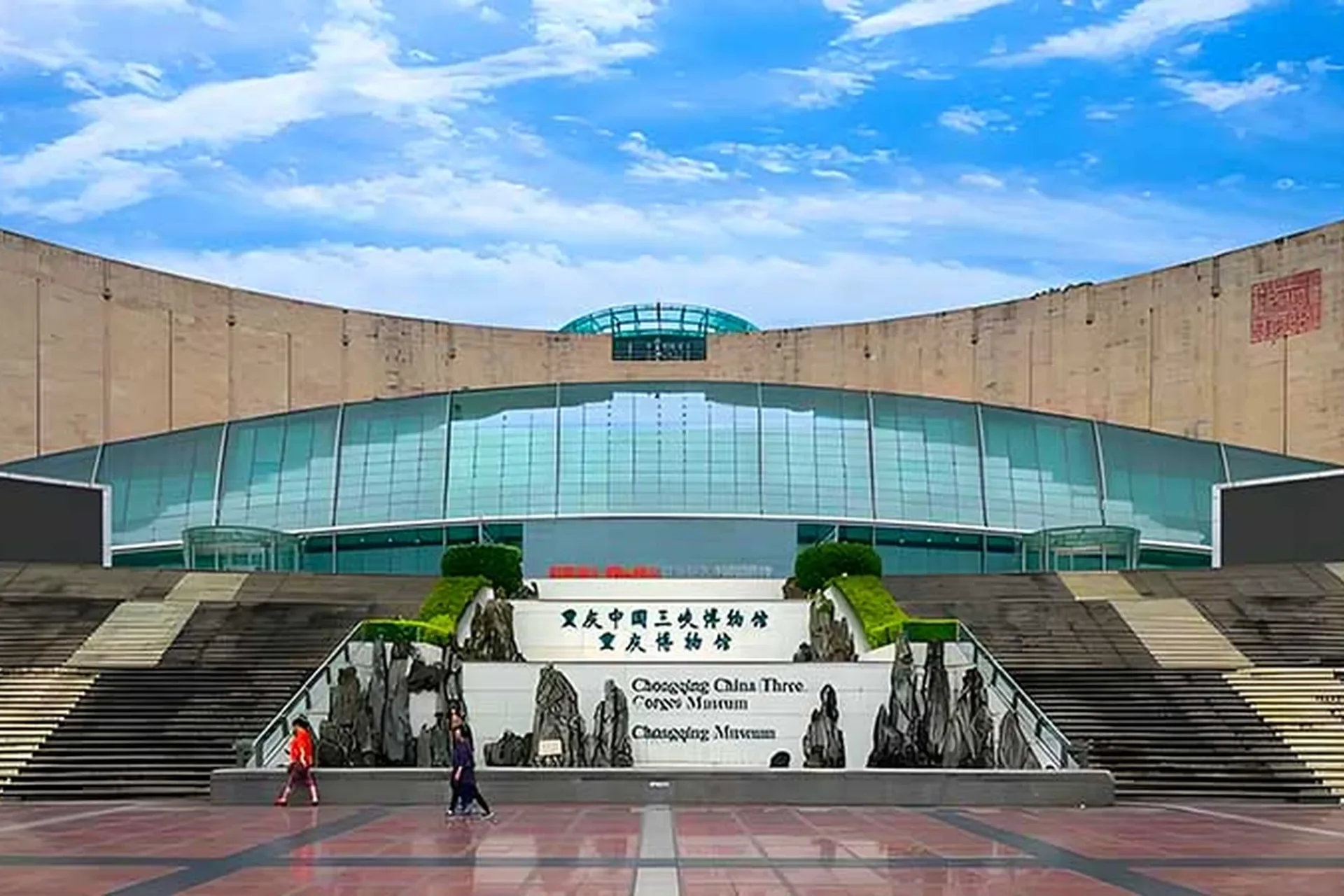
"\"The Three Gorges Museum (full name: Chongqing China Three Gorges Museum) faces the Great Hall of the People across Renmin Square in central Chongqing, forming one of the city's most impressive architectural ensembles. The museum's collection of 280,000+ objects covers four main areas: the ancient Ba and Shu cultures of the upper Yangtze (with remarkable bronze weapons and drums), the history of Chongqing as a wartime capital (1937-1945), the natural and cultural heritage of the Three Gorges region, and the construction of the Three Gorges Dam — the largest hydroelectric project in human history. The Dam section is particularly compelling, documenting the largest archaeological salvage operation in history (over 1,000 archaeological sites excavated before flooding) and the relocation of 1.3 million people whose ancestral homes now lie under water.\".".
Last updated:
Quick Answer
Is Three Gorges Museum worth visiting?
"The history of the Yangtze River, the Three Gorges Dam, and Chongqing — from ancient Ba culture to the world's largest hydroelectric project. Free. Allow 2–2.5 hours. Chongqing's premier museum.".
Quick facts
| Category | history |
|---|---|
| Ticket | Free. Passport required. Reserve via the Three Gorges Museum WeChat mini-program or collect a ticket at the entrance. Walk-ins usually accommodated. |
| Hours | 9:00-17:00 (last entry 16:00). Closed Mondays. |
| Recommended duration | 2-2.5 hours. |
| Best time to visit | Weekday mornings. The museum is centrally located and popular with tour groups — the first 90 minutes after opening are quietest. Avoid weekends and Chinese holidays. |
| How to get there | Metro Line 2 to Zengjiayan (曾家岩), Exit A. Walk west 5 minutes on Renmin Road to Renmin Square. The museum is on the northwest side of the square, facing the Great Hall of the People. DiDi from central Chongqing costs ¥15-25. |
| English signage | partial |
Why visit
The Three Gorges Dam gallery tells a story that most museums avoid — the human cost of China's greatest engineering project alongside the engineering achievement. The juxtaposition of bronze artifacts rescued from sites now 100 meters underwater with the stories of relocated families is powerful and nuanced.
Collection highlights
- Ancient Ba (巴) Culture Gallery — bronze tiger-shaped weapons, war drums, and ritual objects from the mysterious Ba Kingdom, which ruled the upper Yangtze from ~1100-316 BC alongside the better-known Shu Kingdom in Sichuan
- Three Gorges Dam Exhibition — scale model of the dam (233 m x 18 m), detailed displays on lock navigation, sediment management, and the submerged archaeological sites. The model shows every gate, turbine, and ship lift
- Salvage Archaeology Gallery — artifacts rescued during the massive 1994-2008 salvage excavation campaign before the reservoir flooded 1,000+ archaeological sites. The Baiheliang ancient hydrological inscriptions (白鹤梁, 1,200 years of water-level records carved into a rock that is now 40 m underwater) are recreated in a partial replica
- Chongqing Wartime Capital Gallery — photographs, documents, and objects from 1937-1945 when Chongqing served as China's wartime capital during the Second Sino-Japanese War and suffered devastating Japanese bombing
- Yangtze River Natural History — fossils and specimens from the Three Gorges before inundation, including rare endemic fish and plant species
Tips
- Start on the 2nd floor with the Three Gorges Dam exhibition — it provides context for everything else in the museum
- The Great Hall of the People across the square is worth a look — it is a massive circular building modeled on Beijing's Temple of Heaven. The square between the two buildings is a popular local gathering spot
- I found the salvage archaeology section unexpectedly moving in June 2026 — seeing photos of archaeologists racing to excavate sites as water levels rose, knowing entire ancient towns would be submerged within weeks
- The museum's viewpoint on the Dam is measured — it acknowledges both the engineering achievement and the human/environmental costs. This is not propaganda; it is a surprisingly balanced presentation
- Chongqing's streets are notoriously disorienting (the city is built on hills with bridges and tunnels everywhere) — the museum and Renmin Square are on one of the few flat areas, which is a relief
- Combine with a walk through the nearby Zhongshan 4th Road (中山四路) historic district — Republican-era buildings, trees, and quiet lanes that feel nothing like the rest of urban Chongqing
Frequently asked questions
Does the museum present a balanced view of the Three Gorges Dam?
The museum presents the Dam as both an engineering achievement and a complex project with significant human and environmental costs. The exhibition covers the relocation of 1.3 million people, the loss of 1,000+ archaeological sites, and ecological changes alongside the technical and economic benefits. The tone is factual rather than propagandistic — it acknowledges tradeoffs without editorializing.
Can I visit the actual Three Gorges Dam from Chongqing?
The Three Gorges Dam is in Yichang, Hubei Province, about 600 km downstream from Chongqing. The museum is in central Chongqing — it tells the story of the Dam and the region but is not at the Dam itself. To visit the Dam, take a Yangtze cruise (3-4 days downstream) or a high-speed train from Chongqing to Yichang (4 hours).
What is the ancient Ba culture?
The Ba (巴) were a Bronze Age people who inhabited the upper Yangtze River region (modern Chongqing and eastern Sichuan) from about 1100 BC until their conquest by the Qin Dynasty in 316 BC. They are known for their distinctive bronze weapons (tiger-shaped dagger-axes, willow-leaf swords), boat-coffin burials, war drums, and a warrior culture described in Chinese historical texts as fierce and music-loving. The Ba language and writing remain undeciphered.
How does the Three Gorges Museum differ from Chongqing's other museums?
The Three Gorges Museum is the city's primary comprehensive museum, covering regional history from prehistory through the Dam era. The Chongqing Art Museum (重庆美术馆), 2 km away, focuses on modern Chinese art. The Hongyan Revolutionary History Museum (红岩革命历史博物馆), 5 km north, covers the Communist Party's wartime activities in Chongqing. The Three Gorges Museum is the one to prioritize.
What is the Baiheliang ancient hydrological inscription site?
Baiheliang (白鹤梁, White Crane Ridge) was a 1,600-meter-long rock ridge in the Yangtze River at Fuling, near Chongqing, inscribed with 1,200 years of water-level records (763 AD to 1963). It was the world's oldest hydrological observation station. When the Three Gorges Dam reservoir flooded the site, a protective underwater museum was built over it — visitors can descend 40 meters below the water surface to view the original inscriptions through glass tunnels. The Three Gorges Museum has a partial replica and explanation.
How long does the Yangtze cruise take from Chongqing to the Three Gorges Dam?
Downstream (Chongqing to Yichang/Dam): 3-4 nights. Upstream (Yichang to Chongqing): 4-5 nights. The cruise passes through the Three Gorges themselves — Qutang, Wu, and Xiling — and includes a shore excursion to the Dam. The museum is an excellent pre-cruise primer; visit it before departing Chongqing.
Read next
Other things to do in Chongqing
Ciguang (Ciqikou) Ancient Town
ciguang in Beijing: 重庆主城区保存最完好的古镇,巴渝传统建筑与码头文化交融,网红打卡圣地。. 2026 verified.
Ciqikou Ancient Town
A 1,000-year-old Jialing River porcelain port turned pedestrian snack street in Chongqing's Shapingba District — free to enter, 2-3 hours to walk, and best at 08:30 on a weekday before the crowd…
Dazu Rock Carvings
50,000+ Buddhist, Taoist, and Confucian statues carved into Chongqing cliffsides between the 9th and 13th centuries.…
Hongya Cave (Hongyadong)
Hongya Cave stilt-house architecture in Chongqing - 11 storeys stacked above Jialing River. Free to visit, open 2026 nightly.
Hongyadong (Huangjuewan)
"\"A 11-floor hillside complex of traditional Chinese stilted buildings rebuilt in 2006 on the site of a Ming-dynasty wall city gate.…\".".
Liziba Monorail Station
Chongqing Rail Transit Line 2 runs straight through floors 6-8 of a 19-storey apartment block at Liziba — a six-second spectacle you photograph from a free platform across the road.…
Wulong Karst - Three Natural Bridges
wulong-karst in Beijing: 世界自然遗产地,三座巨型天生石桥气势磅礴,《变形金刚 4》《满城尽带黄金甲》取景地。
Yangtze River Cableway
"A 1987 commuter cable car that still glides 1,166 m over the Yangtze between Yuzhong and Nan'an for about 20 yuan - the ride lasts under 5 minutes, but expect to queue an hour at peak.".