Hangzhou · national museum
National Archives of Publications and Culture — Hangzhou Branch (Wenrun Ge) (中国国家版本馆(杭州)文润阁, Zhōngguó Guójiā Bǎnbǎn Guǎn (Hángzhōu) Wénrùn Gé)
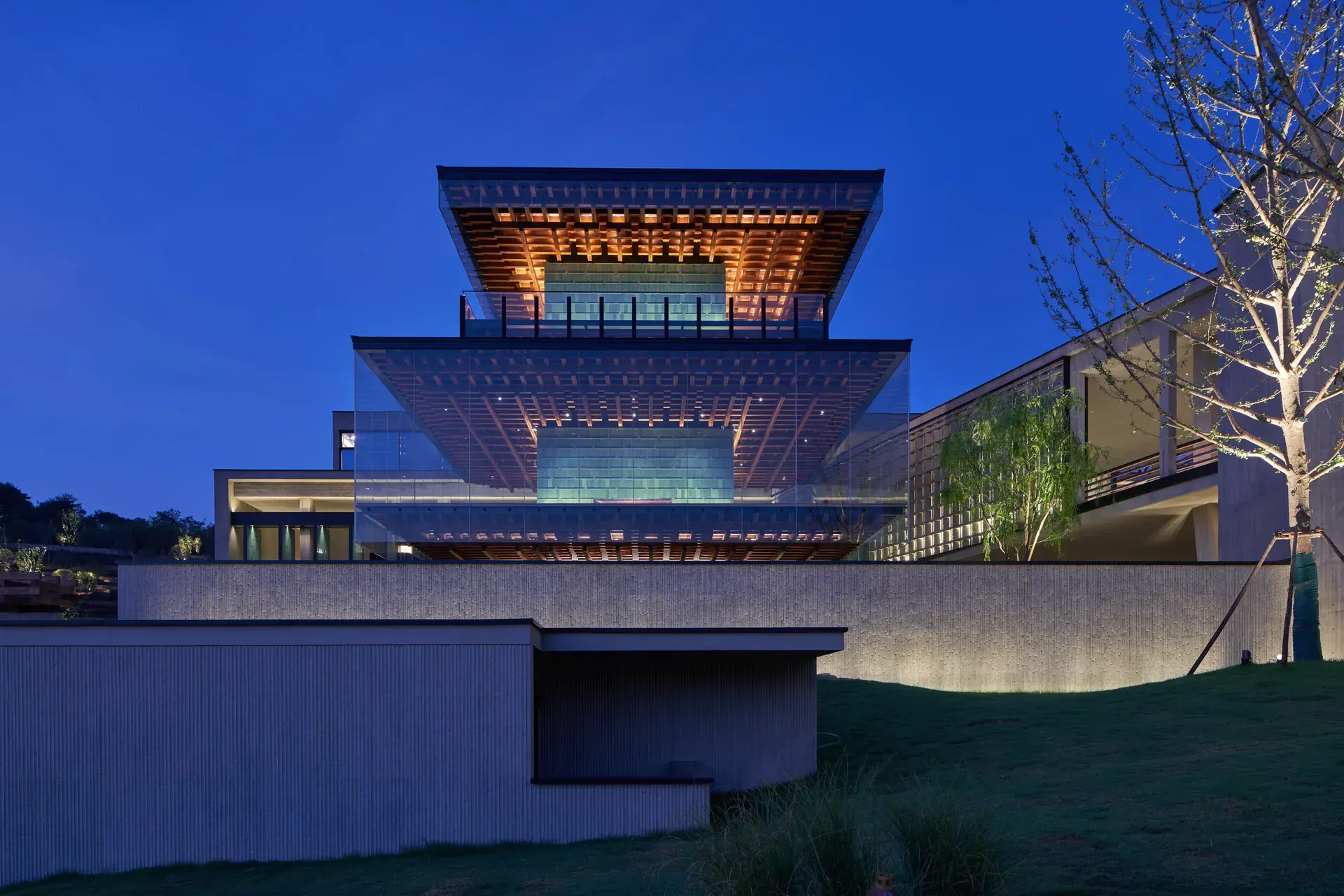
"The National Archives of Publications and Culture (中国国家版本馆) is a central-state archive project with four regional branches; the Hangzhou branch, Wenrun Ge (文润阁), sits on a forested hill above Xianghu Lake in Xiaoshan district and opened to the public in late July 2022. Its remit is to collect every \"version\" — books, periodicals, newspapers, maps, stamps, woodblocks, manuscripts, coins, digital media — published or used in China since the invention of printing. It is one of the few new top-tier national cultural institutions built in mainland China in the 21st century.".
Last updated:
Quick Answer
Is National Archives of Publications and Culture — Hangzhou Branch (Wenrun Ge) worth visiting?
"China's newest national \"version\" repository, opened July 2022 in a 100,000 sqm hilltop complex near Hangzhou's Xianghu Lake,.".
Quick facts
| Category | national |
|---|---|
| Ticket | Free with valid ID (PRC residents) / Free for foreign passport holders with on-site registration (as of 2026, verify) |
| Hours | Tuesday–Sunday 09:00–17:00; last entry 16:00; closed Mondays (verify) |
| Recommended duration | 2.5 to 3 hours for the main pavilions; add 1 hour if the temporary exhibition hall has a special show |
| Best time to visit | Weekday mornings, ideally Tuesday or Wednesday right at 09:00 opening; weekends and school-holiday periods fill the underground floors by 11:00 |
| How to get there | Metro Line 1 to Xianghu Station (湘湖站), Exit A, then 10–15 min by DiDi (¥15–20 from West Lake area, ~30 min off-peak) — there is no metro stop at the gate and the on-site parking lot is large but fills on weekends (verify) |
| English signage | partial |
Why visit
If you have done the West Lake loop and want a museum that is genuinely different from anything else on the China-tourism circuit, Wenrun Ge is the one. The hilltop setting alone — terraced courtyards and stone walls echoing Song-dynasty academy architecture, with views over Xianghu Lake — outclasses most of Hangzhou's lakeside museums. Inside, it is not a "treasure" museum in the Shanghai Museum sense; it is a state-of-the-art, very modern presentation of Chinese publishing, language scripts, and documentary heritage. The Hangzhou branch focuses on southern China, Jiangnan scholarship, and the history of movable-type and woodblock printing — which is, historically, the right place for it.
Collection highlights
- Eight-pavilion hilltop complex laid out as a Song-dynasty-style academy campus with stone-walled courtyards and reflecting pools
- Underground "Tongban" (通版) exhibition hall with replica editions of Dunhuang manuscripts, Yongle Encyclopedia fragments, and Ming–Qing woodblock originals
- Printing-history gallery covering Tang woodblocks, Bi Sheng's movable type, and 19th-century lithography machinery
- Jiangnan scholarship wing with rare editions from the Qing-era Zhejiang libraries (Wenlan Ge, Tianyi Ge traditions)
- Stamps, banknotes, and coinage hall covering PRC currency series since 1948
- Digital "version" gallery showing e-books, blockchain-anchored deposits, and provincial digital archives on interactive screens
Tips
- Bring your passport — foreign visitors must register at the visitor center with their passport before entry, even though tickets are free
- Skip the official guided tours if you do not read Chinese; the English audio guide is limited and the QR-code wall labels sometimes fail to load outside WeChat
- Wear real walking shoes — the site is built on a hill with long flights of stone steps between pavilions; the gap between the lowest courtyard and the top is roughly 60 vertical meters
- Lunch on-site is limited to a single cafe and a small noodle bar in the visitor center; eat in Xiaoshan town before or after instead
- If you are short on time, go straight to the underground exhibition hall (Tongban Exhibition) first — it has the most concentrated highlights, then walk up through the pavilions on the way out
Frequently asked questions
Where is the National Version Museum Hangzhou branch, exactly?
Wenrun Ge is at 308 Tianmushan Road, Xiaoshan District (萧山区天马路308号), about 17 km southeast of West Lake. The nearest metro is Line 1 Xianghu Station (湘湖站), Exit A.
When did Wenrun Ge open to the public?
The Hangzhou branch opened on 23 July 2022, alongside the Beijing main branch; the Xi'an (Kaige Ge) and Chengdu (Wenjin Ge) branches opened on the same date.
How much is the ticket?
Admission is free as of 2026, but foreign visitors need to present a passport at the visitor center for on-site registration before they can enter.
What are the opening hours?
Tuesday through Sunday, 09:00 to 17:00, with last entry at 16:00. The complex is closed on Mondays. Hours can change around Chinese national holidays — check the official notice the day before.
How big is the site?
The whole campus covers about 100,000 square meters, with eight main pavilions arranged along a central axis on a forested hill above Xianghu Lake.
How much of the collection can I see?
The national archive holds over 1 million physical items in its Hangzhou branch reserves, with rotating displays in the underground Tongban Exhibition Hall and the per-pavilion galleries; only a fraction is on view at any one time.
How do I get there from West Lake?
Take Metro Line 1 from Ding'an Road or Longxiang Bridge stations to Xianghu (about 25 minutes), then a 10-minute DiDi (about ¥15). A direct DiDi from West Lake costs roughly ¥60–80 and takes 35–50 minutes depending on traffic.
Is there English signage?
Partial. The main exhibition texts have English panels, but the audio guide is mostly Chinese. The Hangzhou branch is less foreigner-oriented than the Beijing main branch.
Can I combine it with West Lake in one day?
Yes — visit West Lake in the early morning, take Line 1 south around midday, spend 2.5–3 hours at Wenrun Ge, then return. Total transit time is about 90 minutes each way.
Is it crowded?
Less crowded than the National Museum of China in Beijing, but the underground exhibition hall fills up on weekends and during school holidays (July–August, Chinese New Year week). Tuesday and Wednesday mornings are the quietest slots.
Read next
Other things to do in Hangzhou
Grand Canal (Hangzhou Section)
The 1,776 km Grand Canal's southern terminus — a UNESCO World Heritage site since 2014 — runs through Hangzhou as a working waterway past the 1631-built Gongchen Bridge and free museums.…
Leifeng Pagoda
leifeng-pagoda in Beijing: 西湖十景雷峰夕照,新塔40元登塔俯瞰西湖,白蛇传传说源地,新塔内保存古塔遗址地宫,景色壮观。
Lingyin Temple
lingyin-temple in Beijing: 杭州最古老寺庙,东晋始建,香火极盛,寺内有珍贵石刻造像,飞来峰永福寺联票75元。
Longjing Tea Plantation
longjing-tea-plantation in Beijing: 西湖龙井茶核心产区,乾隆皇帝御封的十八棵御茶树所在地,免费茶田漫步,茶文化体验,品茶买茶。. 2026 verified.
Meiling Tunnel Trail
meiling-dragon in Beijing: 杭州经典徒步路线,连接灵隐与梅家坞,穿过梅灵隧道,全程约8公里,山林幽静,茶园风光佳。
Putuoshan Island
Buddhist island sacred to Guanyin — 3 major temples, 33 m golden statue. Ferry ¥160 round-trip from Zhoushan. Half-day minimum. Pilgrimage site with a serene coastal atmosphere.
Gongchen Bridge & Grand Canal
qi-bridge in Beijing: 京杭大运河杭州段标志性三孔石拱桥,建于1631年,桥西为小河直街历史文化街区,免费,漫步最佳。
Six Harmonies Pagoda
"A 60-meter Song-era pagoda on Yuelun Hill above the Qiantang River — 7 interior floors hiding behind 13 exterior eaves, climbable in about 90 minutes for a river-and-bridge view.".
Southern Song Imperial Street
song-dynasty-ruins in Beijing: 南宋都城临安的中轴大道,1000年历史,保存完好地下文物层,连接河坊街,免费漫步,夜晚灯光美。
West Lake
west-lake in Beijing: 杭州标志性湖泊,面积约6.38平方公里,周长约15公里。免费开放(部分景点另付费)。游船55元起。2011年世界文化遗产。苏堤全长2.8公里,地铁1号线龙翔桥站/凤起路站。深度游建议4-8小时。
Xiang Lake Park
xiang-lake-park in Beijing: 杭州第二大名湖,水域面积约5平方公里,西湖姐妹湖。免费进入(展馆另付费)。跨湖桥遗址博物馆免费(8000年文明)。环湖骑行约15公里。地铁1号线湘湖站步行15分钟。建议3-5小时。
Xixi National Wetland Park
China's first national wetland park — 11.5 sq km of reed beds, lotus ponds, and persimmon groves threaded by water lanes, about 20 minutes west of West Lake.…
Museums in Hangzhou
China National Silk Museum
"The world's largest silk museum. Live silkworms, weaving demonstrations on 19th-century looms, and 2,000-year-old Silk Road textiles. Free. Hangzhou's most underrated museum.".
China National Tea Museum
"China's only national-level tea museum, set among actual Longjing tea plantations in Hangzhou. Tea ceremony demonstrations, 1,000+ tea artifacts, and fresh Longjing at the source. Free.".
Hangzhou Museum
West Lake cultural history from Neolithic Liangzhu through Southern Song imperial glory. Free entry near Hefang Street. Celadon ceramics and Song Dynasty urban life. Allow 1.5–2 hours.
Zhejiang Museum of Natural History
Hangzhou's natural history museum near West Lake — dinosaurs, fossils, minerals, and the biology of Zhejiang's unique ecosystems. Free. Allow 1.5–2 hours.
Zhejiang Museum
"Zhejiang's premier museum at the foot of West Lake - strong in Neolithic archaeology (Hemudu/Yangshao), Longquan celadon, Hangzhou's Southern Song history,.".. 2026 verified.
Zhejiang Provincial Museum
"Liangzhu Neolithic jade (5,000-year-old ritual cong and bi), the world's finest celadon ceramics, and Southern Song imperial artifacts — on the shore of West Lake. Free.".