Summary
Hangzhou (杭州), capital of Zhejiang province, runs on a simple formula: a lake at the centre, tea hills to the west, a canal quarter to the north and a food culture that would justify the trip on its own. For most of the 12th and 13th centuries the city — then called Lin'an (临安) — was capital of the Southern Song dynasty, and its poet-governors, Bai Juyi and Su Dongpo, left behind the causeways that still organise every visit. Marco Polo passed through in the late 13th century and reportedly called it the finest city in the world.
We have written this guide the way we plan our own trips: decisions first, atmosphere second. You will find opening hours and ticket prices for West Lake, Lingyin Temple, the Longjing tea villages, the Grand Canal and Xixi Wetland, plus neighbourhood-by-neighbourhood advice on where to stay, what to eat (and what to skip), and how to connect everything by metro, bus, boat and bicycle. Prices are in CNY and reflect conditions as of 2026; where a figure moves with the season we give a range rather than false precision.
Plan on three to four days. Two covers the lake and Lingyin at a run; four lets you add the canal, the wetland and one day trip without racing. If you are coming from Shanghai, the high-speed train takes under an hour, which makes Hangzhou work even as a long weekend.
Why Hangzhou
Hangzhou occupies an unusual position in the Chinese imagination: it is the city other Chinese people recommend to visitors. Ask a Shanghai or Beijing resident where to spend a relaxed week and the answer is usually here. That domestic reputation matters — the metro lines, signage, booking systems and hotel stock were built for a demanding local audience, and foreign visitors benefit from all of it.
The practical case for the city is strong:
- Two UNESCO World Heritage listings: the West Lake Cultural Landscape (2011) and the Grand Canal (2014), plus the archaeological remains of the Southern Song capital.
- Longjing (Dragon Well) tea country inside the city limits — working villages, not a themed park, twenty minutes from the lake.
- A metro network of more than a dozen lines, including an express link to Xiaoshan airport, with fares from 2 to 8 CNY.
- A regional kitchen (Hangzhou cuisine, a branch of Zhejiang cooking) with signature dishes that exist nowhere else in the same form: West Lake vinegar fish, Longjing shrimp, pian'erchuan noodles.
- Direct high-speed connections: Shanghai in 45-70 minutes, Huangshan in about 90 minutes, Ningbo in an hour, Beijing in roughly five.
A modern layer surprises first-time visitors: Hangzhou is the home city of Alibaba and Ant Group, and it hosted the 2022 Asian Games (staged in 2023), whose stadium complex rises on the south bank of the Qiantang River. A thousand-year-old pagoda and a drone-delivered coffee order coexist here without anyone finding it strange.
In our view Hangzhou works best at walking speed. The headline sights cluster around a single lake, and the finest experiences — a dawn walk on Su Causeway, a cup of first-flush tea in a farmhouse — cost little or nothing. Spend on meals and a well-located hotel, and let the free scenery do the heavy lifting.
Top Attractions
Hangzhou's geography is unusually forgiving. The lake sits immediately west of downtown; the tea hills continue west beyond it; the canal quarter begins two metro stops north of the centre. Nothing in this section is more than forty minutes from anything else. The five entries below are the ones we consider non-negotiable, ordered as we would visit them.
West Lake (西湖)
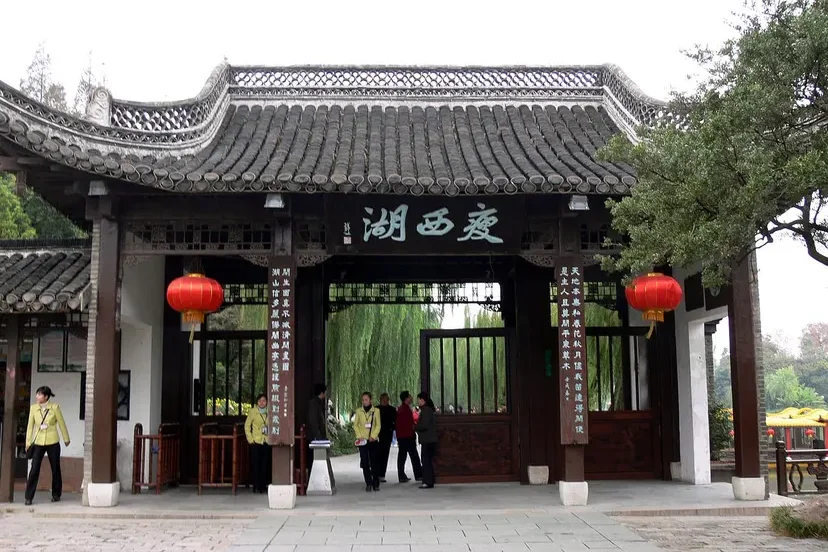
West Lake is the reason Hangzhou exists as a destination, and it deserves the crowds: a 6.4-square-kilometre sheet of water framed by low hills, with causeways, islets, pagodas and bridges composed over eleven centuries into a landscape painted, quoted and imitated ever since. The core zone is free and open at all hours, rare for a Chinese scenic area of this rank.
The classic walk is the two causeways. Bai Causeway (白堤) runs east-west past the Broken Bridge (断桥), where the White Snake legend is set, in about thirty minutes at strolling pace. Su Causeway (苏堤) is longer — roughly three kilometres north to south under willows and peach trees, built from dredged lake silt under the poet-governor Su Dongpo from 1089. Walk one causeway and cycle the other; the full shoreline loop is about fifteen kilometres, a half-day on foot or two hours by bike. The city's red public bicycles are nearly free for the first hour, and docks ring the lake.
Boats matter here. State-run cruise boats leave from Hubin and other piers to Xiaoying Island (小瀛洲), home of the Three Pools Mirroring the Moon (三潭印月) — the three stone pagodas printed on the one-yuan banknote — for roughly 55-70 CNY with island landing. A wooden boat with boatman costs around 150-200 CNY per hour, which we consider the better spend: water-level view, quiet conversation, no PA system.
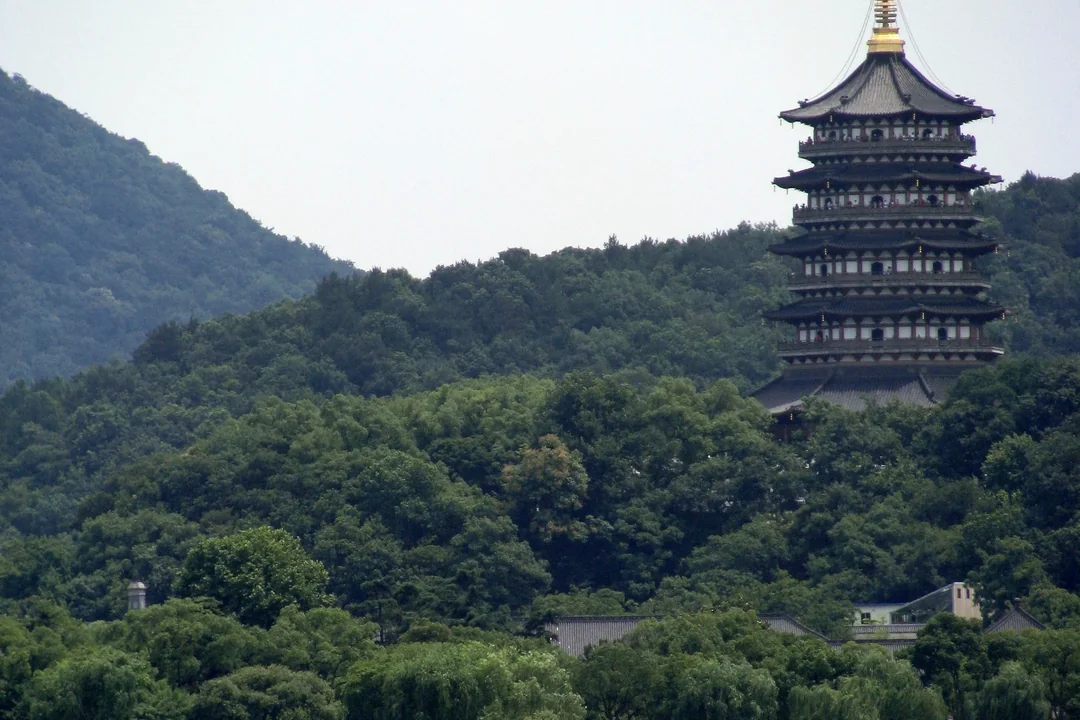
On the south shore, Leifeng Pagoda (雷峰塔) charges about 40 CNY to climb — escalators serve the 2002 reconstruction over the collapsed original — and its top-floor view at dusk, with the lake turning gold, is the best panorama in the city. Nearby Yue Fei Temple (岳王庙), shrine of the loyal Song general, costs around 25 CNY. The "Ten Scenes of West Lake" — Spring Dawn at Su Causeway, Lotus in the Breeze at Crooked Courtyard (best July-August), Lingering Snow on the Broken Bridge and the rest — work as a checklist if you like structure; treat them as suggestions, not a quota.
Timing advice from experience: enter the lake before 8:00 AM or after 16:00; between those hours, especially on weekends, the shoreline jams with tour groups. Metro Line 1 to Longxiangqiao (龙翔桥) puts you one block from the east shore; Ding'an Road (定安路) serves the south-east corner.
Lingyin Temple and Feilai Peak (灵隐寺·飞来峰)
Lingyin — "Temple of the Soul's Retreat" — was founded in 328 AD and is one of the wealthiest and most active Chan Buddhist monasteries in China. It sits in a wooded valley about five kilometres west of the lake, and the approach sets the tone: streams, incense smoke and a cliff face studded with stone carvings.
Tickets have two layers and you need both: the Feilai Peak (飞来峰) scenic area costs about 45 CNY, and the temple adds roughly 30 CNY — budget around 75 CNY total. Feilai Peak ("the peak that flew here", carried from India in legend) holds more than 300 Buddhist reliefs carved between the 10th and 14th centuries, including a famous Song-dynasty laughing Buddha niche. Inside, the Hall of Heavenly Kings, the Grand Hall of the Great Sage (with a 25-metre camphor-wood Buddha) and the Hall of Five Hundred Arhats form the spine; allow ninety minutes, or half a day with the side halls.
Three free sticks of incense are usually handed out with the ticket; light them at the designated burners rather than carrying them into the halls. Dress with shoulders covered, go clockwise around the halls, and ask before photographing monks — many are fine with it, some are not, and the question itself is the etiquette.
Go early: we aim for the 7:00 opening in high season, because by 10:00 the courtyards are dense and the valley road slows to walking pace. Bus 7 runs from the city centre in about forty minutes; a taxi or DiDi takes twenty to thirty minutes for 25-40 CNY. With energy left, the smaller Yongfu Temple (永福寺) up the same valley has better gardens and a fraction of the visitors, and the North Peak (北高峰) cable car (~50 CNY round trip) lifts you to a God of Wealth temple with a view over the whole lake basin.
Longjing Tea Village (龙井村)
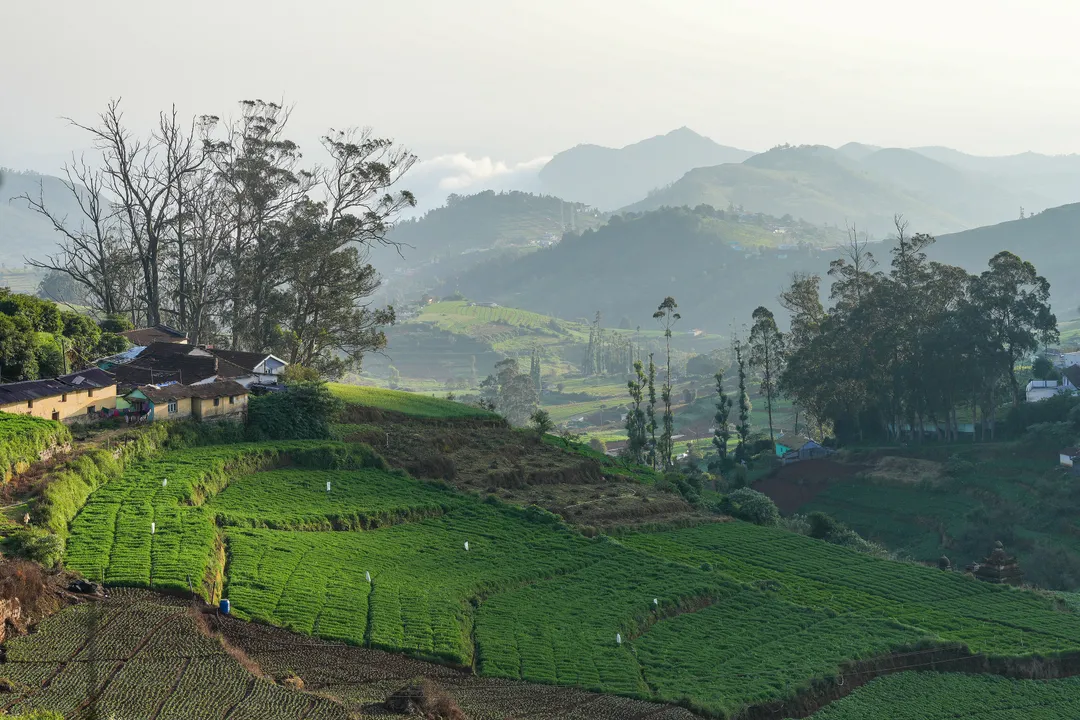
Longjing is both a place and a drink: the pan-fired flat-leaf green tea that China considers its national benchmark, grown on terraces inside Hangzhou's city limits. The village of Longjing itself, plus neighbouring Meijiawu (梅家坞) and the Shifeng (狮峰) slopes above it, form the protected origin zone — the same way Champagne the region guards Champagne the wine. Come here to walk the rows, drink several grades side by side, and buy directly from the farm that grew the leaf.
A visit is unscripted: a farmer or her family invites you to sit (tasting fees of 20-50 CNY per person are normal, often waived with purchase), and successive brews keep arriving while you look at the terraces. Budget 300-800 CNY per 500 g for honest village Longjing in 2026; top pre-Qingming grades from the Shifeng slopes run well past 1,000 CNY. The harvest to know is Mingqian (明前) — leaf picked before the Qingming festival in early April, the most prized and expensive — followed by Yuqian (before late April) at gentler prices. Autumn leaf is cheaper again and perfectly drinkable.
Two cautions. First, the tens-of-CNY "Longjing" tins sold in souvenir streets are grown elsewhere; if the price looks impossible, it is. Buying in the village, with the tea scooped from the farm's own bins in front of you, is the simplest defence. Second, politeness does not obligate you to purchase — thank the family, pay the tasting fee, move on.
The China National Tea Museum (中国茶叶博物馆), free, on Longjing Road minutes from the village, is worth an hour for its historic processing tools and zero-pressure tasting tables. Buses 27 and 87 reach the villages from the lake side for 2 CNY; a taxi is 20-30 CNY. Pair the village with the Nine Creeks hike described later — the walk from Longjing over the ridge is the best two hours of light exercise in the city.
The Grand Canal and Gongchen Bridge (京杭大运河·拱宸桥)
The Beijing-Hangzhou Grand Canal is the longest artificial waterway on earth — nearly 1,800 km, UNESCO-listed in 2014 — and Hangzhou is its southern terminus. The canal quarter around the arched stone Gongchen Bridge (拱宸桥, Ming dynasty in origin, rebuilt in the late Qing) is now the most liveable historic district in town: warehouses turned into museums, shophouses into cafes, and a working waterway still pushing barges past the tourists.
Three historic blocks spread from the bridge. Xiaohe Old Street (小河直街), a grid of timber houses on a creek junction, is the prettiest for photographs in the late afternoon. Dadou Road (大兜路历史街区) is the food street, its restaurants facing the water under plane trees. Qiaoxi (桥西历史街区), directly south of the bridge, concentrates the free museums: the Hangzhou Arts and Crafts Museum, plus the wonderfully specific Knife, Scissors and Sword Museum, Umbrella Museum and Fan Museum. All are free with passport or Chinese ID, and most close on Mondays.
Two water experiences define the area. The commuter water bus (水上巴士) runs from Wulinmen wharf north to Gongchen Bridge for 3 CNY — the best-value boat ride in China — past lock gates and back-garden life you cannot see from the bank. After dark, licensed night cruises loop the illuminated reaches for roughly 100-150 CNY per person; book ahead in peak season.
Access is easy: Metro Line 5 has a Grand Canal (大运河) station a short walk from the bridge. Give the quarter half a day, or an evening combined with dinner on Dadou Road. Compared with West Lake it is refreshingly local — on a weekday you share it with dog-walkers, calligraphy groups and children chasing pigeons.
Xixi National Wetland Park (西溪国家湿地公园)
Xixi is what the lake's shores were before they were tamed: 11.5 square kilometres of reed marsh, fish ponds, mulberry groves and channels, protected as China's first national wetland park in 2005 and reachable by Metro Line 3 to Xixi Wetland South. It is the local "escape the crowds" answer that genuinely works — the park's scale swallows its visitors, and boats, not buses, are the transport inside.
Entry to the main zone costs around 80 CNY, with boat packages adding 60-100 CNY — the boats through the narrow channels are the point, so buy a combined ticket. Allow three to four hours. Seasonal notes from our visits: persimmons hang heavy in October (the park's autumn signature), reeds turn gold in November, and summer brings lotus and mosquitoes — buy the repellent at the gate. The park found fame in Feng Xiaogang's 2008 film If You Are the One (非诚勿扰), which every boat guide will mention, and a small cafe village sits near the east entrance for recovery time.
One planning tip: the East Zone near the main gate is the most developed. For quiet, take the boat deeper west toward the old village sites, where the channels narrow to a single hull's width. Combine Xixi with nothing else that day — it is a morning-to-mid-afternoon commitment done properly, and rushing it wastes the entry fee.
Where to Stay
Hangzhou's hotel stock is deep, and the right neighbourhood depends on what you want out of the lake. Our shortlist, west to east:
Hubin / east lake shore (Longxiangqiao, Line 1). The most convenient address in the city: the water is three minutes away, with the in77 mall, restaurants and Nanshan Road's bars on top of you. You pay for it — lake-view rooms carry a premium and weekend nights are noisy. Ideal for a first visit when you plan to be out from dawn.
Beishan Road / north shore. A heritage villa street under Precious Stone Hill, quiet and leafy, with the Shangri-La Hangzhou as its grande dame and several boutique conversions in restored 1930s houses. You trade restaurant density for calm and a ten-minute climb to the best sunrise view in town. Suits couples and photographers more than night owls.
Simenjing and Manjuelong (south-west hills). The hostel-and-guesthouse village behind the lake, where dorm beds run 60-120 CNY and family-run inns 250-450 CNY. In late September and October the osmanthus trees here perfume entire lanes. Buses into town are frequent but the metro is not at your door; it suits travelers who want tea-farm mornings more than mall evenings.
Wulin Square (Line 1). The business core north-east of the lake, one metro stop or a fifteen-minute walk from the water. The best mid-range value in the city: big-hotel reliability, Hangzhou Tower shopping overhead, East Railway Station and the airport express a short ride away. Our default for a balanced stay.
Grand Canal / Qiaoxi (Line 5). Canal-side boutique hotels and design guesthouses in restored warehouses, with museums as neighbours and dinner on Dadou Road. The atmosphere justifies the fifteen-minute metro ride to the lake; pick it for a second visit or a quiet final night.
Qianjiang New City / Binjiang. The CBD towers and Asian Games stadium on and beyond the river. Business hotels discount heavily on weekends, river-view rooms cost less than lake-view ones, and the skyline light show is free from the waterfront deck. Wrong choice if the lake is your only priority; sensible for modern comfort at lower prices.
Price expectations for 2026: hostel dorms 60-120 CNY; clean budget hotels 200-350 CNY; solid international four-star 450-800 CNY; luxury 1,000-2,000 CNY; and the destination resorts — Amanfayun in the Lingyin valley, the Four Seasons on the north shore — commonly 3,000 CNY and up. Book two to four weeks ahead for April-May and October-November; for National Day Golden Week and Chinese New Year, book six weeks out or expect to pay double.
Gastronomy
Hangzhou cooking (杭帮菜, the local branch of Zhejiang cuisine, one of China's eight great schools) is quiet food: river fish, bamboo shoots, greens, pork and tea, lightly seasoned and pointed at seasonality. It is not spicy, which makes the city a recovery stop on any chilli-fatigued itinerary. The dishes that define it:
- West Lake vinegar fish (西湖醋鱼). Whole river fish in a glossy sweet-sour sauce, the city's signature for 150 years. Honest opinion: it divides people — the traditional version carries a soft, muddy river note that locals prize and some visitors do not. Try it once at a serious house before judging.
- Longjing shrimp (龙井虾仁). Shelled river shrimp stir-fried with fresh Longjing leaves; the tea's grassiness against the sweetness of the shrimp is the city's most elegant plate, typically 90-160 CNY.
- Dongpo pork (东坡肉). A fist-sized brick of belly pork braised in yellow wine and soy until it trembles, named for the poet-governor Su Dongpo. 30-60 CNY a portion; one between two people is plenty.
- Pian'erchuan (片儿川). The city's everyday noodle soup — pickled mustard greens, bamboo shoots and lean pork over wheat noodles. The reference version is at Kuiyuanguan (奎元馆, founded 1867) on Jiefang Road for 20-40 CNY; neighbourhood shops do fine ones from 15 CNY.
- Congbao hui (葱包桧). A street snack of scallion and crispy dough rolled in a thin crease and pressed on a hot plate, named in folk etymology for a hated traitor; 5-10 CNY at morning carts.
- Classics to fill the table: dry-fried "sounding bell" tofu rolls (干炸响铃), beggar's chicken (叫花鸡, ordered in advance, baked in lotus leaf and clay), osmanthus-glutinous lotus root (桂花糯米藕) in autumn, and cat's-ear pasta (猫耳朵) at old-school houses.
Where to eat them. Louwailou (楼外楼, 1848), on Gushan Island facing the lake, is the historic flagship — touristy, yes, but the terrace is unmatched and its vinegar fish and Dongpo pork are the canonical versions; expect 150-250 CNY a head. Zhiweiguan (知味观, 1913) on Renhe Road is the old dim-sum house for Xiaolongbao and cat's ears at 30-60 CNY. For daily value, the Hangzhou-born chains Wai Po Jia (外婆家) and New White Deer (新白鹿) turn out respectable local dishes for 60-100 CNY per person — expect queues at peak hours. At the top end, Jin Sha at the Four Seasons does refined tasting menus from roughly 800-1,200 CNY.
Do not skip breakfast. The city's morning culture — salty soy milk (咸豆浆), shaobing with egg, youtiao, rice-ball soup — survives in hole-in-the-wall shops around the old town and the Youbu-style soy-milk houses downtown, all in the 10-25 CNY range and at their best before 8:00.
Practicalities: most restaurants order by scanning a table QR code in WeChat or Alipay — both now handle foreign cards, and Alipay's built-in translation copes with menus. Picture menus are common; standalone English menus are not, outside malls. Dinner rush runs 17:30-19:00; arriving at 19:30 usually halves the wait. We follow the same rule here as everywhere in China: eat where the local queue is.
Practical Information
Visa
China's unilateral visa-free policy — generally 30 days per entry — covers most of Europe, Australia, New Zealand and a growing list of countries as of 2026, and a 240-hour (10-day) transit scheme covers many more nationalities. The lists change several times a year, so verify your status on your nearest Chinese embassy's site before booking. If you do need a visa (L category), processing takes four to seven business days. Carry your passport always: hotels and metro stations register it, and many attractions tie e-tickets to passport numbers.
Currency and Payments
The currency is the renminbi yuan (CNY), trading in recent years between roughly 7.0 and 7.3 to the US dollar. Cash has nearly disappeared from daily life: QR payments through Alipay (支付宝) and WeChat Pay (微信支付) rule, and both apps accept international Visa, Mastercard, Amex and JCB cards after in-app linking — do this before you fly. Carry 200-500 CNY in notes as a buffer for market stalls and breakfast shops. ICBC and Bank of China ATMs at the airport, East Railway Station and major branches dispense to foreign cards; per-machine limits vary, so take one large withdrawal rather than many small ones.
Internal Transport
Hangzhou Metro runs more than a dozen lines with bilingual signage and fares from 2 to 8 CNY; every station has X-ray security, so keep bags easy to open. The lines that matter: Line 1 (both main train stations, Longxiangqiao at the lake, Ding'an Road for the old town), Line 3 (west to Xixi Wetland South and Huanglong), Line 5 (Grand Canal station) and Line 19, the airport express linking Xiaoshan International Airport (HGH) with East Railway Station in roughly 20-25 minutes for under 10 CNY. Pay by transit card, Alipay/WeChat ride codes or single-journey tokens.
Above ground, the city belongs to two-wheelers: bike lanes are wide, the red public bicycles are nearly free for the first hour, and share bikes unlock for a few yuan. DiDi (滴滴) works inside Alipay in English and is how we move after dark — a twenty-minute cross-town ride costs 25-45 CNY; taxis meter from about 13 CNY. Buses cost 2-4 CNY (memorise bus 7 to Lingyin). Do not forget the water: the 3 CNY canal water bus is commuter transport doubling as sightseeing. Google Maps is unreliable in China; Amap (高德) or Baidu Maps are the standards, both with passable English modes.
Best Time to Visit
Spring (April-May) and autumn (October-November) are the two windows locals defend: 15-25°C days, low rain, and the calendar's two signature moments — pre-Qingming tea harvest before early April, and the osmanthus bloom that perfumes the Manjuelong hills from late September into October. Summer (June-August) is genuinely hot, 33-40°C with humidity, and mid-June to early July brings the plum-rain (梅雨) drizzle; August and September carry a fringe typhoon risk. Winter (December-February) sits between 0 and 10°C, damp rather than Siberian; the trade is empty causeways, cheap hotels and the plum blossoms of late February. Avoid the national Golden Weeks — early October above all, plus Chinese New Year and the early-May holiday — when domestic travel squeezes every attraction to gridlock.
Cultural Considerations
A few habits smooth everything. In tea houses, a host who refills your glass is being polite, not pushy; tap two bent fingers on the table as the quiet thank-you, and tilt a lidded cup's lid askew when you want more. In temples, take the free incense at the gate, light it at the burners rather than carrying it indoors, walk clockwise, and cover shoulders and knees; ask before photographing monks or worshippers in prayer — at Lingyin you are a guest at an active monastery, not a spectator.
Everyday manners: tipping is not expected, though top hotels add a service charge; queueing is near-universal, with numbered tickets handed out at popular restaurants. Smoking is banned indoors; patios and temple forecourts are where smokers gather. Tap water is not potable — rooms provide kettles or sealed bottles. Conversations run louder than northern European ears expect; that is register, not anger. Two infrastructural notes matter more than etiquette: install your VPN before arrival (Google, WhatsApp and most Western platforms are blocked at network level), and your passport is your identity for trains, hotels, museums and e-tickets alike.
Lunar dates matter: Chinese New Year falls between late January and mid-February, Dragon Boat in June, Mid-Autumn in September or October. During these festivals the parks fill with Hangzhou families on their one annual outing; join them, but book tables and tickets days ahead. Avoid initiating discussion of modern political history with strangers — locals steer away from it, and following their lead is simple courtesy.
Three-Day Itinerary
This is the plan we hand to friends on a first visit. It assumes comfortable shoes, an Alipay-linked card and a willingness to start early.
Day 1 — West Lake, properly. At 07:00 walk from Longxiangqiao station to the Broken Bridge and take Bai Causeway west while mist is still on the water. Cross Gushan Island; at noon, lunch at Louwailou (or picnic from a convenience store — both are legitimate). Take a state boat to Xiaoying Island and the Three Pools, then walk Su Causeway south under the willows. Exit at the south shore for Leifeng Pagoda an hour before sunset and watch the lake turn colour. Dinner on Nanshan Road. Total ticket spend: under 120 CNY plus boat.
Day 2 — Temples and tea. Bus 7 or a 07:00 taxi to Lingyin; do Feilai Peak's carvings first in flat light, then the halls while they are quiet. Mid-morning, taxi to Longjing village (20 minutes) for a farmhouse tasting and lunch of tea-flavoured dishes. Walk off lunch over the ridge: the trail drops through Nine Creeks (九溪烟树) to the Qiantang River, ninety unhurried minutes, then bus back from the trail mouth. Evening: a live house at Huanglong, or an early night.
Day 3 — Canal and old town. Morning water bus from Wulinmen to Gongchen Bridge (3 CNY), the free Qiaoxi museums, lunch on Dadou Road. Metro to Ding'an Road for Hefang Street and the Southern Song Imperial Street — tourist-facing, but the side alleys and the Hu Qingyu Tang pharmacy museum repay the detour. Late afternoon, the China National Silk Museum (free), or the Deshou Palace ruins museum (free, reservation) if you planned two weeks ahead. Finish with the lake show "Enduring Memories of Hangzhou" (最忆是杭州, tickets from around 260 CNY) or the canal night cruise.
A fourth day, if you have it: Xixi Wetland by boat in the morning, the Binjiang riverfront and its weekend light show in the evening — or hand the day to one of the trips in the next section.
Beyond the Highlights
Hefang Street and the Southern Song Imperial Street (清河坊·南宋御街)
The Qinghefang quarter is Hangzhou's restored old-town strip — touristy, yes, but it is also where several living craft institutions sit. Wang Xingji (王星记) has made fans since 1875; Zhang Xiaoquan (张小泉) has forged scissors since 1628; Hu Qingyu Tang (胡庆余堂, 1874), the pharmacy founded by the merchant Hu Xueyan, still dispenses herbal medicine behind a museum facade for token admission. The Imperial Street running north traces the Song capital's ceremonial axis, with glass-covered slices of Song-era pavement. Go mid-morning on a weekday, buy a fresh dingsheng cake (定胜糕, a steamed rice cake whose name means "victory assured"), and duck into the lanes east of the street, where souvenir density drops and laundry lines begin.
Nine Creeks and Misty Trees (九溪烟树)
The walk from Longjing village down through Nine Creeks is the best free thing in Hangzhou — the name, one of the classic "Ten Scenes", undersells it. The route follows a stream through tea terraces and tree shade, crossing the water on stone steps, past a small cascade, and out to the Qiantang River after roughly 4-5 km. Under mist after rain it earns its name entirely. Wear shoes that can get wet; the stones are slick year-round. Climb back over the ridge to Meijiawu for a late tea, or end at the river and bus back. In October the path is thick with osmanthus scent from Manjuelong just over the hill.
China National Silk Museum and China National Tea Museum (中国丝绸博物馆·中国茶叶博物馆)
Hangzhou's two national museums are free, uncrowded and better than most paid attractions. The Silk Museum, at the foot of Yuhuang Hill south of the lake, runs from Han-dynasty fragments through the Silk Road to working looms and contemporary textile art; the building and garden alone justify the trip. The Tea Museum on Longjing Road pairs history halls with demonstration tables where staff brew several styles, with none of the farmhouses' purchase expectation. Both close Mondays, like most Chinese state museums, and take walk-ins with a passport — holiday weeks may need a same-day online slot.
Precious Stone Hill and Baochu Pagoda (宝石山·保俶塔)
For the view without the Leifeng ticket, climb Precious Stone Hill on the north shore. The trail starts opposite the Shangri-La on Beishan Road and rises eighty metres — fifteen to twenty minutes — to an outcrop locals use as a sunrise balcony, with the slender Baochu Pagoda (保俶塔), rebuilt many times since its first raising over a millennium ago, standing above the trees. From the top the whole lake reads at a glance: causeways, city towers, Leifeng Pagoda opposite. Come at 06:30 for dawn with the tai-chi groups, or any clear evening. Beishan Road rewards the walk down: 1920s-30s villas and the chestnut avenue that is the city's favourite wedding-photography backdrop.
Nightlife
Hangzhou is not a late city by Shanghai standards, but it holds its own, and the lake after dark — free, floodlit at the bridges — is the opening act every night.
The main strip is Nanshan Road (南山路) on the south-east shore: bars, clubs and live rooms along a plane-tree avenue, loud until 02:00 on weekends, with the China Academy of Art's campus giving it a student undertone. The Wulin and Huanglong area skews to live houses, craft beer and KTV; the sports-centre rooms book touring indie bands most weekends. Wulin Night Market (武林夜市) is the street-food version of a night out, busiest 19:00-23:00.
Two evening productions are worth scheduling around: "Enduring Memories of Hangzhou" (最忆是杭州), Zhang Yimou's show staged on the lake water itself, most nights outside winter from around 260 CNY — book mid-priced seats; the cheap ones sit far from the water — and the Grand Canal night cruise (roughly 100-150 CNY), drifting past the illuminated Gongchen Bridge with a fraction of the audience. On weekend evenings the Qianjiang New City skyline runs a free light show, best watched from the City Balcony waterfront deck.
Practical notes: last metro trains leave central stations around 23:00, DiDi surge mildly after 22:00, and clubs rarely enforce dress codes. The local pour at live houses is craft lager or green-tea cocktails, both better than they sound.
Day Trips from Hangzhou
Hangzhou sits on enough high-speed rail that you can swap it for a different century and be back for dinner. The four excursions we rate highest:
Wuzhen (乌镇)
The best-preserved canal town within reach, 80 km north-east: white-walled houses on water lanes, indigo-dye workshops and a night lighting scheme that is genuinely cinematic. High-speed train from Hangzhou East to Tongxiang (35-45 minutes, around 30 CNY), then a 20-minute taxi. Tickets run around 150 CNY for the West Scenic Zone, the larger half. Our advice: stay a night inside the zone — guesthouses there sell permits that keep you in the lanes after day-trippers leave, and Wuzhen after 21:00 is the town people photograph all day to reach.
Shaoxing (绍兴)
Twenty to thirty minutes south by high-speed train (under 50 CNY), Shaoxing is old Zhejiang: narrow lanes along channels, black-awning boats, and the home city of the writer Lu Xun, whose former residence quarter is free with a passport. Drink yellow rice wine (黄酒) by the small warm cup with huixiang beans at a street tavern, walk Cangqiao Old Street at dusk, and take the local stinky tofu as a dare. Half a day suffices; a full one with an unhurried lunch is better.
Moganshan (莫干山)
A bamboo mountain in Deqing county, an hour and a quarter door to door (high-speed train to Deqing in 15-20 minutes, then a 40-50 minute drive up the switchbacks). Shanghai merchants and missionaries built summer villas here in the late 19th century; today those stone houses and new design-led forest lodges fill the ridges. Day-trippers can hike the bamboo trails and villa quarter; but Moganshan is really an overnight — cool air under canopy, for anyone whose Hangzhou days need a rest day. Rates swing hard with the season.
Qiandao Lake (千岛湖)
A reservoir of 1,078 wooded islands, about one hour on the Hangzhou-Huangshan high-speed line to Qiandao Lake station plus a transfer. Standard visits take a boat loop among the islands (half-day circuits from roughly 150 CNY) and lunch on the giant fish-head soup (鱼头) the region is known for. It is a big-water landscape rather than a cultural one — pick a clear day, skip haze. Ambitious travelers continue up the same line toward Huangshan's peaks and villages.
Events and Festivals
Hangzhou's calendar rewards timing as much as planning — several of its best moments are free and unticketed:
- Chinese New Year (late January to mid-February). The city empties into home towns and the lake goes quiet — except Lingyin, which fills with midnight incense crowds on New Year's Eve. A calm, cheap week to visit if you book dinner ahead.
- Plum blossom season (February into early March). The Lingfeng plum groves and the Chaoshan hills east of the city flower before anything else; locals treat the first blossom as the year's opening ceremony.
- Pre-Qingming tea harvest (mid-March to early April). The leaf that defines the city is picked and pan-fired in the villages; some farmhouses open wok-side viewing. Expect the year's highest tea prices and the villages at their liveliest.
- Cherry blossom at Taiziwan (late March to mid-April). Free park on the lake's south-west corner, planted as a statement; go on a weekday before 09:00 or join a photo congress.
- Dragon Boat Festival (June). Races and the drum-heavy folk boats of the Xixi wetland's Jiangcun tradition.
- Qiantang tidal bore (peaking mid-September, around the 18th day of the eighth lunar month). The world's largest tidal bore on the city's own river; the classic viewpoint is Yanguan in Haining, 50 km east. Free from city banks, ticketed at the prime stands.
- Osmanthus season (late September through October). The Manjuelong hills — one of the "new ten scenes" is named for it — perfume entire valleys; cafes and distilleries sell the flowers in everything for a month.
- National Day Golden Week (1-7 October). To be avoided: every attraction is at crush capacity. If trapped by flight schedules, spend it in museums booked days ahead or on the canal at dawn.
- West Lake Expo and art season (October-November). A trade-and-culture fair tradition dating from 1929, with design weeks and gallery openings clustered around it; the Hangzhou Marathon closes roads one November Sunday.
Mid-Autumn (September or October) is the romantics' pick: mooncakes, the lake, half the city on the causeways with lanterns. Weather-wise, September-November is the year's most reliable stretch.
Shopping
What is worth carrying home from Hangzhou, in order of our conviction:
Tea. Buy at the source. A farmhouse tin from Longjing or Meijiawu, vacuum-sealed for travel, is the city's best product at every price from 100 to 3,000 CNY. Supermarket gift tins are fine for colleagues; the "50 CNY Longjing" of souvenir streets is tea in the way a postcard is architecture. Spring for the Mingqian harvest if buying in April, and check the year on the package — green tea fades.
Silk. Du Jinsheng (都锦生), the century-old brocade house, is the quality benchmark for woven silk and quilted covers; the silk markets near Fengqi Road sell scarves and bed sets at a third of boutique prices if you check seams and haggle calmly (open at one-third of the asking figure, settle near half). Reputable stalls will demonstrate real mulberry silk's burn test unprompted.
Crafts with a Hangzhou address. Wang Xingji fans, Zhang Xiaoquan scissors and kitchen shears, and oil-paper umbrellas from the Umbrella Museum shop in Qiaoxi — functioning tools with lineage, priced 30-400 CNY, far better souvenirs than a pagoda keyring.
Food gifts. Lin'an hickory nuts (山核桃) by the bag, lotus-root starch (藕粉) for breakfast porridge, fresh dingsheng cakes that last a day, and osmanthus products in season. All available at the Lianhua or Hema supermarkets, which removes the haggling variable entirely.
For fashion and malls: in77 at Hubin for luxury beside the lake; Hangzhou Tower at Wulin for the department-store standard; MixC in Qianjiang New City for the full brand ladder; and Sijiqing (四季青) for the enormous wholesale clothing market, where the game is morning energy and bargaining — many stalls shut by 16:00. Visitors can claim departure tax refunds on purchases above 500 CNY from licensed stores; ask at the service desk and keep receipts with your passport.
Decision Support
The short version of this whole guide, for readers who skimmed to the end:
Map
Hangzhou's sights hang off one body of water: West Lake anchors the centre, tea hills immediately west, Lingyin five kilometres beyond the shore, the canal quarter three kilometres north-east, Xixi Wetland five kilometres north-west of the hills. On Amap or Baidu Maps everything above fits inside a ten-kilometre circle. The lake itself is a fifteen-kilometre loop — half a day on foot, two hours by bike. Metro Lines 1, 3, 5 and 19 cover the five attraction clusters in this guide; on a typical stay you will use a bus (7 to Lingyin) or a short DiDi exactly twice.
Cost breakdown
Per person, per day, 2026 prices: hostel bed 60-120 CNY, or mid-range rooms 350-700 CNY (half that per head sharing); food 60-120 CNY on street food and noodles, 150-250 CNY with one proper restaurant meal; metro and buses under 30 CNY, DiDi legs 25-45 CNY each; attraction tickets run 0 CNY (lake, old town, national museums) to about 75 CNY (Lingyin plus Feilai Peak), with boats and shows adding 55-260 CNY on chosen days. Realistic daily totals: backpacker 250-350 CNY, mid-range 700-1,000 CNY, and 2,000 CNY-plus once luxury hotels and the lake show enter the plan. A three-day mid-range trip for two, excluding flights, lands around 4,000-6,000 CNY all-in.
When to go
First choice: late March to mid-May — tea harvest, blossom, comfortable walking weather. Second: September to November — osmanthus, the Qiantang bore, the year's clearest skies, with the first week of October carved out as a no-go. Summer is punishing (33-40°C plus plum rain in June-July) but lotus is at full flower and hotel rates soften. Winter is damp, 0-10°C, and the quietest, cheapest time to have the causeways nearly alone, with plum blossom from February. Give the city three full days; four if a day trip or Xixi is on the list. Book rooms six weeks ahead for Golden Weeks and four weeks ahead for the two peak-season windows.
Practical
Set up Alipay or WeChat Pay with your foreign card before departure, and install a VPN then too — not after arrival. An eSIM (Airalo and peers, 5-30 USD) covers data on landing. Book Lingyin, Leifeng Pagoda and the lake show a day or more ahead on their WeChat mini-programs or Trip.com; passports are checked against tickets. Trains: use the official 12306 app, and reach stations twenty minutes early for security lines. Most museums close Mondays. Tap water is not drinkable; refill bottles from kettles. Save 12301 (tourist hotline) and 120 (ambulance); chain pharmacies with green cross signage sit on most commercial streets. And the one rule that beats all apps: start your mornings at the lake before 08:00 — Hangzhou rewards the early more than any city we know.
Sources
Openings, ticket prices and event dates above were cross-checked in September 2026 against the city's official tourism portal and the reference listings we find most reliably updated, plus UNESCO's citation for the World Heritage inscription:
https://www.gotohz.com
https://www.trip.com/travel-guide/hangzhou/
https://whc.unesco.org/en/list/1333