Shanghai · specialty museum
China Maritime Museum (中国航海博物馆, Zhōngguó Hánghǎi Bówùguǎn)
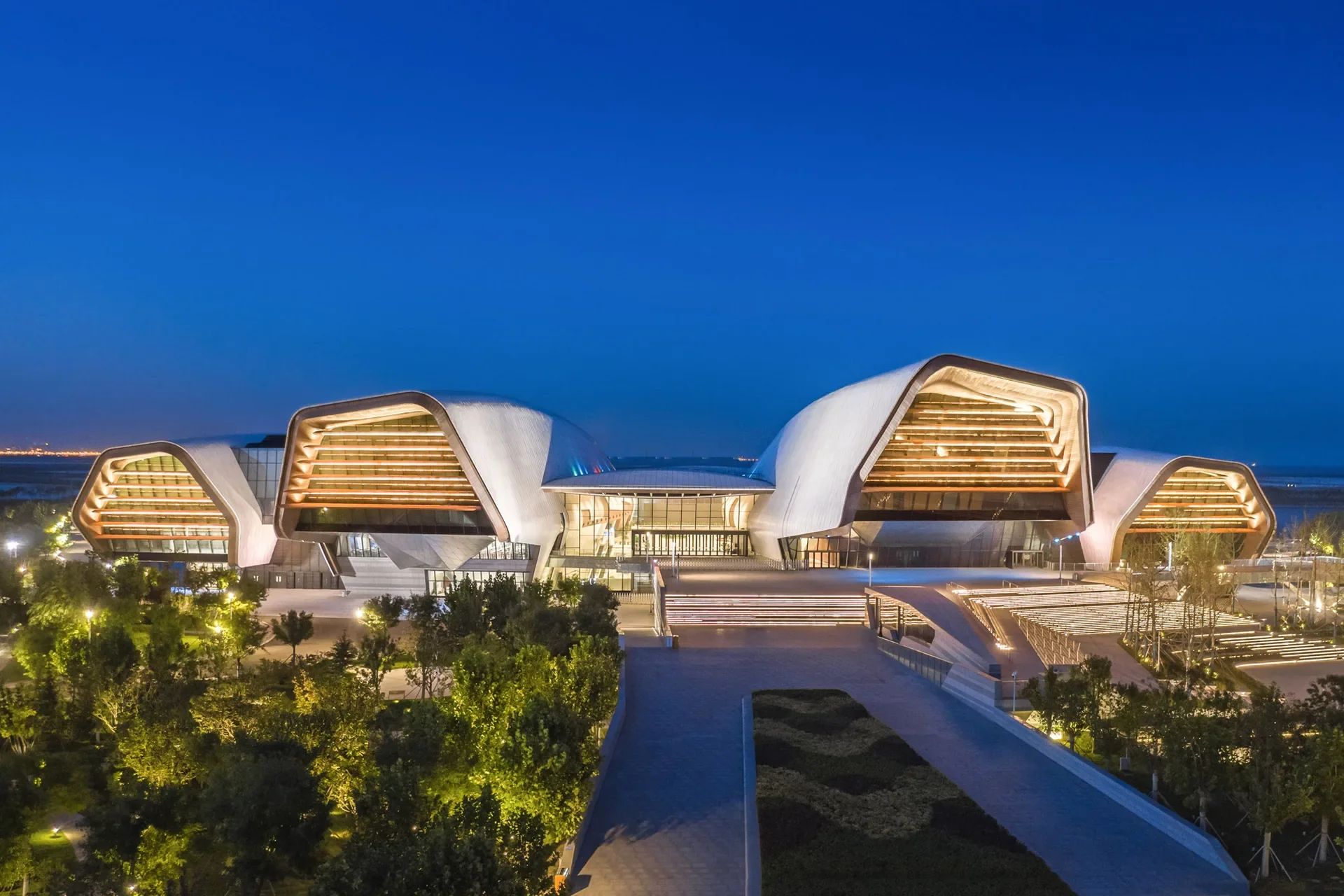
"The China Maritime Museum sits on the shore of Dishui Lake (滴水湖) in Shanghai's Lingang New City — a remote Pudong location that means it receives far fewer visitors than it deserves. The 2010 building is shaped like a billowing sail and contains a full-size replica of a Ming Dynasty treasure ship's prow rising through the central atrium. The collection covers Chinese maritime history from the Warring States period through the modern PLA Navy, with its strongest section devoted to the Ming Dynasty treasure fleets of Admiral Zheng He (郑和, 1371-1433), whose 1405-1433 voyages reached Southeast Asia, India, the Arabian Peninsula, and East Africa with fleets of up to 300 ships and 28,000 men — decades before Columbus crossed the Atlantic in three ships with 90 men. The museum displays detailed models of Zheng He's treasure ships (宝船, estimated 125 meters long by contemporary accounts), navigation instruments, and replica trade goods (silk, porcelain, spices). Other galleries cover ancient Chinese compass technology, the Maritime Silk Road porcelain trade, modern container shipping, and a children's interactive zone.".
Last updated:
Quick Answer
Is China Maritime Museum worth visiting?
"Maritime Silk Road, Zheng He's treasure ships, and a full-size Ming Dynasty junk replica inside a sail-shaped building near Dishui Lake. China's national maritime museum. ¥50.".
Quick facts
| Category | specialty |
|---|---|
| Ticket | ¥50 (as of June 2026). Purchase at the ticket office or via the museum WeChat account. Children under 1.3 m free. Students half price with valid ID. |
| Hours | 9:30-16:00 (last entry 15:30). Closed Mondays. |
| Recommended duration | 2.5-3 hours. |
| Best time to visit | Weekday mornings. The museum is in a remote location and is rarely crowded even on weekends. The Lingang area is windy year-round — the museum interior is comfortable in any weather. |
| How to get there | Metro Line 16 to Dishui Lake (滴水湖), Exit 1. From the station, take bus Shenggang 1 Road (申港1路) or Lingang 4 Road (临港4路) direct to the China Maritime Museum stop, or walk 20 minutes along the lake. DiDi from central Shanghai costs ¥180-250 one way (approximately 75-90 minutes, 70+ km). Buses are infrequent — DiDi is the practical choice. Alternatively, Line 16 express bus from Longyang Road station to Dishui Lake takes 30 minutes. |
| English signage | yes |
Why visit
The full-size treasure ship prow rising through the atrium is one of the most dramatic museum installations in Shanghai. The Zheng He gallery provides essential context for understanding the scale of Ming Dynasty maritime ambition — a story that is under-told outside China. The navigation technology gallery, tracing the Chinese compass from Han Dynasty diviner's boards to Ming mariner's compasses, is also excellent.
Collection highlights
- Full-size Ming treasure ship prow replica — the bow of a reconstructed treasure ship (宝船) rising through the central atrium, built to estimated dimensions from historical texts. The ribbed wooden hull structure demonstrates Ming shipbuilding at its peak
- Zheng He navigation gallery — replica mariner's compass, star charts, sounding leads, and route maps showing the seven voyages (1405-1433) from Nanjing to East Africa. The voyage route animations are particularly clear
- Han Dynasty pottery ship model — a ceramic tomb model of a river boat with rudder, oarsmen, and a deck cabin, Eastern Han Dynasty (25-220 AD), demonstrating China's early adoption of the stern-post rudder (1,000 years before Europe)
- Maritime Silk Road porcelain cargo — Ming Dynasty blue-and-white export porcelain recovered from shipwrecks in the South China Sea, including the famous "Hatcher Cargo" (circa 1643) from a wreck near Indonesia
- South-Pointing Fish (指南鱼) — a Song Dynasty compass using a magnetized iron fish floating in water, the earliest form of the mariner's compass. The museum has a replica showing how it worked
- Modern container ship model — a 1:200 scale model of a COSCO ultra-large container vessel (20,000+ TEU capacity) with cutaway showing cargo holds, bridge, and engine room
Tips
- The museum is FAR from central Shanghai — Dishui Lake is about 70 km southeast of the Bund. Allocate at least 3 hours of travel time round-trip. The journey is worth it for maritime enthusiasts but casual visitors should be aware of the distance
- I visited in June 2026 and the treasure ship prow replica was even more impressive in person — the scale of the wooden hull ribs (each the thickness of a tree trunk) communicates Ming shipbuilding ambition better than any model or illustration
- Combine with a visit to the Shanghai Haichang Ocean Park (上海海昌海洋公园, adjacent) for a full family day in Lingang, or with a walk around Dishui Lake (the largest artificial lake in Shanghai, 5.56 sq km)
- The museum cafe serves basic drinks and snacks — there is a better food court at Lingang New City commercial center (临港新城商业中心, 2 km) near the Metro station
- The museum shop sells Zheng He treasure ship model kits (¥120-400) and nautical compass replicas — all high quality
- The interactive children's zone (knot-tying, semaphore signaling, paper boat building) is one of the best museum children's areas in Shanghai
Frequently asked questions
Who was Zheng He?
Zheng He (郑和, 1371-1433) was a Ming Dynasty admiral, diplomat, and explorer who led seven naval expeditions across the Indian Ocean between 1405 and 1433. Born a Muslim named Ma He in Yunnan, he was captured as a boy by Ming forces, castrated, and assigned to serve the future Yongle Emperor in Beijing. As a trusted eunuch-admiral, he commanded fleets of up to 317 ships and 28,000 men, visiting Southeast Asia, India, the Arabian Peninsula, and East Africa (reaching as far south as modern Mozambique). His treasure ships, by contemporary accounts, were approximately 125 meters long — four times the length of Columbus's Santa Maria. The voyages established Chinese tributary relations across the Indian Ocean and collected exotic gifts (giraffes, zebras, ostriches) for the Ming court. After Zheng He's death, the treasure fleet was disbanded and China turned inward — the voyages were never repeated.
Why is the China Maritime Museum so far from central Shanghai?
The museum was built in Lingang New City (临港新城) as part of a broader plan to develop Shanghai's deep-water port area and decentralize cultural institutions from the city center. Dishui Lake, the museum's location, is adjacent to the Yangshan Deep-Water Port — one of the world's busiest container ports. Placing the national maritime museum next to an actual working port was a deliberate thematic choice. The distance is significant (70+ km from the Bund) and visiting requires planning, but the location near the port adds context.
How big were Zheng He's treasure ships?
According to the Ming Dynasty text "History of Ming" (明史, compiled 1679-1739), Zheng He's largest treasure ships (宝船) were 44 zhang (约 137 m) long and 18 zhang (约 56 m) wide, with nine masts. This would make them the largest wooden ships ever built. Modern scholars debate these dimensions — some consider them exaggerated, while others point to the 11-meter-long rudder post discovered at the Ming shipyard in Nanjing as physical evidence supporting very large hulls. The museum presents both the traditional dimensions and the scholarly debate.
Is the China Maritime Museum suitable for children?
Yes, more so than most specialty museums. The central atrium with the treasure ship prow is immediately engaging for all ages. The children's interactive zone (2F) has hands-on activities: knot-tying stations, semaphore flag signaling, a paper boat-building workshop, and a simple navigation simulator. The museum also runs weekend family workshops (check the WeChat account for schedules). The full-size ship models throughout the museum hold attention well.
What is the Maritime Silk Road?
The Maritime Silk Road (海上丝绸之路) was the sea-based counterpart to the overland Silk Road, connecting Chinese ports (Quanzhou, Guangzhou, Ningbo) with Southeast Asia, India, the Persian Gulf, and East Africa from the Han Dynasty (206 BC) through the Ming Dynasty (1368-1644). Unlike the overland route, which carried primarily luxury goods (silk, jade), the maritime route moved bulk commodities — porcelain, tea, spices, and later silver. The China Maritime Museum traces this entire history with a particular focus on the Song-Yuan-Ming peak period (10th-15th centuries) when Chinese maritime technology led the world.
How do I get to the China Maritime Museum from central Shanghai?
The most practical route: Metro Line 16 from Longyang Road (龙阳路) to Dishui Lake (滴水湖), the terminal station. The express Line 16 service takes about 30 minutes; the regular service about 60 minutes. From Dishui Lake station, either take a DiDi (10 minutes, ¥15) or bus Shenggang 1 Road to China Maritime Museum stop. Driving or DiDi from central Shanghai takes 75-90 minutes (¥180-250 one way) via the S2 expressway. The museum has a large parking lot.
Read next
Other things to do in Shanghai
Century Park
century-park in Beijing: "浦东最大公园,140公顷,草地音乐节,赏花好去处.".
City God Temple (Chenghuang Temple)
city-god-temple in Beijing: "上海老城厢文化核心,豫园商圈,小商品市场.".. 2026 verified.
Sweet Love Road (Dixing Road)
dixing-road in Beijing: "上海最浪漫街道,300米梧桐隧道,网红打卡地.".
Hefang Street (Near West Lake)
hangzhou-park in Beijing: 清河坊历史街区,杭州最著名古街,南宋1000多年历史,免费。地铁1号线定安路站步行10分钟,胡庆余堂、方回春堂等百年老店汇聚。
Oriental Pearl Tower
oriental-pearl-tower in Beijing: "上海地标,468米,旋转餐厅,俯瞰夜景最佳点.".
Shanghai Disneyland
The first Disney park on mainland China, open since June 2016 in Pudong, with the tallest Disney castle anywhere (~60 m) and rides you can't get elsewhere like TRON and the redesigned Pirates.…
Shanghai Tower
shanghai-tower in Beijing: "中国最高楼,632米,世界第二高,龙形螺旋设计.".
The Bund
the-bund in Beijing: "52栋历史建筑群,上海名片,万国建筑博览会,夜景最佳.".
World Financial Center (Shanghai IFC)
world-financial-center in Beijing: "陆家嘴三件套之一,开瓶器造型,100层观光厅.".
Zhujiajiao Water Town
"A 1,700-year-old canal town 45 minutes from Shanghai — stone bridges, boat rides, and lane food. Free entry (attractions cost extra). Half day.".
Museums in Shanghai
M50 Art District
"A converted 1930s wool-spinning mill on Moganshan Road now hosting 130+ artist studios and galleries; plan 2–3 hours for a real walk-through, not a quick photo stop.".
China Art Museum
"Modern and contemporary Chinese art in the striking former China Pavilion from Expo 2010. Free entry. Home of the animated digital \"Along the River During the Qingming Festival.\".".
HOW Art Museum
"A private contemporary art museum in Pudong with about 3,000 sqm of exhibition space, walkable in 90 minutes if you skip the gift-shop vortex.".
Long Museum (Pudong)
"Two million RMB and eight years of collecting went into this private art museum in the Pudong riverfront — set aside about 2 hours and arrive before noon.".
Long Museum West Bund
"Shanghai's largest private art museum inside a former coal物流 warehouse — 33,000 sqm of contemporary and modern Chinese art, the Wang Jianwei installation,.".
Power Station of Art
"China's first state-run contemporary art museum, set inside a converted 1897 British-built coal-fired power plant on the Huangpu River — admission is free and 2-3 hours covers the main halls.".
Rockbund Art Museum
"Contemporary art in a striking 1933 Art Deco building on the Bund. ¥50. Rotating exhibitions by Chinese and international artists. The building rivals the art.".
Shanghai History Museum
"Shanghai's journey from fishing village to 1930s \"Paris of the East\" — told through artifacts, photographs, and immersive street scenes. Below the Oriental Pearl Tower. Free.".
Shanghai Museum
"\"China's best museum for ancient Chinese art — 5 floors of masterworks: ancient bronzes, jades, ceramics, calligraphy, paintings, coins, and Ming-Qing家具. Free. Located on People's Square.\".".
Shanghai Natural History Museum
"A world-class natural history museum inside Shanghai's famous \"Plant-Bulb\" building on People's Square — 10 million specimens, evolution galleries,.".
Shanghai Propaganda Poster Art Centre
"Private collection of Mao-era propaganda posters in a basement gallery. ¥20. One of Shanghai's most distinctive small museums. A window into 20th-century Chinese political art.".
Power Station of Art
"Shanghai's state-run contemporary art museum inside a former thermal power plant — China's first state-run contemporary art museum,.".. 2026 verified.
Shanghai Science and Technology Museum
"A family-oriented science museum with robot musicians, a walk-through animal world, and Shanghai's best hands-on physics exhibits — budget a full afternoon (4–5 hours). ¥60 adults, ¥30 students.".
Shanghai Urban Planning Museum
"A 5-floor museum inside Shanghai's municipal government building showing the city's past, present, and future urban planning — the highlight is a 1:500 scale model of Shanghai in 2035. ¥50.".