Shanghai · art museum
Power Station of Art (上海当代艺术博物馆, Shànghǎi Dāngdài Yìshù Bówùguǎn)
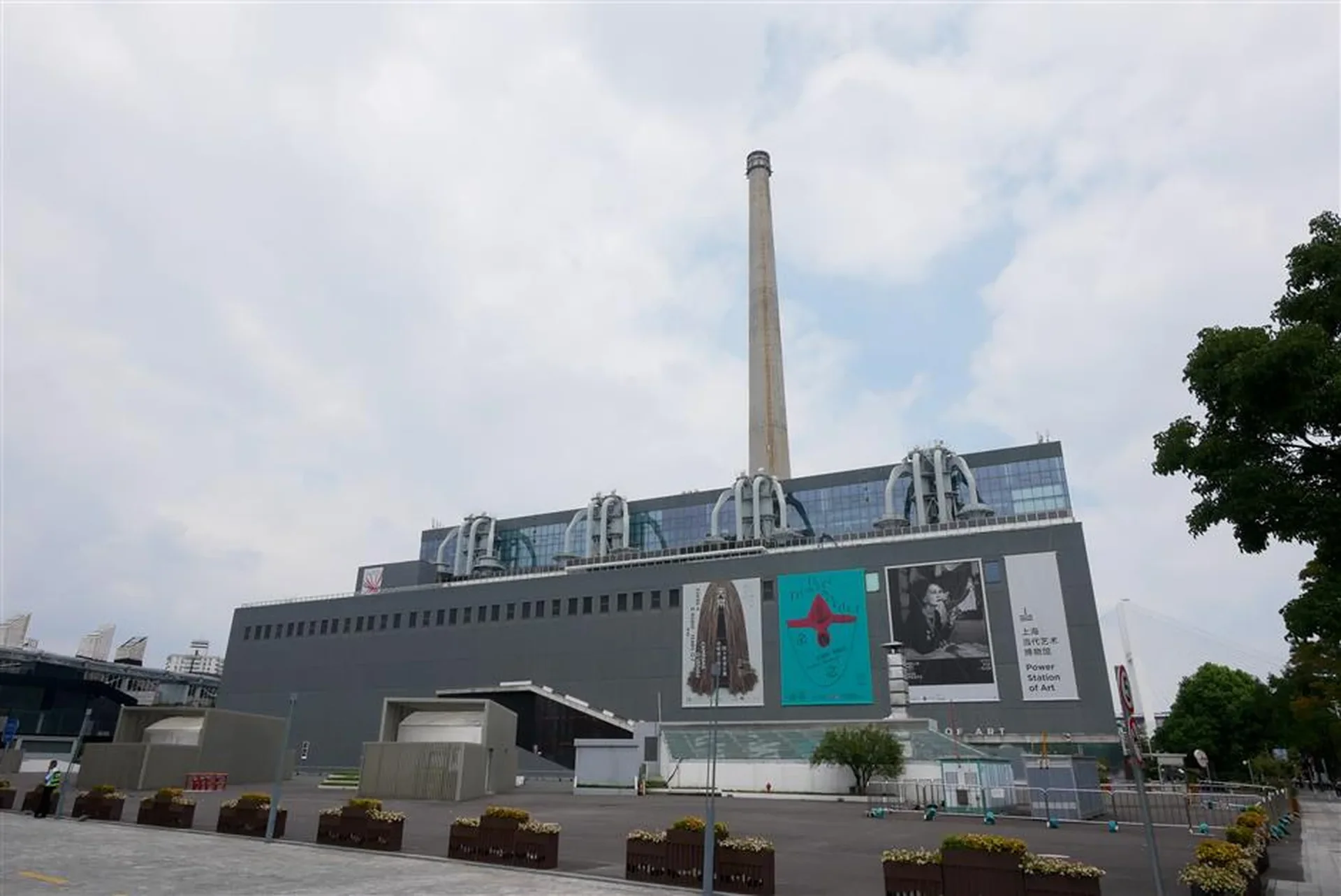
"Power Station of Art (PSA) opened in October 2012 during the Shanghai Biennale, taking over the decommissioned Nanshi Power Station built originally in 1897 and rebuilt in 1955 as a coal-fired plant. It spans roughly 41,000 square meters of exhibition space — by floor area the largest state-run contemporary art museum in mainland China. The complex retains the original 165-meter chimney and coal-hopper hall, with the cavernous turbine hall now used as the central gathering space for the Shanghai Biennale.".
Last updated:
Quick Answer
Is Power Station of Art worth visiting?
"China's first state-run contemporary art museum, set inside a converted 1897 British-built coal-fired power plant on the Huangpu River — admission is free and 2-3 hours covers the main halls.".
Quick facts
| Category | art |
|---|---|
| Ticket | Free (as of 2026); special exhibitions occasionally charge 60-100 CNY. (verify) |
| Hours | Tuesday-Sunday 10:00-18:00 (last entry 17:00); closed Mondays except national holidays. (verify) |
| Recommended duration | 2-3 hours for the main galleries; add 1 hour if a major temporary exhibition is running. |
| Best time to visit | Weekday afternoons (Tuesday-Thursday, 14:00-16:00) for the fewest tour groups; avoid the Shanghai Biennale opening weeks in November when queues can stretch 45 minutes. |
| How to get there | Metro Line 4 or Line 8 to Lupu Bridge Station, Exit 2, then 8-minute walk south along the river — do NOT take Exit 1, it puts you on the wrong side of the elevated road. Taxi from People's Square runs 35-45 CNY and 20-30 minutes depending on Yan'an Elevated traffic. Bus 18, 36, 146 stop outside the main gate. (verify) |
| English signage | yes |
Why visit
PSA is where you go when M50 feels too gallery-clubby and the Long Museum too privately curated. Because it's free, state-run, and right across the river from the Expo site, it consistently lands the most ambitious international travelling shows — a 2023 Anish Kapoor retrospective, the 13th Shanghai Biennale in 2024, and a steady rotation of younger Chinese artists who will be quoted prices in five years. The brutalist industrial bones also mean the building itself is the exhibit: you walk under the original gantry cranes and through the former coal yard. If you've already done the Bund and Yu Garden, this is the single best way to spend a Tuesday afternoon in Shanghai without paying a yuan.
Collection highlights
- The 165-meter preserved brick chimney (visible from across the river and from Lupu Bridge)
- Turbine Hall — 35-meter-tall central space holding the Biennale anchor installations
- 5-7F "Building 5" permanent exhibition tracing the plant's history from 1897 Nanshi Power Station to 2007 decommissioning
- Riverside coal yard and gantry crane preserved as outdoor sculpture court
- Shanghai Biennale main venue every two years (most recent 13th edition, November 2024 - March 2025)
- Past ticketed shows have included Anish Kapoor (2023), John Akomfrah (2019), and the Cai Guo-Qiang "My Broom Has Two Strokes" smoke-drawing commission
Tips
- Bring photo ID — entry requires scanning a Chinese ID, passport, or WeChat mini-program QR code at the gate; foreigners tap passport on the reader at the left kiosk.
- Skip the official audio guide (60 CNY) — wall labels are bilingual and most PSA curators write tighter English copy than the audio script.
- The 3F café has river-view seating but charges 35-50 CNY for a flat white; cheaper to walk 10 minutes to the Taikoo Li Qiantan cafes if you have time.
- Free Wi-Fi works only on the ground floor and 1F; download offline maps before ascending.
- Photography is allowed without flash for permanent collection, but rotating special exhibitions often ban photos entirely — check the signage at each doorway, guards will yell.
Frequently asked questions
Is the Power Station of Art actually free?
Yes — general admission to the permanent collection and most halls is free as of 2026. Ticketed special exhibitions (e.g., the Anish Kapoor 2023 show) typically ran 60-100 CNY; check the PSA WeChat account the week of your visit for any current paid shows.
When was the Power Station of Art built?
The original Nanshi Power Station was built in 1897 by the British as one of Shanghai's first coal-fired plants; the surviving art-deco structure dates to a 1955 rebuild. The site was decommissioned in 2007 and reopened as PSA on October 1, 2012, timed to the 9th Shanghai Biennale.
How big is the Power Station of Art?
About 41,000 square meters of exhibition space across multiple halls — by floor area it is the largest state-run contemporary art museum in mainland China. The Turbine Hall alone is roughly 35 meters tall.
Which metro station is closest to the Power Station of Art?
Lupu Bridge Station on Line 4 or Line 8. Use Exit 2 and walk 8 minutes south along Miaojiang Road toward the river; Exit 1 spits you out on the wrong side of the elevated road.
Does PSA have an English audio guide?
It does at 60 CNY, but the English wall labels are typically better written than the audio narration — most regulars skip it.
How long does it take to visit the Power Station of Art?
Plan 2-3 hours for the permanent collection and 3-4 hours if a major ticketed exhibition is on; the Biennale opening weeks can take a full half-day.
Is the Power Station of Art accessible for wheelchairs?
Yes — elevators connect all gallery floors and the riverside terrace, ramps run through the Turbine Hall, and accessible restrooms are on each floor. Borrow a wheelchair at the 1F information desk free of charge.
Can I take photos inside PSA?
Yes without flash in the permanent galleries, but special exhibitions often ban photography entirely — look for the red 禁止拍照 (no photos) signs at each doorway, security will enforce it.
What is the Shanghai Biennale and when does it run?
A major international contemporary art exhibition held every two years since 1996; PSA has been the main venue since 2012. The 13th edition ran November 2024 to March 2025; expect the 14th in late 2026.
Is PSA worth it if I only have half a day in Shanghai?
Only if contemporary art is a priority — the Bund and Yu Garden are a more efficient half-day for first-timers. PSA is the right call if you have already seen the classics and want a half-day that is free, indoor, and air-conditioned.
Read next
Other things to do in Shanghai
Century Park
century-park in Beijing: "浦东最大公园,140公顷,草地音乐节,赏花好去处.".
City God Temple (Chenghuang Temple)
city-god-temple in Beijing: "上海老城厢文化核心,豫园商圈,小商品市场.".. 2026 verified.
Sweet Love Road (Dixing Road)
dixing-road in Beijing: "上海最浪漫街道,300米梧桐隧道,网红打卡地.".
Hefang Street (Near West Lake)
hangzhou-park in Beijing: 清河坊历史街区,杭州最著名古街,南宋1000多年历史,免费。地铁1号线定安路站步行10分钟,胡庆余堂、方回春堂等百年老店汇聚。
Oriental Pearl Tower
oriental-pearl-tower in Beijing: "上海地标,468米,旋转餐厅,俯瞰夜景最佳点.".
Shanghai Disneyland
The first Disney park on mainland China, open since June 2016 in Pudong, with the tallest Disney castle anywhere (~60 m) and rides you can't get elsewhere like TRON and the redesigned Pirates.…
Shanghai Tower
shanghai-tower in Beijing: "中国最高楼,632米,世界第二高,龙形螺旋设计.".
The Bund
the-bund in Beijing: "52栋历史建筑群,上海名片,万国建筑博览会,夜景最佳.".
World Financial Center (Shanghai IFC)
world-financial-center in Beijing: "陆家嘴三件套之一,开瓶器造型,100层观光厅.".
Zhujiajiao Water Town
"A 1,700-year-old canal town 45 minutes from Shanghai — stone bridges, boat rides, and lane food. Free entry (attractions cost extra). Half day.".
Museums in Shanghai
M50 Art District
"A converted 1930s wool-spinning mill on Moganshan Road now hosting 130+ artist studios and galleries; plan 2–3 hours for a real walk-through, not a quick photo stop.".
China Art Museum
"Modern and contemporary Chinese art in the striking former China Pavilion from Expo 2010. Free entry. Home of the animated digital \"Along the River During the Qingming Festival.\".".
China Maritime Museum
"Maritime Silk Road, Zheng He's treasure ships, and a full-size Ming Dynasty junk replica inside a sail-shaped building near Dishui Lake. China's national maritime museum. ¥50.".
HOW Art Museum
"A private contemporary art museum in Pudong with about 3,000 sqm of exhibition space, walkable in 90 minutes if you skip the gift-shop vortex.".
Long Museum (Pudong)
"Two million RMB and eight years of collecting went into this private art museum in the Pudong riverfront — set aside about 2 hours and arrive before noon.".
Long Museum West Bund
"Shanghai's largest private art museum inside a former coal物流 warehouse — 33,000 sqm of contemporary and modern Chinese art, the Wang Jianwei installation,.".
Rockbund Art Museum
"Contemporary art in a striking 1933 Art Deco building on the Bund. ¥50. Rotating exhibitions by Chinese and international artists. The building rivals the art.".
Shanghai History Museum
"Shanghai's journey from fishing village to 1930s \"Paris of the East\" — told through artifacts, photographs, and immersive street scenes. Below the Oriental Pearl Tower. Free.".
Shanghai Museum
"\"China's best museum for ancient Chinese art — 5 floors of masterworks: ancient bronzes, jades, ceramics, calligraphy, paintings, coins, and Ming-Qing家具. Free. Located on People's Square.\".".
Shanghai Natural History Museum
"A world-class natural history museum inside Shanghai's famous \"Plant-Bulb\" building on People's Square — 10 million specimens, evolution galleries,.".
Shanghai Propaganda Poster Art Centre
"Private collection of Mao-era propaganda posters in a basement gallery. ¥20. One of Shanghai's most distinctive small museums. A window into 20th-century Chinese political art.".
Power Station of Art
"Shanghai's state-run contemporary art museum inside a former thermal power plant — China's first state-run contemporary art museum,.".. 2026 verified.
Shanghai Science and Technology Museum
"A family-oriented science museum with robot musicians, a walk-through animal world, and Shanghai's best hands-on physics exhibits — budget a full afternoon (4–5 hours). ¥60 adults, ¥30 students.".
Shanghai Urban Planning Museum
"A 5-floor museum inside Shanghai's municipal government building showing the city's past, present, and future urban planning — the highlight is a 1:500 scale model of Shanghai in 2035. ¥50.".