Lijiang Travel Guide
Summary
Lijiang (丽江) is a city of about 1.2 million people at 2,400 meters in northwest Yunnan, on the old road between Kunming and the Tibetan borderlands. Travelers come for three things: the UNESCO-listed Dayan old town, a lattice of canals and timber courtyards built by the Naxi people; Jade Dragon Snow Mountain (玉龙雪山), whose 5,596-meter summit wall stands about 15 kilometers north of the city center; and Lijiang's role as the logistics base for the wider region — Tiger Leaping Gorge, Lugu Lake and Shangri-La are all planned from here.
We wrote this guide for visitors with two to four days and a preference for straight answers. Which of the three old towns should you sleep in, and does it matter? (It matters more than any other decision you will make here.) How do you get a Jade Dragon Snow Mountain cableway ticket before they sell out? What does the 50-80 CNY ancient-town maintenance fee actually buy? Where do you eat when every second shop on the main lanes sells the same grilled yak skewers?
Our position is blunt: Lijiang is both better and worse than its reputation. The core of Dayan at 2 p.m. in August is close to unwalkable — tour flags, loudspeakers, wall-to-wall souvenir shops. The same lanes at 7:30 a.m., or in Baisha village ten kilometers north in any season, are among the finest low-effort city experiences in China. The gap between a mediocre visit and a great one here is timing and geography, not budget, and every recommendation below is organized around closing that gap.
Why Lijiang
Most Chinese cities of this size are forgettable administrative centers. Lijiang is the exception because three histories intersect here.
First, it is the seat of the Naxi (纳西), a people of roughly 300,000 whose ancestors migrated down from the Tibetan plateau and settled this valley over a thousand years ago. The Naxi kept their own religion (Dongba, shamanic with strong Tibetan Buddhist influence), their own orchestra tradition, and — uniquely — a living pictographic script. Dongba characters, about 1,400 of them, look like small drawings: a man, a horse, an eye. It is the only pictographic writing system still in ceremonial use anywhere, and you will see it on shop signs, temple murals and handwritten scrolls in the Dongba museum. This is not heritage-park theater; a small number of practicing Dongba priests still perform rites in the villages.
Second, the city sits where the Tea Horse Road (茶马古道) — the mule caravan route that swapped Yunnan tea for Tibetan horses — dropped out of the mountains toward Dali and Kunming. Dayan grew rich as a trading town, and its layout shows it: no city walls (the ruling Mu clan's surname, 木, enclosed in a wall 口, would form the character for "trapped," so walls were never built), canals drawn from the Black Dragon Pool springs, and Sifang Street as the market square where caravans met.
Third, geography. The north end of the valley is blocked by Jade Dragon Snow Mountain, a thirteen-peak massif sacred to the Naxi that tops out at 5,596 meters. From the roofline of the old town the mountain dominates the sky on clear days. Very few cities anywhere have a glaciated 5,000-meter wall this close to the market square.
The 1996 earthquake (magnitude about 7) killed around 300 people, flattened much of the old town, and accidentally started the modern tourism economy: the reconstruction was done largely in traditional materials and joinery, and in December 1997 UNESCO inscribed the old town — Dayan together with Shuhe and Baisha — as a World Heritage Site. What you walk through today is a rebuilt 800-year-old town, and an honest guide should say so.
Who Lijiang suits: photographers, hikers, culture-first travelers, and anyone using it as a base for the gorge-and-plateau loop to the north. Who it does not: travelers who need step-free streets (the old towns are cobblestone-and-stair environments with no vehicle access), anyone planning heavy nightlife (this is a small city that sleeps early outside two streets), and visitors for whom the altitude itself is a medical question — 2,400 m in town, 4,680 m at the mountain boardwalk, and both numbers deserve respect.
Top Attractions
We rank the sights below in descending order of how much they reward your time. All five can be covered in two full days; each also works as a standalone half-day if your itinerary is tighter.
Lijiang Old Town and Sifang Street (丽江古城与四方街)
Dayan old town is the reason Lijiang is famous. Enter from any of a dozen unmarked lanes: there is no gate and no entry ticket, only the sporadically checked maintenance fee. The layout is a deliberate maze — the Naxi built it that way on purpose, and GPS signal degrades in the narrow lanes, so expect to be lost for the first hour. Consider that part of the design, not a failure of yours.
Sifang Street (四方街, "Four Directions Street") is the old market square at the center, paved with cobblestones set in patterns that were, by tradition, the caravans' message board. Five commercial streets radiate from it: Xinhua (the bar strip at night), Dongdajie (tourist retail), Wuyi (eateries), plus Guangbi and Xinyi. The canal network splits into three channels through town, and in the evenings the sluices are raised to wash the stones — a practice running back centuries, and worth catching once at dusk.
What earns its time: the Mu Mansion (木府, entry roughly 40-60 CNY), the rebuilt seat of the hereditary Mu rulers — a convincing complex of halls, courtyard and gardens, and the best 90 minutes of imperial-era history on offer in town; the climb up Lion Hill (狮子山) through cedar shade to Wangu Tower (万古楼, roughly 30-50 CNY) for the view over the sea of grey-tiled roofs with the snow mountain behind; and the morning market streets east of the center, where locals shop before 9 a.m. and the price of mangoes is a third of the old-town number.
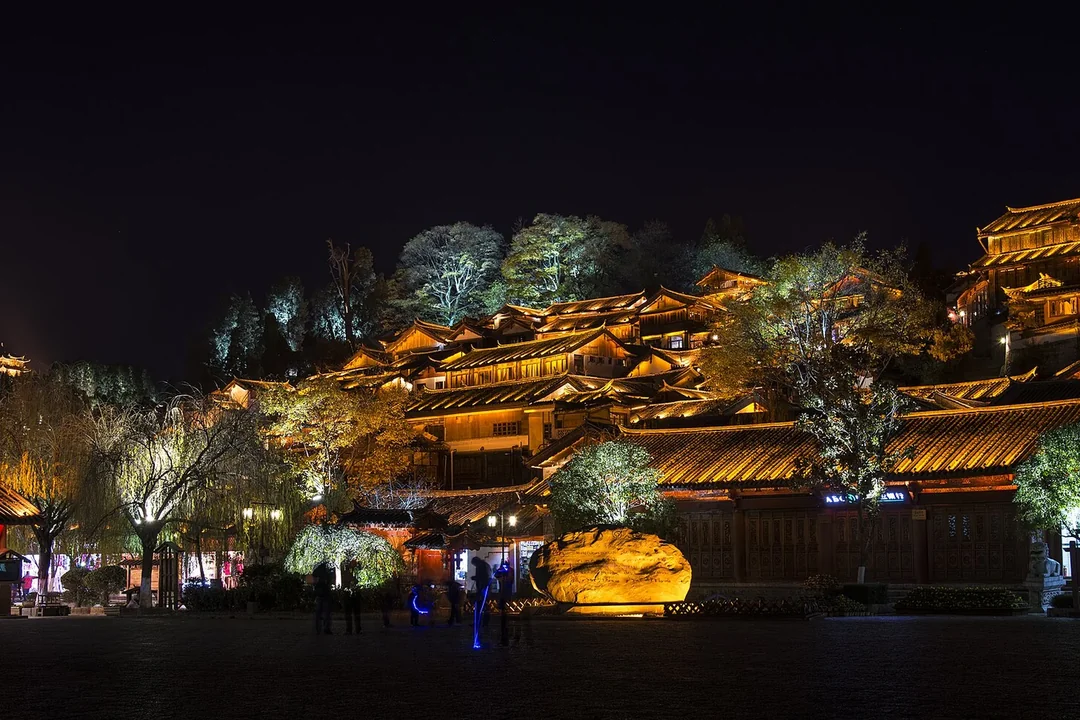
What to skip: the "free" tea tastings that end in a 400-CNY cake of average tea, and the costume-and-drum photo setups on Sifang Street. Evening is the old town's best hour — lanterns over the canals around Big Stone Bridge (大石桥), rooftop bars full, the noise oddly charming from one street away. Our verdict, plainly: the old town earns its fame at 7 a.m. and again at 8 p.m., and loses it between 11 and 5.
Jade Dragon Snow Mountain and Blue Moon Valley (玉龙雪山与蓝月谷)
The mountain is the main excursion, and most visitors do it badly because of three logistical traps. Handled correctly, it is the single best day trip from Lijiang.
The tickets: scenic-area entry is about 100 CNY; the big cableway (大索道), which runs to a station at 4,506 m, costs roughly 120-140 CNY; the mandatory eco-bus is around 20 CNY; the optional electric cart at Blue Moon Valley is 50-60 CNY. Impression Lijiang (印象丽江) — the outdoor show staged by 500 local performers from ten ethnic groups in a natural amphitheater at 3,100 m, produced by Zhang Yimou's team — adds roughly 190-280 CNY. Total for a full independent day: 430-600 CNY per person before transport. Tours quoting much less are subsidizing the difference with shopping stops.
The traps: one, cableway tickets are real-name, quota-limited, and sell out days ahead in peak season — book through the official "玉龙雪山" WeChat mini-program, Trip.com, or your hotel the moment your dates are fixed, and carry the passport you booked with. Two, the weather decides everything: the summit cableway closes in high wind, and in July-August the peak sits behind cloud more often than not. Check the morning of, go early (first cabins around 7:30), and treat a sold-out or weather-closed summit as a scheduling problem, not a disaster — the lower cableways and the valley still deliver. Three, altitude. The top station is 4,506 m and the boardwalk climbs to 4,680 m — over 2,200 m above the city. Walk slowly and steadily, skip the previous night's alcohol, hydrate aggressively, and rent oxygen at the base (40-100 CNY) rather than buying at the top station at panic prices. Down coats rent for 30-50 CNY; even in summer the summit air is near freezing. Visitors with cardiac or respiratory conditions should be content with the views from below.
Blue Moon Valley (蓝月谷), at the mountain's foot inside the same ticket, is a run of stepped pools in mineral blue under white travertine banks — congested at midday, nearly empty if you can push your visit to late afternoon on the way out. If the big cableway is sold out, the lower Spruce Meadow (云杉坪) and Yak Meadow (牦牛坪) cableways are worthwhile substitutes with a fraction of the crowd. One honest note: the glacier has retreated sharply over recent decades. What you see from the top is real but diminished, whatever the postcards imply.
Shuhe Ancient Town (束河古镇)
Shuhe, 6-7 km northwest of Dayan, is officially part of the same World Heritage inscription and unofficially "Dayan fifteen years ago" — an older, smaller caravan town along the Qinglong stream, with coppersmith workshops, courtyard cafes and dramatically fewer tour groups. It is where we send travelers who liked the idea of the old town but not the reality of it.
A taxi or Didi runs 20-30 CNY from Dayan, and local buses connect the two for pocket change. Give it half a day: Shuhe's own smaller Sifang Street, the Longquan temple end of town where the stream runs shallow and clear, and the back lanes north of the square where guesthouses sit inside vegetable gardens. Horses are still led down the main street in keeping with the caravan past; the staged rides are skippable — we would rather walk.
Shuhe also holds the better courtyard-boutique inventory at mid prices, and its evenings are quieter: fire pits, a handful of live-music bars, restaurants that close by 11. If your image of Lijiang is writing postcards beside a canal rather than bar-crawling beside one, base yourself here and commute into Dayan for the big evenings.
Black Dragon Pool Park (黑龙潭公园)
At the north edge of Dayan, Black Dragon Pool is a spring-fed pond holding the single most photographed view in Yunnan: the Moon-Embracing Pavilion (得月楼) and a marble bridge in the foreground, Jade Dragon Snow Mountain framed behind, all doubled in the water on still mornings. That composition is on the cover of half the guidebooks in the province. Go before 10 a.m., before the breeze roughs the surface and the tour groups arrive — and know that in drought years the pool has dropped low enough to lose the reflection entirely, so manage expectations in a dry spring.
Entry has historically been covered by your maintenance-fee receipt, so keep that ticket. The park around the pool is where Lijiang actually lives in the mornings: pensioners with caged birds, tai chi groups, noodle picnics on the grass banks. The Dongba Culture Museum on the park grounds displays genuine Dongba manuscripts, ritual objects and script charts — thirty well-spent minutes if the murals at Baisha interested you. The pool is fed by the same aquifer that supplies the old town canals, which is why the health of these springs is a permanent local political issue: without this water there would be no Dayan.
Baisha Village (白沙古镇)
Baisha, about 10 km north, was the Naxi capital before the Mu clan moved down-valley to Dayan, and it retains what the bigger towns now perform: single-story mud-wall and timber houses, farmland reaching to the edge of the village, and a main street you can walk end to end in twenty minutes. The three reasons to come are the Ming-dynasty Baisha Murals (白沙壁画, entry around 30 CNY), painted across three centuries in a fusion of Han Chinese, Tibetan and Naxi religious styles inside Dabaoji Palace; the embroidery institute opposite, where double-sided needlework of genuinely rare difficulty is done in front of you; and the mountain view straight up the main street on any clear day.
Buses from town are infrequent; a Didi is 20-35 CNY each way, or rent a bicycle — the route out past the fields is flat, rural and safe by Chinese road standards. Baisha pairs naturally with a Shuhe stop on the same half-day loop. We rank it above both bigger old towns for a free afternoon: no ticket gates, almost no amplifiers, and cafes where the average customer stays two hours, not twenty minutes.
Where to Stay
The where-to-stay decision in Lijiang is really which town to live in. We would decide it as follows.
Dayan (inside the old town) is the atmospheric choice: courtyard guesthouses with carved timber screens and canals under the bedroom window. Prices run about 200-450 CNY for a decent courtyard double and 450-900 CNY for the design boutiques; dorm beds in the social hostels go for 60-120 CNY. The costs are equally real: no vehicles inside the old core, so you haul luggage over cobblestones (arrange a gate pickup with your host — they do this daily and expect the request), sound carries across courtyards until the bar strip closes, and breakfast is whatever your guesthouse serves. Pick a property north or east of Sifang Street, away from Xinhua Street's noise, and read recent reviews specifically for the word "quiet."
Shuhe is our default recommendation for most first-time visitors. The same timber-and-tile aesthetic at slightly lower prices (150-400 CNY mid-range), quieter nights, better mid-priced boutique stock, and a 20-30 CNY, fifteen-minute taxi to Dayan for the evenings you want it. The trade is distance: you will commute in for dinner at least twice, and late-night taxis back get scarcer after midnight.
The new district (south and east of the old town) holds the business hotels and the international five-stars — some of the best-value luxury rooms in China at 800-2,000 CNY, with reliable heating, gyms and elevators, and a ten-minute drive to the old-town gates. Stay here for early trains or flights, for mobility-impaired travelers, or when a courtyard room in a wet January holds no romance.
Booking timing: two to three weeks ahead for March-May and September-November, and months ahead for the National Day week (October 1-7) and Chinese New Year, when prices double and the good courtyard houses sell out entirely. In the July-August rainy season, mid-week demand drops and same-week booking is realistic. One question to ask any property in writing: does the room have heating? Winter nights fall below freezing in unheated timber buildings, and "heating" sometimes means one plug-in radiator for a forty-square-meter room.
Gastronomy
Lijiang's food is Yunnan mountain food: cured, pickled, dairy-and-meat heavy, built for cold nights. Four dishes define the local canon, and a visitor who eats all four has eaten Lijiang.
Cured pork ribs hotpot (腊排骨火锅) is the signature: salt-cured pork ribs simmered in broth with radish, tomato and leeks, with flatbread on the side. The canonical place to eat it is the row of hotpot houses around Xiangshan Market (象山市场) west of the old town, where a full pot for two runs 100-150 CNY — roughly half the old-town price for the same dish, served to as many locals as tourists. Order erkuai (饵块, pressed rice cakes) on the side and finish them in the broth.
Jidou liangfen (鸡豆凉粉) is a firm jelly made from ground chickpeas, served cold with chili, vinegar and garlic in summer or pan-fried crisp in winter, for 10-15 CNY from street windows — the correct breakfast-side or afternoon snack. Naxi grilled fish (纳西烤鱼) is a whole river fish butterflied, scored, stuffed with herbs and tomato and grilled over charcoal, usually 40-80 CNY, and at its best in the no-menu restaurants in the back lanes rather than the picture-menu places on Wuyi Street. Alongside these sit Lijiang baba (丽江粑粑), a flaky flatbread at 5-15 CNY, and rice blood sausage (米灌肠) for the adventurous.
Beyond the canon: yak meat appears dried, in hotpot and as cheese; butter tea (酥油茶), Tibetan-influenced and salty, is an acquired taste worth acquiring once; and from July to September Yunnan's wild-mushroom season peaks, with matsutake and porcini on every menu. The local rule is absolute: eat wild mushrooms only at established restaurants that cook them through, never self-cooked, never raw — every season a few visitors learn this in a hospital bed.
Breakfast is a local institution: rice-noodle soups, fresh soy milk and steamed buns from the market streets east of Dayan for 10-20 CNY, eaten standing. Coffee is the surprise of the trip for most people — Yunnan grows the bulk of China's arabica, and Lijiang has a serious specialty scene, with several roasters near the old town pouring local single-origin for 30-45 CNY a cup. Vegetarians eat well here by mainland standards: wild greens, mushroom dishes, tofu and pickles cover every meal. And buy fruit where locals do, in the markets, at a third of old-town prices.
Practical Information
Visa
China's entry rules changed fast between 2024 and 2026, and we will not pretend they are settled. As of this writing, passport holders of a long list of countries — most of the EU, plus the UK, Australia, New Zealand, Japan, South Korea, Singapore, Malaysia and others — enter visa-free for up to 30 days for tourism, a policy extended repeatedly into 2026. A separate 240-hour (ten-day) transit-without-visa scheme covers 54 nationalities arriving through eligible ports with a confirmed onward ticket to a third country; Kunming's Changshui airport qualifies, and Lijiang is a one-hour flight or three-hour train beyond it. Verify your nationality against the National Immigration Administration's current tables before booking flights — this is the single most changeable fact in this guide, and the official source is the only one that counts.
Currency and Payments
The currency is the yuan (CNY). In practice Lijiang runs on mobile payment: Alipay and WeChat Pay both accept international cards (link a Visa or Mastercard in the app before departure), and cover everything from Didi rides to noodle windows. Set up one of them, then still carry 300-500 CNY in cash, favoring small notes — market stalls, temple donation boxes and the occasional vendor whose QR terminal "only takes Chinese cards" remain cash territory. ICBC and Bank of China ATMs take foreign cards and are common in the new district. Tipping is not expected anywhere in Lijiang, including restaurants and guides.
Transport
Getting in: Lijiang Sanyi airport (LJG) is 28 km south, 45-60 minutes by airport shuttle (about 20 CNY) or Didi and taxi (80-120 CNY), with flights to Kunming, Chengdu, Chongqing, Xi'an, the coastal majors and a handful of international routes. High-speed D-trains from Kunming take about 3-3.5 hours (second class around 220 CNY), and the railway station sits 20-30 minutes from the old town by taxi. Since late 2024, the Lijiang-Shangri-La railway has cut that northern trip to roughly 1.5 hours, which reshapes every plateau itinerary — see Day Trips.
Getting around: there is no metro. The old town is pedestrian-only, and the surrounding towns are linked by cheap local buses and by Didi (Dayan to Shuhe 20-30 CNY, to Baisha 25-35 CNY; taxis start around 8-10 CNY on the meter). Bicycles rent well for the flat Baisha loop. Two cautions from experience. Mobile signal and GPS degrade inside the old town's lanes — walk out to your guesthouse's nearest gate on day one and drop a map pin, because "near the third bridge" is not findable otherwise. And arrange luggage help when booking old-town accommodation, since vehicles stop at the gates and the cobblestones are brutal with a roller bag.
The altitude deserves respect even in town: Lijiang sits at 2,400 m, higher than any capital in Europe. Most visitors feel nothing beyond breathlessness on stairs for a day or two. Hydrate more than feels necessary, go easy on alcohol the first night, and treat a headache at the mountain summit as a signal to descend, not to push on.
Best Time to Visit
The honest ranking: October into early November first — clear skies, warm days, cold nights, the mountain visible almost daily. April-May second: dry trails, blossoms in the villages, rising crowds. December-March third: the coldest stretch but the clearest summit views, thin crowds, and unheated rooms at their least appealing. Late June-August last: that is the monsoon, when cloud sits on the peak, paths turn to mud, and the domestic summer-holiday crowds stack on top of the weather. Whenever you come, avoid the three golden-week walls — Chinese New Year (dates move between late January and mid-February), the May 1-5 holiday, and October 1-7 — when prices double, cableway tickets vanish, and Sifang Street becomes a river of people.
Cultural Considerations
The Naxi are the reason this valley feels different from Han China, and a little context repays itself quickly. Dongba (东巴) is the indigenous religion — animist and shamanic, layered with Tibetan Buddhism — and its priests, also called Dongba, still perform ceremonies from pictographic manuscripts. When you see those drawings on postcards and shop signs, you are looking at liturgy, not decoration. The two places where this is presented with substance rather than souvenir-sugar are the Dongba Culture Museum at Black Dragon Pool and the murals at Baisha.
Respectful behavior is straightforward. Do not touch manuscripts, altar objects or prayer flags; ask before photographing ceremonies or elderly locals in traditional dress (many will say yes; some will ask for a small tip, which is fine to decline politely); and take shoes off where a household or temple asks. The orchestra tradition — Dongjing music, Han court and Taoist pieces preserved at the far end of the caravan roads — survives in nightly concerts at the old town's Naxi Ancient Music Hall (tickets roughly 120-160 CNY). We recommend one evening without reservation: the players are the last generation who learned this music as living practice rather than repertoire, the commentary is bilingual, and the hall itself is a piece of local history.
Two money behaviors matter locally. The ancient-town maintenance fee (古城维护费, 50-80 CNY) funds conservation of the canal system and building fabric; it is checked at the Mu Mansion, Black Dragon Pool and occasionally at old-town gates, so pay it and keep the receipt rather than negotiating at the door. It is the closest thing to a conservation tax this town has, and it is money better spent here than on another carved yak. Second, the people in ethnic dress you meet may be vendors, performers or simply residents on their way to market; context usually makes the difference obvious, and treating everyone as the last of these is the better default.
Finally: Lijiang's residents have watched their town become one of China's most visited places within a single generation. Some cynicism toward tourists is earned and is not about you personally. A few words of Mandarin and an interest in Naxi specifics rather than generic praise open more doors here than anywhere on the coast.
Two-Day Itinerary
Day 1 — the old town done right. Be inside Dayan by 7:30, before shops open, when the lanes belong to dog-walkers and breakfast steam. Walk Sifang Street, follow the main canal up to Big Stone Bridge, then push east into the morning market streets for fruit and fresh soy milk. Mu Mansion at opening (90 minutes), lunch on or near Wuyi Street, then out of the midday heat: Black Dragon Pool and the Dongba museum in late afternoon, when the mountain light is at its most photogenic from the pavilion banks. Climb Lion Hill for sunset over the roofline, dinner at a Xiangshan Market ribs-hotpot house, and the Naxi Ancient Music concert at 8 p.m. if the day still has energy in it.
Day 2 — the mountain. Reserve the first cableway slot you can get (aim for 7:30-9:00) and leave town by 6:45-7:15. At the scenic area: eco-bus to the big cableway, boardwalk to 4,680 m — slowly — then down to Blue Moon Valley ahead of the midday crush. Lunch at the base is mediocre and overpriced, so consider carrying bread and fruit and eating properly back in town. If you booked Impression Lijiang, the afternoon show slots in before the drive back. Stop at Baisha on the return for the murals and a coffee on the main street; be back in Dayan by 7 for a quiet dinner, or in Shuhe by 7:30 for a fire pit.
Wet-weather day 2 alternative: if the summit is clouded out or the cableway is closed, invert the day — Baisha murals and embroidery in the morning, Shuhe's cafes and coppersmiths through the rain, the Dongba museum and a long hotpot dinner in the evening, and roll the mountain attempt to the next clear morning.
With a third day: Lashi Lake or Wenhai in the morning (see Beyond the Highlights), or begin converting the trip into the regional loop — the gorge, then Shangri-La. The two-day core above deliberately front-loads the old town on day one, because day two's mountain is weather-dependent, and a clouded-out summit on your only full day is the most common regret we hear from visitors who tried to do everything in 36 hours.
Beyond the Highlights
Lashi Lake (拉市海), 10 km west, is a highland wetland at about 2,440 m and a wintering ground for migratory birds from November to March. The standard program is a "Tea Horse Road" horseback ride along the lakeshore plus a boat trip, sold from every counter in town. The honest version: the birdwatching and the village rides are good; the industry around them is the scammiest in Lijiang, with touts quoting 10-20 CNY rides that become 300-500 CNY at the stable. Book through your guesthouse or an established operator with a printed price list (half-day packages run roughly 100-300 CNY), or take the local minibus and simply walk the dike with binoculars — which is what we would do.
Wenhai (文海), about 30 km past Shuhe, is the connoisseur's alternative: an alpine meadow with a seasonal lake at roughly 3,100 m, ringed by Yi and Naxi hamlets, receiving a fraction of Lijiang's visitors. The serious approach is to hike it from Baisha over the ridge (4-5 hours with a guide or good tracks); the comfortable approach is a 60-90 minute drive on a rough road. There is almost nothing there, which is the point: a guesthouse or two, horses on the grass, and a silence the old town lost decades ago.
Also within reach without planning: Yufeng Temple (玉峰寺), fifteen minutes beyond Baisha, home to a camellia tree a few centuries old that flowers through the spring; the Dongba paper workshops where you can pull a coarse sheet yourself and watch pictographs written onto it; and, in Dayan itself, the twenty minutes at dusk beside the upper canal when the sluices rise and the stones get washed — an everyday ritual most visitors sleep or drink through. None of these need a ticket broker; all of them need only a free morning.
Nightlife
Lijiang's default night is the old-town lantern walk: canals lit from below, bars stacked three stories over the water along Xinhua Street, live cover bands audible from three lanes away. If that is your evening, it is fully available and needs no planning — a beer on a rooftop over Big Stone Bridge runs 30-60 CNY, and the strip stays loud until midnight, later on weekends.
Three alternatives are better. The Naxi Ancient Music concert (see Cultural Considerations) is the cultured hour of the week. The back-lane listening bars — a handful in the quieter corners of Dayan and more of them in Shuhe — offer actual conversation, whiskies and local craft attempts at prices only mildly painful. And the simplest: fire pits. Courtyard venues in Shuhe light them most nights in the cooler months; guests sit around them with barley wine, and the volume never requires shouting.
One caution we consider it a duty to print: Lijiang's bar strip has a persistent scan-romance-and-drink scam, in which a friendly stranger invites you to a specific nearby bar, drinks are ordered, and the bill arrives in four figures. The pattern is old and well documented here as elsewhere in China. Invite people to a bar you chose, pay as you go, and this cannot happen to you.
Day Trips
Tiger Leaping Gorge (虎跳峡)
The gorge is the region's best day trip and one of the world's great canyon walks — the Jinsha River forces itself through a cleft between Jade Dragon and Haba Snow Mountains, with walls rising more than 3,000 m above the water in places. From Lijiang, Qiaotou (桥头), the trailhead, is about 80 km and under two hours by bus or car; gorge entry is roughly 45-65 CNY.
Two ways to do it. The easy one: shuttle to the Upper Gorge boardwalk and the Tiger Leaping Stone viewpoint — 90 minutes of walking, guard-railed, crowded, and still genuinely impressive. The better one, if you have the legs and an extra day: the High Trail, a two-day trek from Qiaotou along the north rim through guesthouse hamlets (the Naxi Family, Tea Horse and Halfway guesthouses anchor it) to the Middle Gorge below Tina's, where a ladder-and-ledge descent reaches the river itself. No technical skill is needed, real fatigue is guaranteed, and the rim views over the gorge are the strongest walking memories Yunnan has to offer. Sleep at Halfway or Tina's, carry cash for rooms and dinner, and start early both days.
Lugu Lake (泸沽湖)
Four to five hours by road (about 200 km; the newer expressway has trimmed the worst of the old haul), Lugu Lake at 2,690 m is the heartland of the Mosuo, a people related to the Naxi whose matrilineal households and "walking marriages" have made them an anthropological fixture — and a magnet for romanticized nonsense in equal measure. Take the culture as it presents itself rather than as the brochures sell it, and the lake itself rewards the journey: deep blue water under limestone cliffs, pig-trough dugout boats to the Lige Peninsula and the islands, and a circuit road you can drive or ride in a slow day. This is a two-day round trip from Lijiang, not one. Buses and shared cars leave from the north-side passenger station, lakeside guesthouses run 150-400 CNY, and a clear dawn over the water is the entire point of going.
Shangri-La (香格里拉)
Since the Lijiang-Shangri-La railway opened in late 2024, what was a four-hour mountain drive is roughly a 1.5-hour train, and the Tibetan plateau edge is now a practical excursion. At 3,200 m, Shangri-La (the Diqing county seat) delivers a different region in an afternoon: Songzanlin Monastery (松赞林寺), the largest Tibetan Buddhist monastery in Yunnan, a layered white-and-gold complex reached by a long stair climb (combined ticket around 90-100 CNY); Dukezong old town, rebuilt after the 2014 fire and honest about it; butter-tea houses; and the Napa Lake wetlands with yaks on the shore. We would still overnight rather than day-trip — the monastery in early morning light is the experience, not the train-arrival version — but a same-day return now works for tight itineraries, and it pairs naturally with an outbound stop at Tiger Leaping Gorge if you hire a car instead.
Events and Festivals
Two local festivals beat the national holidays for authenticity, and both move with the lunar calendar, so check dates against your travel month.
Sanduo Festival (三朵节), the eighth day of the second lunar month (usually early March), honors Sanduo, the Naxi protector deity of Jade Dragon Snow Mountain. It is Lijiang's own public holiday: horse racing and temple fairs at Yufeng Temple, families picnicking in the hills around the valley, and a city visibly emptied of working locals for the day. If your dates can flex into it, follow the picnics — that is the festival.
Torch Festival (火把节), the 24th-26th of the sixth lunar month (typically late July into August), lights bonfires in every Yi and Naxi village in the valley, with dancing around the flames and a controlled amount of chaos. It falls inside the rainy season, which is the trade: thinner crowds, dramatic skies, wet firewood.
Around these, plan against the national calendar: Chinese New Year (late January to mid-February) brings folk performances into the old town alongside peak-everything crowds; the October 1-7 National Week is best avoided outright; and December-March delivers clear-sky days and thin crowds, with some shops and rides in hibernation. If you are timing a visit specifically for clear mountain photographs, winter mornings deliver the highest odds of all — just bring the warmest layers you own.
Shopping
Buy less, buy better — that is our rule for Lijiang, because the old town's retail floor is enormous and mostly identical, and nobody needs a third singing beer mug.
Worth the money: Pu'er tea (普洱茶). Yunnan is its home region, and serious shops in Dayan and Shuhe will brew several cups before you commit; honest mid-tier cakes start around 100-300 CNY, and any "thousand-year wild tree" cake at a bargain price is fiction. Naxi and Dongba crafts: hand-pulled Dongba paper (deliberately unbleached and coarse — that is the material, not a defect), pictograph calligraphy, and woodblock prints. Yak-wool shawls and sweaters from 80-200 CNY are the practical purchase travelers end up happiest with, and Yunnan coffee beans are the modern addition to that list — buy from the roasters, not the gift shops. Silverware has a real tradition in nearby Heqing county and a fake industry to match it: buy by weight from shops that weigh and stamp in front of you, or skip it entirely. We would put jade in the skip category altogether on a trip this length; the odds of a tourist getting value on expensive jade here are poor, and the "tour-bus jade gallery" is among the oldest tricks in Chinese domestic tourism.
Bargaining is expected in markets and small shops, less so in tea houses with printed prices; aim for roughly 30 percent off an opening quote and settle wherever it lands without theater. Get a receipt for anything over a few hundred yuan. And remember export rules: genuine antiques — manuscripts, old ritual objects — cannot legally leave China. You should not be offered them, and you should decline if you are.
Decision Support
Map
The distances you will actually use: Dayan to Shuhe 6-7 km (15-20 minutes by car); Dayan to Baisha about 10 km (20 minutes); Dayan to Black Dragon Pool 1 km on foot; Dayan to the Jade Dragon gate 25-30 km (45-60 minutes); airport 28 km south; railway station 7-10 km; Qiaotou at Tiger Leaping Gorge 80 km. Download an offline Baidu or Amap (Gaode) map before arrival — Google Maps' coverage of the old town's lanes is unreliable, and inside Dayan the alleys are unlabeled in every app. On day one, walk out to your guesthouse's nearest gate and drop a pin: the old town is a maze by design, and the pin is how you get home at midnight.
Cost breakdown
Realistic per-person daily budgets at 2026 prices, in CNY. Backpacker: 250-400 (hostel dorm 60-120, noodle meals 20-40 each, buses, one paid sight). Mid-range: 600-1,000 (courtyard double at 250-450 split between two, two proper meals plus coffee, Didi rides, one entry ticket). Comfortable: 1,200-2,000 (boutique or five-star at 600-1,500, better dinners, private-driver days). The mountain day is its own line: entry about 100 + big cableway 120-140 + eco-bus about 20 + optional Blue Moon Valley cart 50-60 + optional Impression Lijiang 190-280, which totals 430-600 per person before guide or transport. The maintenance fee (50-80) is once per stay, not per day. Cash needs are small: a 300-500 CNY float on top of mobile payments covers a multi-day visit comfortably.
When to go
If you can choose freely: October into early November — clear, warm days around 15-20°C, cold nights, mountain visibility at its annual best, crowds past their summer peak. Second choice, April-May: dry, in blossom, busier. December-March for the clearest summit views and lowest prices, if you accept cold rooms and short days. Avoid late June-August, when the monsoon and the domestic summer holidays stack, and the three golden weeks (Chinese New Year, May 1-5, October 1-7) unless the trip is already fixed around one. For the regional loop including Shangri-La at 3,200 m, spring and autumn beat winter for both road and rail conditions.
Practical
Documents: carry your passport at the sights (tickets are real-name) and keep a printout of your first night's booking for arrival. Phones: tourist eSIMs (Airalo and similar, 5-30 USD) or an airport SIM booth; hotel WiFi is universal; arrange any VPN for your home services before departure, not after. Health: the nearest serious hospital is Lijiang People's Hospital in the new district; pharmacies are everywhere; ibuprofen handles the ordinary altitude headache, and worsening symptoms at altitude mean descend — no exceptions. Sunscreen and lip balm are not optional at 2,400 m: the UV is fierce while the air feels cool. Water: bottled only, about 2 CNY per liter away from the sights. Toilets: free across the old town, mostly squat-style, rarely stocked with paper — carry tissue. Emergency numbers: police 110, ambulance 120, fire 119, national tourist hotline 12301. Electricity is 220V with type A/C/I sockets; adapters are borrowed from any hotel desk.
Sources
https://whc.unesco.org/en/list/811 UNESCO World Heritage entry for the Old Town of Lijiang — the 1997 inscription covering Dayan, Shuhe and Baisha, with maps, photos and the official justification.
https://www.trip.com/travel-guide/lijiang/ Trip.com's Lijiang travel guide — current ticketing and availability for the Jade Dragon Snow Mountain cableway, Impression Lijiang and regional transport.