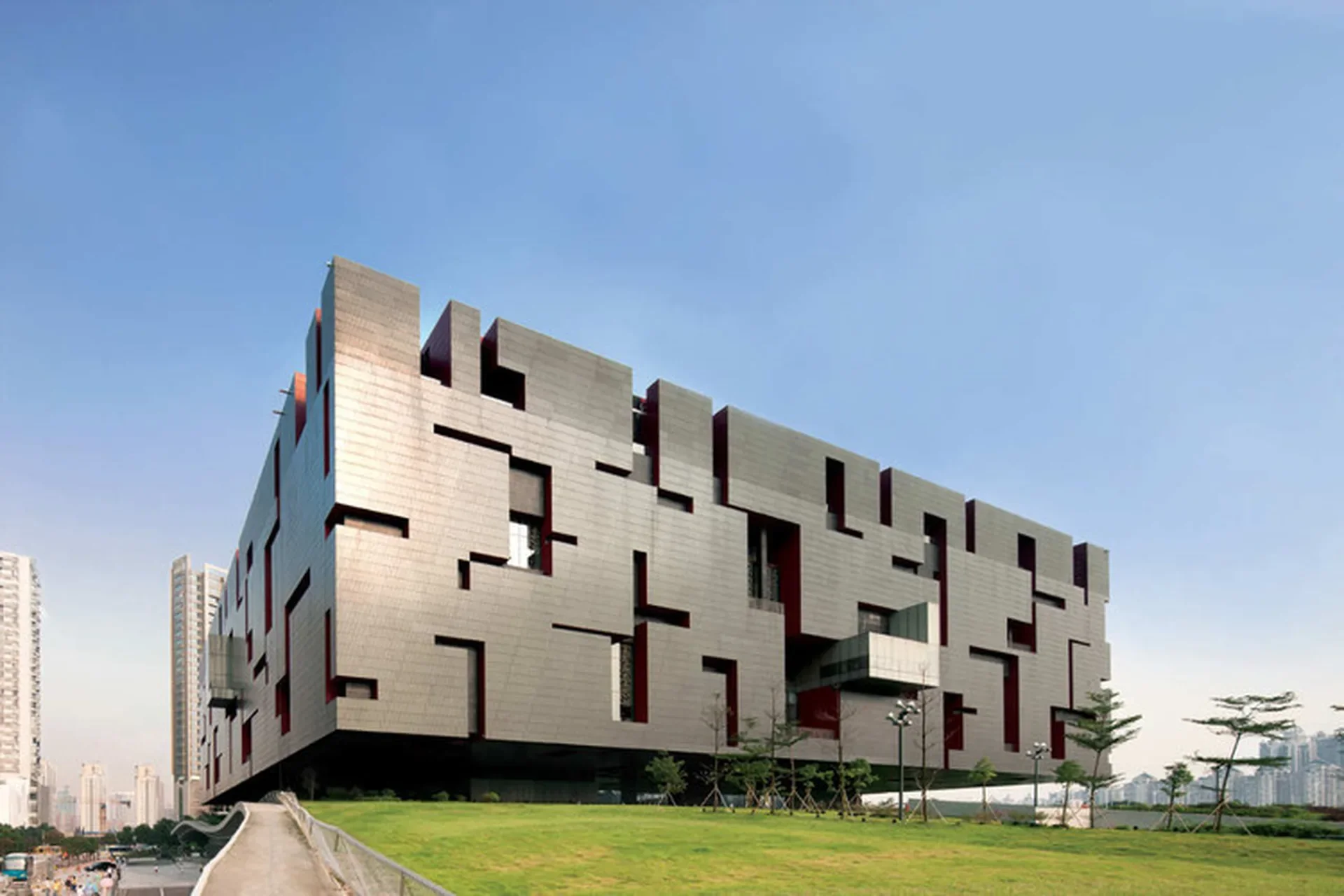
Guangdong Museum
The Guangdong Museum (广东省博物馆) opened in 2010 in Guangzhou's Zhujiang New Town CBD, a dramatic interlocking timber-and-glass building designed by the architect of the Seattle Central Library. The museum traces 2,000 years of Lingnan (岭南, Guangdong-Cantonese) culture — a distinctive southern Chinese regional identity shaped by maritime trade, overseas diaspora, and proximity to Southeast Asia. The four key collection areas are: (1) Lingnan architecture and daily life — carved wooden houses, furniture, and daily objects from Guangdong's unique folk tradition; (2) Chao porcelain (潮州瓷) — the finest collection of Chaoshan porcelain outside of Chaozhou, including the famous "Chaozhan" studio pieces; (3) Ming Dynasty shipwreck archaeology — objects from the Xuande (宣德) and Wanli (万历) era shipwrecks in the South China Sea, including thousands of porcelain pieces; (4) Guangdong prehistoric archaeology — the 100,000-year-old "Zhongshan Man" (中山人) hominid sites and the extraordinary Nanhai Island archaeological finds.
Guangzhou · history museum2026-10-18
Quick Answer
Is Guangdong Museum worth visiting?
Guangdong's flagship museum in Guangzhou's Zhujiang New Town, holding the world's finest collection of Lingnan culture and Chao porcelain; verified in 2026.
Quick facts
| Category | history |
|---|---|
| Ticket | Free admission (with ID or reservation code). Free. Passport required. Timed entry via the Guangdong Museum official website or WeChat mini-program. Special exhibitions charge ¥50-100. |
| Hours | 9:00-17:00 (last entry 16:00). Closed Mondays. |
| Recommended duration | 2.5-3.5 hours. |
| Best time to visit | October through March (cool, dry). Guangzhou is extremely hot and humid June-September (35°C+ with 80%+ humidity). Avoid Chinese New Year (late January/February) when the city empties but some attractions close. Spring (March-April) is pleasant. |
| How to get there | Metro Line 3 or 5 to Zhujiang New Town Station (珠江新城站), then walk 5 minutes through the flower gardens. Metro Line APM to Guangzhou Opera House Station (广州大剧院站), then walk 3 minutes. From Guangzhou Railway Station by DiDi: ¥30-40. From Guangzhou Baiyun International Airport: ¥80-110. |
| English signage | Partial |
Why visit
The Ming Dynasty shipwreck collection is unique in China — objects recovered from merchant ships that sank in the South China Sea during the 15th-16th centuries, providing an unmatched picture of the maritime trade that connected China with Southeast Asia, India, and East Africa. Combined with the Lingnan architecture gallery (reconstructed Qing Dynasty merchant houses), this is the most distinctive regional museum in southern China.
Collection highlights
- Ming Dynasty shipwreck porcelain — thousands of pieces of Jingdezhen and Chaozhou porcelain recovered from Ming-era merchant ships that sank in the South China Sea, including perfectly preserved "Xuande blue and white" bowls
- Lingnan carved wooden houses — two complete Qing Dynasty merchant houses (镬耳屋) transported from the Pearl River Delta and reassembled inside the museum
- Chao porcelain collection — the world's finest collection of Chaozhou (潮州) studio porcelain including teapots, vases, and tea sets in the distinctive "Shuizhou" style
- "Guangzhou in the World" maritime trade map — a large interactive map showing the Guangzhou (Canton) maritime trade routes from the Han Dynasty through the Qing Dynasty, including the 18th-century "Canton System" of trade
- Guangdong prehistoric archaeology — 100,000-year-old hominid fossils and stone tools from the Nanhai submarine archaeological sites
- "Red Pearl" silk and embroidery — Qing Dynasty Cantonese silk embroidery panels featuring the distinctive "Guangdong gold" thread technique
Tips
- The museum is in Guangzhou's CBD (Zhujiang New Town) — combine with the nearby Guangzhou Tower (广州塔, 600m tall) and the flower park (花城广场) for a full day
- The Lingnan architecture section (reconstructed merchant houses) is on the 3rd floor and is the most distinctive and immersive exhibit
- Allow extra time for the flower gardens and fountain plaza between the museum and Guangzhou Tower
- The museum has an excellent restaurant (粤菜) on the top floor with views of the Zhujiang New Town skyline
- The shipwreck archaeology gallery is consistently popular — go early in the day
- Combine with the Chen Clan Ancestral Hall (陈家祠) for traditional Cantonese architecture, 20 minutes by metro
Frequently asked questions
What is Lingnan culture?
Lingnan (岭南, literally "south of the Nanling mountains") is the cultural region of Guangdong, Guangxi, Hainan, and Hong Kong-Macau. It is characterized by: (1) a distinct Cantonese language and pronunciation unintelligible to Mandarin speakers; (2) Chao-Shan (潮汕) and Cantonese cuisine; (3) overseas diaspora — Guangdong and Fujian are the origins of most overseas Chinese; (4) maritime trade orientation rather than inland agricultural focus; (5) a distinctive "cowboy" entrepreneurial business culture. The Guangdong Museum is the definitive introduction to Lingnan culture.
What are the most significant shipwreck collections?
The museum has artifacts from several Ming Dynasty shipwrecks recovered from the South China Sea, the most significant being the Xuande (宣德, 1430s) and Wanli (万历, 1620s) era ships. These ships were carrying porcelain, silk, and gold from Jingdezhen and Chaozhou for export to Southeast Asia and the Middle East. The recovered porcelain pieces — some still in their original wooden crates — give an unparalleled picture of Ming Dynasty export trade.
How does Guangdong Museum compare to the Guangzhou Museum?
The Guangdong Museum (广东省博物馆) is the provincial-level institution in Guangzhou's CBD. The Guangzhou Museum (广州市博物馆, at the Yuexiu Park hilltop) is the city-level museum with Guangzhou-specific history. Both are worth visiting — the provincial museum is larger and more focused on maritime trade.
Does Guangdong Museum have English signage?
Partial — the shipwreck archaeology and Lingnan architecture sections have the most English. The general galleries have limited English. Audio guides in English are available (¥50 deposit).
Is the museum good for children?
Moderate — the shipwreck archaeology and reconstructed merchant houses are engaging for all ages. The 4D theater inside charges separately (¥40-60) and is popular with children. The interactive "Guangzhou in the World" map is also engaging for older children.
Read next
Other things to do in Guangzhou
Baiyun Mountain (Guangzhou)
Guangzhou's 'green lung' and the top hill of Yangcheng, with admission at just CNY 5. Moxing Ridge tops out at 382 m — a great hiking escape whose summit square overlooks the whole city.
Nanhai Temple (Temple of the God of the South Sea)
One of ancient China's four great sea-god temples, founded in the Sui dynasty to bless fleets on the Maritime Silk Road. Admission CNY 10, and the Boluo Dan fair is a spectacular riot.
Canton Tower (Guangzhou Tower)
Guangzhou's 'Slim Waist' icon stands 600 m tall, with a rooftop Ferris wheel and Sky Drop; observation tickets from CNY 107. The Pearl River night panorama is unbeatable.
Chen Clan Ancestral Hall
The finest ancestral hall in Guangdong and a jewel of Lingnan architecture — wood, brick, stone and lime carving at every turn. Admission CNY 10; now the Guangdong Folk Art Museum.
Chen Clan Academy (Chen Lineage Hall)
The formal name of the Chen Clan Ancestral Hall, Guangdong's finest lineage hall and a distillation of Lingnan architecture. Admission CNY 10; now the Guangdong Folk Art Museum.
Guangzhou Opera House
A Zaha Hadid-designed, 1,800-seat hall opened in 2010 in Zhujiang New Town and ranked among the world's ten great opera houses. Lobby free; show tickets CNY 100-1280.
Shangxia Walkway
Cantonese Art Deco shopping street — 1.2 km of restored 1930s arcade buildings, milk custard, and silk shops, 15 minutes from the Beijing Lu pedestrian zone. Free. 1–2 hours.
Kaiping Diaolou (Watchtower Villages)
About 1,833 surviving fortified tower-houses scattered across rural Kaiping, built mainly between the 1890s and 1930s by returned overseas Chinese; plan a full day, ideally an overnight, to see.
Pearl River Night Cruise
A 60-to-80-minute boat ride down Guangzhou's lit-up Pearl River past Canton Tower and the Zhujiang New Town skyline.
Shamian Church (Our Lady of Lourdes Church)
The best-known church on Shamian Island, built by the French in 1890 in Gothic style. Free to enter, and open for photos outside Mass times — arguably Guangzhou's most romantic church.
Shamian Island
Guangzhou's most European quarter — a British and French concession after the Opium Wars, now an island of 150-plus European buildings. Free to wander and a favorite for wedding photos.
Shangxiajiu Pedestrian Street
Guangzhou's most famous qilou arcade shopping street, about 1,200 m along Shifu and Xiajiu roads. Free to browse, dense with century-old food names, with Hualin Temple's jade street next door.
Sun Yat-sen Memorial Hall
A 1931 octagonal, blue-roofed hall to Sun Yat-sen on the site of his 1921 presidential office — 49 m tall with a 71 m column-free auditorium span.
Pearl River Night Cruise
Guangzhou's classic evening experience: a boat ride along the Pearl River past the floodlit Canton Tower, Haixinsha and Liede Bridge. Tickets run about CNY 80-150; book ahead for holidays.
Yuexiu Park
Guangzhou's largest comprehensive park, about 860,000 sq m, home to the 11-m Five Rams statue — the city's emblem. Free entry; Zhenhai Tower (Guangzhou Museum) CNY 10 extra. Allow 2-4 hours.
Museums in Guangzhou
Chen Clan Ancestral Hall
Guangzhou's finest example of traditional Cantonese (Lingnan) architecture — a Qing Dynasty ancestral hall with intricate brick, wood, and stone carvings. ¥10.
Guangzhou Museum (Zhenhai Tower)
Inside Zhenhai Tower (1380) overlooking the Pearl River — Cantonese history from Neolithic to modern. ¥10. 1.5 hours. Less crowded than the bigger museums.
Museum of the Mausoleum of the Nanyue King
A 2,000-year-old royal tomb you can walk into — the intact burial of the second Nanyue King, Zhao Mo, with his jade burial suit sewn in silk thread.