Guangzhou · history museum
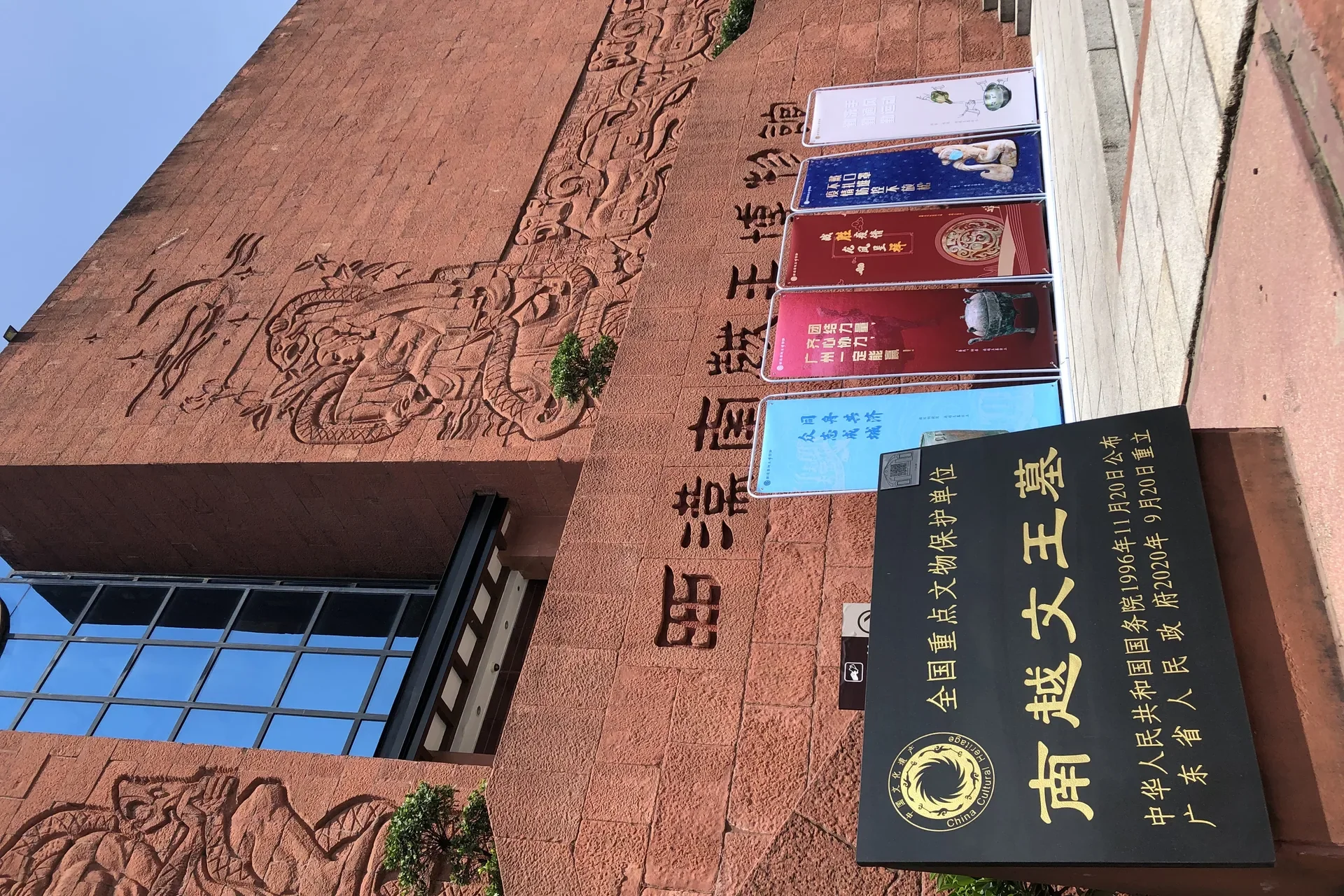
Museum of the Mausoleum of the Nanyue King (西汉南越王博物馆, Xīhàn Nányuè Wáng Bówùguǎn)
"The Museum of the Mausoleum of the Nanyue King (officially the Western Han Museum of the Nanyue King) is built directly over the 122 BC tomb of Zhao Mo (赵眜), the second ruler of the Nanyue Kingdom — a Cantonese-Vietnamese state that controlled southern China and northern Vietnam for 93 years during the Han Dynasty. Discovered in 1983 during hotel construction, the tomb was found completely intact, never looted. Visitors can enter the actual tomb chamber through the original entrance passage, walking past the burial niches of concubines, musicians, and cooks interred with the king. The centerpiece is Zhao Mo's jade burial suit — 2,291 jade plaques sewn together with silk thread (not gold, as silk was the southern tradition). The museum also holds his jade pillow, gold seals, an ivory goblet with 42 engraved dragons, and a unique five-color cosmetic case.".
Last updated:
Quick Answer
Is Museum of the Mausoleum of the Nanyue King worth visiting?
"A 2,000-year-old royal tomb you can walk into — the intact burial of the second Nanyue King, Zhao Mo, with his jade burial suit sewn in silk thread.".
Quick facts
| Category | history |
|---|---|
| Ticket | ¥12 (as of June 2026). Purchase at the ticket office or scan the WeChat QR code at the entrance. Passport required. |
| Hours | 9:00-17:30 (last entry 17:00). Open daily including Mondays. |
| Recommended duration | 2-2.5 hours. Add 30 minutes if you read every label in the jade gallery. |
| Best time to visit | Weekday mornings. The tomb chamber can get humid in Guangzhou summer (May-September) but the museum galleries are well air-conditioned. October-December has the most comfortable weather for the outdoor parts. |
| How to get there | Metro Line 2 to Yuexiu Park (越秀公园), Exit E. Walk east 3 minutes on Jiefang North Road. Bus routes 5, 7, 21, 24, 42, 58, 87, 101, 103, 105, 108, 109, 110, 113, 124, 180, 182, 185, 186, 211, 244, 244A, 256, 265, 273, 284, 519, 528, 543, 549, 552, 555, 556 to Yuexiu Park stop. DiDi from central Guangzhou costs ¥15-25. |
| English signage | yes |
Why visit
Walking into a 2,000-year-old tomb that has not been moved or reconstructed — it is exactly where and how it was built in 122 BC — is a genuinely rare archaeological experience. The jade suit sewn with silk is the only one of its kind on display in China (all others use gold or silver thread). At ¥12, this is the best museum value in Guangzhou.
Collection highlights
- Jade Burial Suit of Zhao Mo — 2,291 jade plaques drilled and threaded with red silk, 1.73 m long. The silk thread has decomposed in places but the jade remains perfectly arranged
- The actual tomb chamber — enter through the same stone passage used for the 122 BC burial, past side chambers containing the remains of 15 sacrificed attendants
- Ivory Goblet with 42 Engraved Dragons — a single elephant tusk carved into a drinking vessel, with an intricate pattern of dragons executed in 0.2 mm-wide engraved lines
- Gold seal "Wen Di Xing Xi" (文帝行玺) — the king's official gold seal, the largest Western Han gold seal ever found (3.1 cm square, 148.5 g)
- Five-color cosmetic case — a lacquered box with compartments for rouge, powder, and eyebrow pigment, confirming Nanyue-era beauty practices
- Rhinoceros-shaped bronze zun — a wine vessel cast in the shape of a standing rhinoceros, inlaid with gold and silver cloud patterns, evidence of rhino presence in ancient Guangdong
Tips
- The tomb chamber is underground and the stairs are original Han Dynasty stone — watch your footing, especially after rain
- I visited in June 2026 and was surprised by how intimate the tomb chamber feels — you are standing exactly where the king's coffin was placed, looking at the original stone floor
- Combine with Yuexiu Park (across the street) and the Guangzhou Museum (Zhenhai Tower, inside the park) for a half-day history walk
- The museum has a small tea house on the grounds that serves Cantonese-style milk tea (¥18) — a welcome break after the tomb's humidity
- The jade suit gallery has dim lighting for conservation — bring a phone flashlight if you want to examine the silk-thread stitching up close
- Photography is allowed without flash throughout the museum, including inside the tomb chamber
Frequently asked questions
Can I enter the actual tomb?
Yes, unlike most Chinese archaeological museums where the artifacts have been moved and the tomb backfilled, you can walk into the original tomb chamber of the Nanyue King Zhao Mo, exactly as it was constructed in 122 BC. You enter through the original stone passage and can peer into the side chambers where concubines, musicians, cooks, and guards were interred. The king's main burial chamber is at the center. The experience is intimate — the tomb is compact (about 100 sq m across seven chambers).
Who were the Nanyue kings?
Nanyue (南越, Southern Yue) was a kingdom established in 204 BC by Zhao Tuo, a Qin Dynasty general who declared himself king after the Qin collapse. The kingdom covered modern Guangdong, Guangxi, and northern Vietnam, with its capital at Panyu (modern Guangzhou). It survived for 93 years across five kings until Emperor Wu of Han annexed it in 111 BC. The Nanyue Kingdom was culturally hybrid — it blended Han Chinese (Zhao Tuo was from Hebei) with the indigenous Yue (Baiyue) population. The museum's collection visibly demonstrates this: Han-style jade suits beside Yue-style bronze drums and ivory carvings with Southeast Asian motifs.
Why is the jade suit sewn with silk instead of gold thread?
Jade burial suits were believed to preserve the body for the afterlife. In the Han imperial heartland (central plains), gold thread was the standard for royalty. The Nanyue Kingdom, being a southern vassal state, used silk thread — partly as a regional distinction and partly because silk production was the local specialty. The silk has largely decomposed over 2,000 years but the jade plaques remain in place, held by gravity and the pressure of the surrounding soil. This is the only silk-thread jade suit ever discovered.
How was the tomb discovered?
In June 1983, construction workers were excavating for a hotel (the current China Hotel, 中国大酒店) on Jiefang North Road when they hit stone slabs 18 meters below ground. Archaeologists identified it as a Han Dynasty tomb within days. The discovery was significant because the tomb was completely intact — it had never been robbed — and because the artifacts confirmed the existence and wealth of the Nanyue Kingdom, which until then was known mainly from Han Dynasty historical texts.
Is this museum suitable for children?
Moderately — older children (8+) who enjoy archaeology or ancient Egypt will find the tomb and jade suit thrilling. Younger children may find the tomb chamber dark and the galleries text-heavy. The museum is compact and can be done in under two hours, which helps with shorter attention spans.
How much does the Nanyue King Museum cost?
¥12 (as of June 2026). This is among the best museum values in China — you get a walk-in tomb, a jade burial suit, and a world-class Han Dynasty collection for about the price of a bowl of Cantonese wonton noodles.
Read next
Other things to do in Guangzhou
Baiyun Mountain
baiyun-mountain in Beijing: 广州市肺,羊城第一山,门票5元,摩星岭海拔382米,徒步登山好去处,山顶广场俯瞰广州全景,秋季山顶石刻最著名。
Nanhai Temple (Temple of the God of the South Sea)
beiji-temple in Beijing: 中国古代四大海神庙之一,隋朝始建,古代出海祭海圣地,门票10元,菠萝诞庙会热闹非凡,值得历史爱好者探访。
Canton Tower (Guangzhou Tower)
canton-tower in Beijing: 广州新地标,小蛮腰昵称,600米高,观光票150元起,塔顶有摩天轮和速降轨道,俯瞰珠江三角洲夜景极佳。
Chen Clan Ancestral Hall
chen-clan-ancestral-hall in Beijing: 广东最精美的祠堂建筑,岭南建筑艺术明珠,门票10元,木雕、砖雕、石雕、灰塑精美绝伦,现为广东民间工艺博物馆。
Chen Clan Academy (Chen Lineage Hall)
chen-lineage in Beijing: 陈家祠的正式名称,广东最精美祠堂建筑,门票10元,岭南建筑艺术精华,砖木石雕精美绝伦,现为广东民间工艺博物馆。
Guangzhou Opera House
guangzhou-opera in Beijing: 珠江新城四大文化建筑之一,扎哈·哈迪德设计,2010年建成,约1800座。免费进大厅参观,演出票100-1280元。世界十大歌剧院之一,建筑爱好者必朝圣。
Shangxia Walkway
"\"Cantonese Art Deco shopping street — 1.2 km of restored 1930s arcade buildings, milk custard, and silk shops, 15 minutes from the Beijing Lu pedestrian zone. Free. 1–2 hours.\".".
Kaiping Diaolou (Watchtower Villages)
About 1,833 surviving fortified tower-houses scattered across rural Kaiping, built mainly between the 1890s and 1930s by returned overseas Chinese; plan a full day, ideally an overnight, to see …
Pearl River Night Cruise
A 60-to-80-minute boat ride down Guangzhou's lit-up Pearl River past Canton Tower and the Zhujiang New Town skyline.…
Shamian Church (Our Lady of Lourdes Church)
shamian-church in Beijing: 沙面岛上最著名的教堂,法国建于1890年,哥特式建筑,免费参观,非弥撒时间可入内拍照,是广州最浪漫的教堂。
Shamian Island
shamian-island in Beijing: 广州最具欧洲风情的历史街区,鸦片战争后英法租界,150余座欧式建筑,免费漫步,婚纱照圣地,美食遍及。
Shangxiajiu Pedestrian Street
shangxiajiu in Beijing: 广州最著名的传统骑楼商业街,全长约1200米,十甫路和下九路组成,免费逛,老字号美食云集,华林寺玉器街相邻。
Sun Yat-sen Memorial Hall
A 1931 octagonal, blue-roofed hall to Sun Yat-sen on the site of his 1921 presidential office — 49 m tall with a 71 m column-free auditorium span.…
Pearl River Night Cruise
sunset-pearl-river in Beijing: 广州最经典的夜游体验,乘船赏珠江两岸夜景,广州塔、海心沙、猎德大桥美景,票价约80-150元,节假日需提前订票。
Yuexiu Park
yuexiu-park in Beijing: 广州最大的综合性公园,面积约86万平方米,五羊石像高11米。门票免费,镇海楼(广州博物馆)另票10元。明代古城墙,镇海楼高28米。地铁2号线越秀公园站A口或B口出。建议2-4小时。
Museums in Guangzhou
Chen Clan Ancestral Hall
Guangzhou's finest example of traditional Cantonese (Lingnan) architecture — a Qing Dynasty ancestral hall with intricate brick, wood, and stone carvings. ¥10.
Guangzhou Museum (Zhenhai Tower)
"Inside Zhenhai Tower (1380) overlooking the Pearl River — Cantonese history from Neolithic to modern. ¥10. 1.5 hours. Less crowded than the bigger museums.".