Guanghan · history museum
Sanxingdui Museum (三星堆博物馆, Sānxīngduī Bówùguǎn)
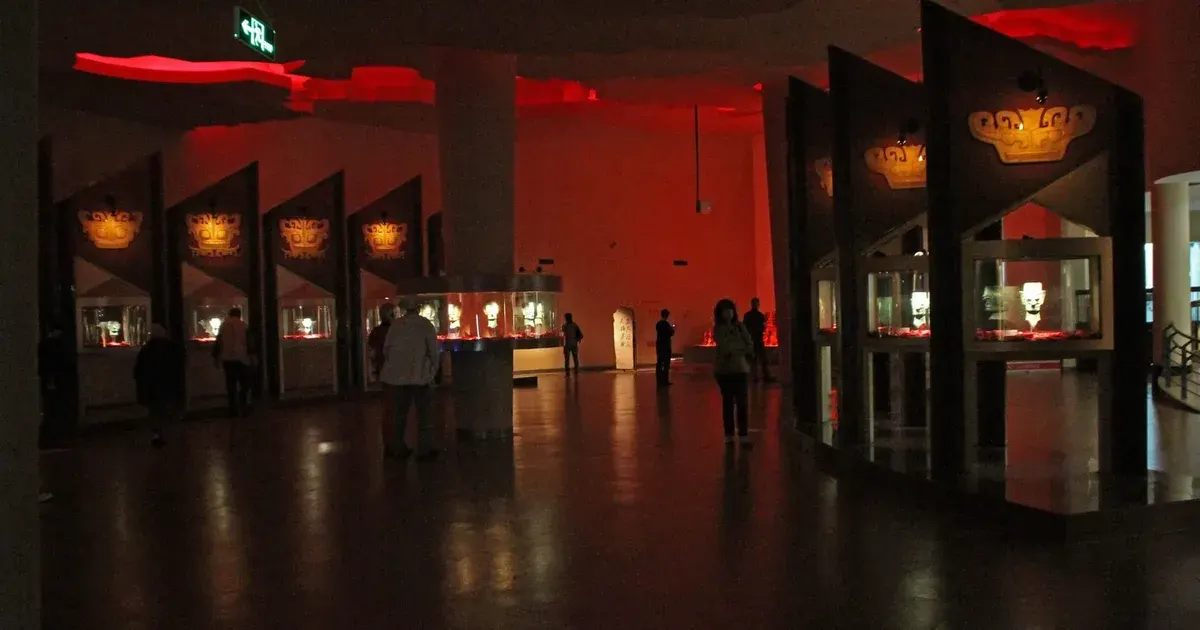
The Sanxingdui Museum, located in Guanghan about 40 km north of Chengdu, displays artifacts from a Bronze Age civilization that flourished in Sichuan around 1600-1046 BC, contemporaneous with the Shang Dynasty in the Yellow River valley but completely distinct in its art and culture. Discovered in 1929 by a farmer digging a well, the site has yielded enormous bronze masks with protruding eyes, gold foil sun disks, a 3.96-meter bronze "divine tree," and thousands of gold, jade, and ivory objects — none of which resemble anything found elsewhere in China. The civilization abruptly vanished around 1000 BC, leaving no written records. The new museum building opened in July 2023 and is a architectural landmark in its own right.
Last updated:
Quick Answer
Is Sanxingdui Museum worth visiting?
3,000-year-old bronze masks with alien-like features from a civilization that left no written record. ¥72. 1 hour from Chengdu. One of the most astonishing archaeological museums on earth.
Quick facts
| Category | history |
|---|---|
| Ticket | ¥72 (Apr-Oct), ¥60 (Nov-Mar). Passport required. Reserve via the Sanxingdui Museum WeChat mini-program or on-site. Weekend visits book 3-5 days ahead. |
| Hours | 8:30-18:00 (Apr-Oct), 9:00-17:00 (Nov-Mar). Ticket sales stop 60 minutes before closing. Closed on the first Monday of each month. |
| Recommended duration | 2.5-3 hours for the new museum building. Add 30 minutes for the park and excavation-area viewing platform. |
| Best time to visit | Weekday mornings, arriving at opening. Avoid weekends and Chinese holidays — Sanxingdui has become wildly popular with domestic tourists since the 2021 excavation discoveries were publicized. |
| How to get there | From Chengdu: High-speed train from Chengdu East (成都东) to Guanghan North (广汉北), 20-30 minutes, ¥15-25. Then taxi or DiDi 15 minutes to the museum (¥15-20). Or direct tourist bus from Chengdu Chadianzi Bus Station (2 hours, ¥30). Round-trip by DiDi from central Chengdu is about ¥300-400 and takes 1-1.5 hours each way. |
| English signage | yes |
Why visit
The bronze masks are unlike anything else in the world — oversized, angular, with bulging cylindrical eyes and exaggerated ears. Standing in front of the 138 cm-wide "Bronze Mask with Protruding Eyes" is an experience that will challenge everything you thought you knew about ancient Chinese civilization.
Collection highlights
- Bronze Mask with Protruding Eyes — 138 cm wide, 66 cm tall, with cylindrical eye stalks extending 16 cm outward. The museum's signature piece
- Bronze Divine Tree (青铜神树) — 3.96 m tall, the largest ancient bronze ever excavated in China, with 9 branches, 27 fruits, and 9 birds, re-assembled from 2,476 fragments
- Gold Foil Sun Disk — a 6.5 cm diameter gold disc with a sun motif, among the earliest gold artifacts in China
- Bronze Standing Figure — 2.62 m tall including base, a thin, elongated human figure in ritual robes, possibly a priest-king
- Gold Mask — a life-sized human face mask of hammered gold, 31 cm wide, found in Sacrificial Pit 5 in 2021
- Jade Cong tubes — similar to Liangzhu Culture forms 2,000 km away, suggesting long-distance cultural contact
Tips
- Take the morning high-speed train from Chengdu East (depart around 8:00 AM) — you will arrive before the 10:00 AM tour bus crush
- The new 2023 museum building has excellent English signage throughout — the best among all Chinese archaeological museums I have visited
- The excavation pits are visible from a viewing platform in the park behind the museum — you can see archaeologists working in-season (typically spring and autumn)
- Guanghan town has excellent Sichuan food. Try the local specialty 广汉缠丝兔 (Guanghan spiced rabbit) at any restaurant near the train station
- Combine with the Jinsha Site Museum in Chengdu proper, which displays a related but later civilization
Frequently asked questions
How do I get from Chengdu to Sanxingdui Museum?
The best way is high-speed train from Chengdu East Station (成都东) to Guanghan North (广汉北) — 20-30 minutes, ¥15-25, trains roughly every 30-60 minutes. Then DiDi 15 minutes to the museum. Alternatively, a direct tourist bus from Chadianzi Bus Station takes about 2 hours. DiDi round-trip from central Chengdu costs ¥300-400.
Who were the Sanxingdui people?
They were a Bronze Age civilization that existed in the Sichuan Basin around 1600-1046 BC, contemporaneous with the Shang Dynasty in the Yellow River valley. They left no written records, and no Chinese historical texts mention them. Their art — with its exaggerated facial features — is completely unlike anything from other Chinese Bronze Age cultures. Their disappearance around 1000 BC remains unexplained.
Is Sanxingdui worth the trip from Chengdu?
Yes, absolutely. It is one of the most important archaeological museums in the world. The bronze masks alone justify the 1-hour journey. Plan half a day door-to-door, or combine with the Dujiangyan Irrigation System for a full day trip.
How new is the Sanxingdui Museum?
The new museum building opened in July 2023 — it is a state-of-the-art facility with climate-controlled galleries, excellent lighting, and comprehensive English signage. The old museum building (1997) has been decommissioned. What you see today represents the latest archaeological discoveries up to the 2021-2022 sacrificial pit excavations.
Can I visit Sanxingdui and the Panda Base on the same day?
It is possible but rushed. Visit Sanxingdui in the morning (depart Chengdu 7:30 AM, return by 1 PM) and the Panda Base in the afternoon (best panda viewing is 8:00-10:00 AM, so this is not ideal). If you must choose, Sanxingdui is a world-unique archaeological site, while pandas can be seen in multiple locations.
Are there English guides at Sanxingdui?
Yes — the museum has excellent English signage throughout, and audio guides (¥20) with full English narration are available at the entrance. English-speaking human guides can be booked for ¥500 for 2.5 hours, but the audio guide is comprehensive enough for most visitors.
Read next
Other things to do in Guanghan
Chengdu Research Base of Giant Panda Breeding
See 50+ giant pandas including cubs at 8:00 AM feeding time in a 100-hectare bamboo-forested breeding center. The best panda experience in China. 3-4 hours.
Leshan Giant Buddha
A 71-meter-tall stone Buddha carved into a cliff face in the 8th century — the largest pre-modern carved Buddha in the world. Boat ride ¥70. 2 hours from Chengdu. Half-day.
Jiuzhaigou Valley
Turquoise travertine lakes, 100+ multi-tiered waterfalls, and snow-capped Tibetan peaks in a UNESCO park at 2,000–4,500 m altitude. ¥169. 2 days recommended.
Wuhou Shrine (Temple of the Marquis of Wu)
China's most famous Three Kingdoms memorial — dedicated to Zhuge Liang, the master strategist of Shu Han. Ming Dynasty architecture, 1,800-year-old cypress trees. ¥60.
Jinli Ancient Street
Chengdu's most famous snack street attached to Wuhou Shrine — Sichuan street food, Sichuan opera, folk crafts. Free entry. 45–90 minutes.
Mount Qingcheng
One of China's four sacred Taoist mountains, birthplace of the Taoist "Way of the Celestial Masters" (142 AD). Forested paths, pavilions, Taoist temples. ¥90. 1 hour from Chengdu.
Wolong Giant Panda Nature Reserve
The original wild panda reserve — 200,000 hectares of bamboo forest, 150+ wild pandas. Volunteer programs available. 1.5 hours from Chengdu. ¥90. Full day.
Mount Siguniang (Four Girls Mountain)
"Four Girls Mountain" — 6,250m peak, trekking paradise with 3 valleys. Yaomei Feng is China's answer to the Matterhorn. ¥150. 2-3 days from Chengdu. Alpine lakes, glaciers, Tibetan villages.
Dujiangyan Irrigation System
Li Bing built this dam-free irrigation system around 256 BCE, and it still waters ~530,000 hectares of the Chengdu Plain today. ¥80, allow 2–3 hours, 30 minutes by train from Chengdu.
Wide and Narrow Alleys
Three restored Qing-dynasty courtyard alleys in central Chengdu (free, open 24/7), laid out on the grid of a 1718 Manchu garrison. Budget 2-3 hours for a slow walk plus a courtyard teahouse stop; go on a weekday after 19:00 for lit lanterns and thin crowds.
Wenshu Monastery
A free Buddhist monastery in central Chengdu, founded in the Sui dynasty (6th c.), rebuilt in 1681, and dedicated to Manjusri — the bodhisattva of wisdom. Budget 1–2 hours for the halls and a long tea in the bamboo garden.
People's Park
A free, century-old city park where Chengdu's teahouse culture plays out under plane trees — pay ¥15-30 for a pot of jasmine tea and settle in for two hours of mahjong, ear-cleaning, and people-watching.
Museums in Guanghan
Sichuan Cuisine Museum
The world's only museum where you can eat your way through 4,000 years of Sichuan food history — and make your own Pixian chili bean paste.
Jinsha Site Museum
The 3,000-year-old "Sun and Immortal Bird" gold disc — one of China's most iconic artifacts — and the sister civilization to Sanxingdui. ¥80. An active archaeological site with a beautiful park.
Chengdu Museum
5-floor modern museum in central Chengdu — Sichuan history from ancient Shu civilization to the modern city, plus excellent shadow puppet gallery. Free, 2–3 hours.
Sichuan Museum
Provincial museum with Sanxingdui bronze replicas, Tibetan Buddhist art, and Sichuan painting. Free. The quieter alternative to the Chengdu Museum downtown.
Sichuan Museum of Traditional Chinese Medicine
A small but dense university museum with 3,000+ TCM artifacts covering Sichuan herbal medicine — plan 60–90 minutes and skip the gift-shop photo backdrop.