Du Fu's Thatched Cottage杜甫草堂
Du Fu (712–770 CE) is considered China's greatest poet, and he spent four years (759–765) living in a thatched cottage in Chengdu, producing over 240 poems here — including some of his most famous works written during the An Lushan Rebellion. The site was abandoned after Du Fu left, rediscovered in the 15th century, and rebuilt as a memorial park. What you see today is a Qing-era reconstruction, but the adjacent museum holds original Song dynasty stone engravings of Du Fu's calligraphy. In autumn, the park's famous ginkgo tree turns golden and a lantern festival fills the evenings.
Chengdu · Visitor Guide2026-10-18
Quick Answer
Is Du Fu's Thatched Cottage worth visiting?
The memorial park of Tang dynasty poet Du Fu — reconstructed bamboo cottage, exposed stone inscriptions, and a museum of his life. ¥50. 2 hours.
Quick facts
| Ticket | ¥50 (as of June 2026). Student/senior ¥25. |
|---|---|
| Hours | 8:00–20:00 (summer), 8:00–18:30 (winter). |
| Recommended duration | 2 hours for the park, museum, and a circuit of the memorial halls. |
| Best time to visit | Autumn (October–November) for ginkgo colors and lantern festival. Spring for plum blossoms. Early morning for any season. |
| How to get there | Metro Line 4 to Caotangbeilu Station (草堂北路站), Exit C, then about a 10-minute walk. Or take Bus 58 from Chunxi Road to the Du Fu Caotang stop (20 min). |
| English signage | Partial |
| Wheelchair accessible | Partial |
| Du Fu's residence | 759–765 CE (Tang dynasty) |
| Poems written here | 240+, including 'Song of My Cottage Unroofed by Autumn Gales' |
| Park area | 24 hectares |
| Key features | Thatched cottage, stone inscriptions, Mill River, museum |
| Festival | Autumn lantern festival (September–November) |
What to expect
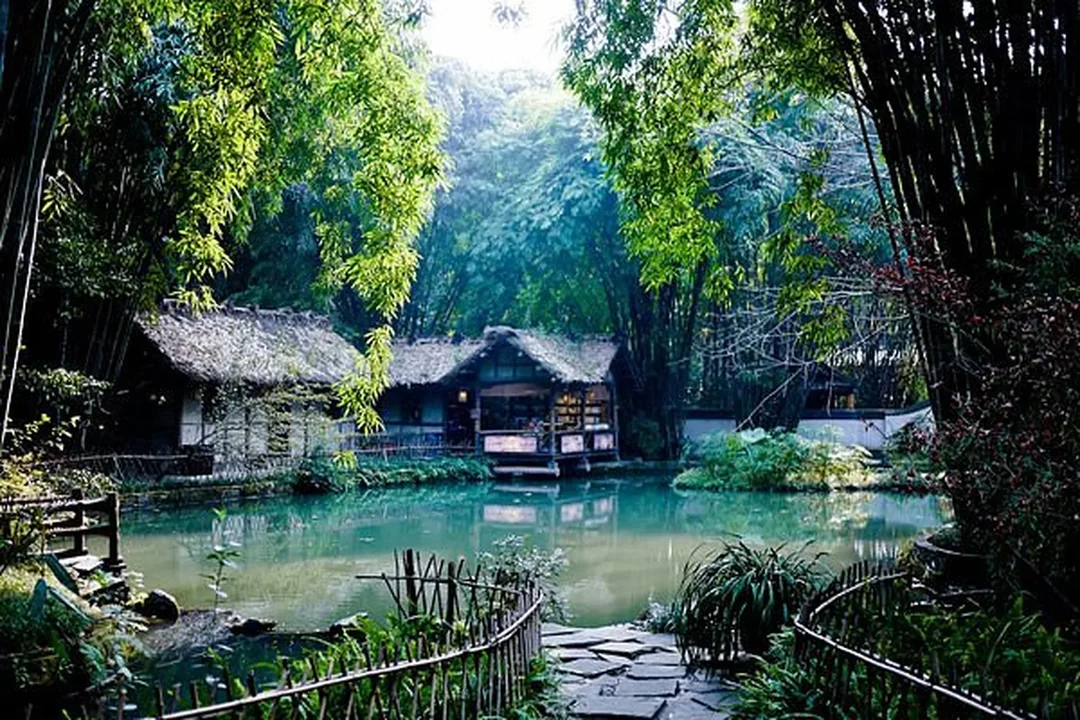
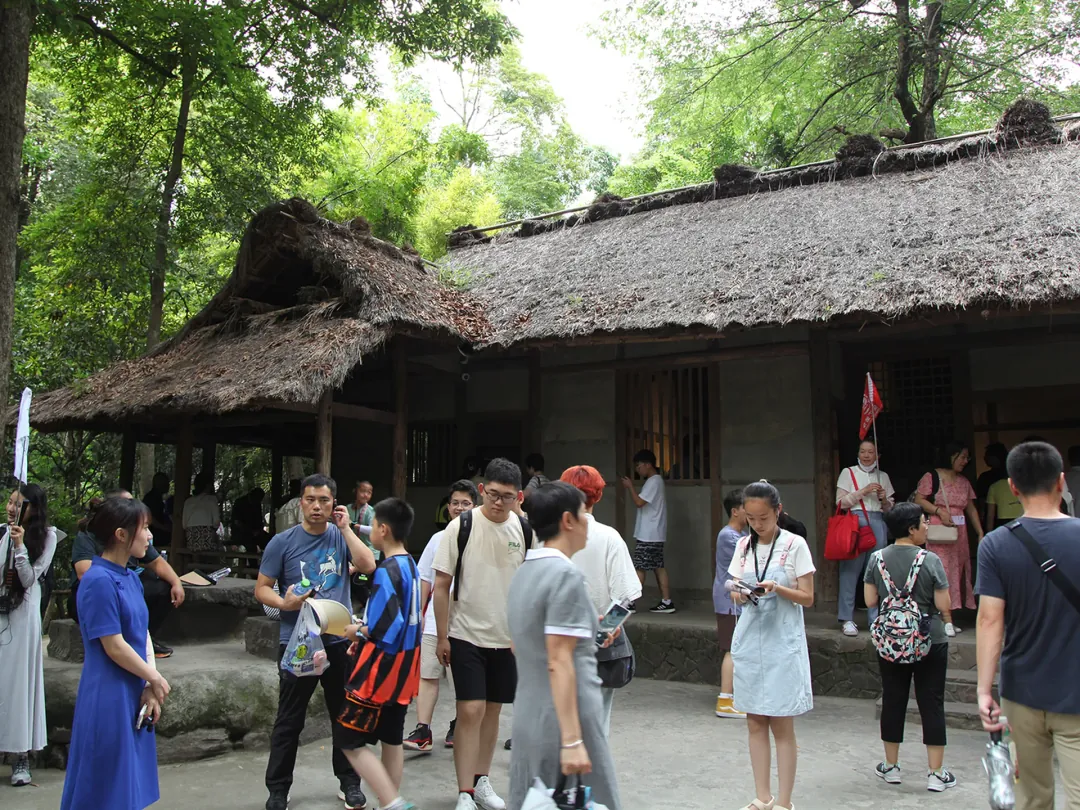
The park is divided into three areas: the Historical Zone (the original site and Du Fu's reconstructed cottage), the Art Museum (an excellent museum of Tang dynasty poetry and calligraphy), and the Garden Area (Mill River, bamboo paths, and pavilions). Start at the historical zone to find the actual site of Du Fu's cottage — a modest bamboo structure reconstructed in 1817 on the original footprint, with the Mill River (浣花溪) flowing past the gate.
The stone inscription corridor (石刻廊) holds Song dynasty reproductions of Du Fu's calligraphy — the originals were carved into stone in 1090 and have survived almost a millennium. The museum's second floor traces Du Fu's life through paintings and annotated editions of his poems. The most poignant section covers his years in Chengdu: he arrived as a refugee from the An Lushan Rebellion and spent four years here in relative peace before traveling further west.
The calligraphy panels throughout the park span his whole career. They include '春望' (Spring View) — '国破山河在,城春草木深' (The state is shattered, mountains and rivers remain; spring in the city, grass and trees grow deep) — written in 757 while Du Fu was trapped in rebel-occupied Chang'an, a few years before he ever reached Chengdu. The masterpiece of his Chengdu years, '茅屋为秋风所破歌' (Song of My Cottage Unroofed by Autumn Gales), was written at the cottage itself in 761.
How to get there
Metro Line 4 to Caotangbeilu Station (草堂北路站), Exit C, then about a 10-minute walk. Buses 19, 35, 58, 82 and 151 stop at Du Fu Caotang. DiDi from central Chengdu: ¥25–35, 20 minutes.
Best photo spots
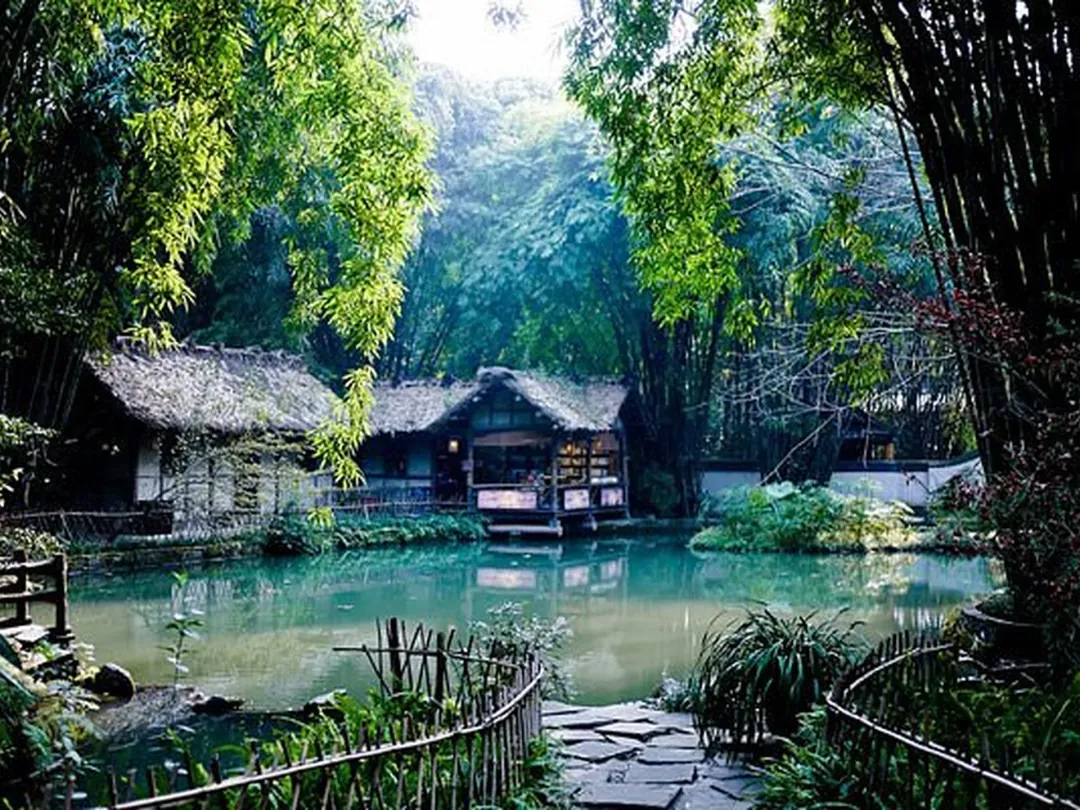
- The thatched cottage from across the Mill River — framed by bamboo and willow
- The stone inscription corridor in morning light
- The ginkgo tree in the garden area (October–November)
- The calligraphy panels along the memorial hall
Tips
- Pair with a visit to the nearby Chengdu Research Base (pandas) in the same day — they are 20 minutes apart by DiDi
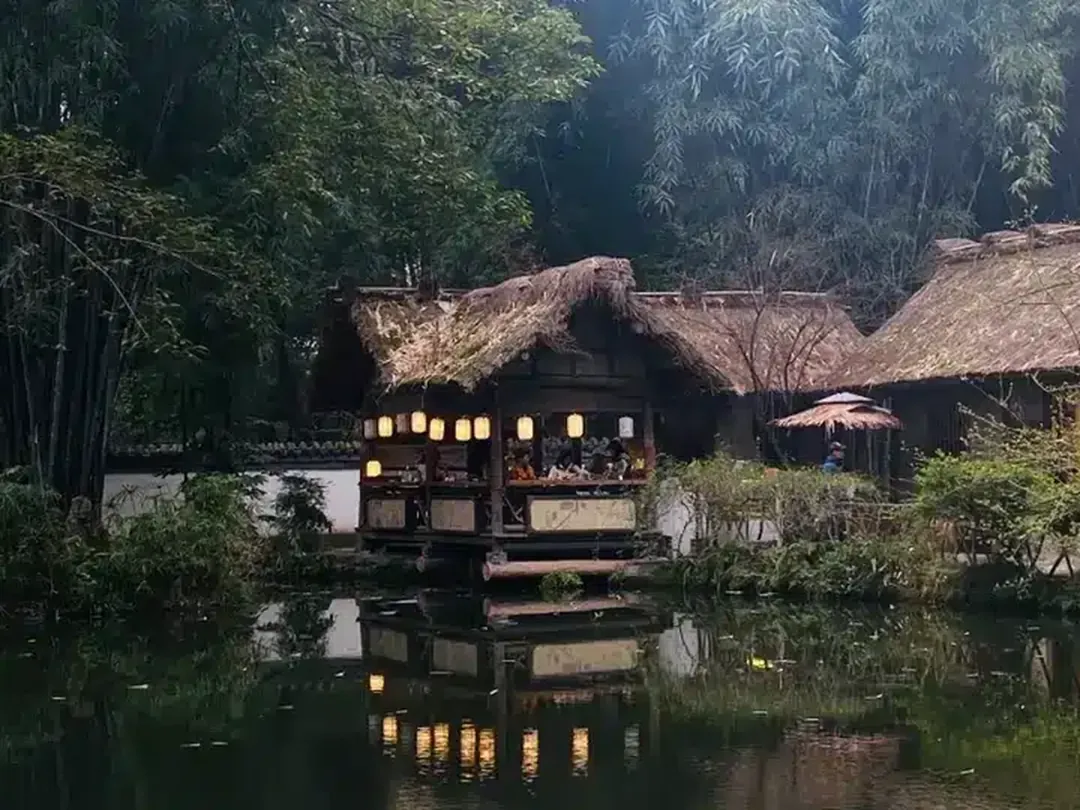
- The autumn lantern festival (September–November) adds an entirely different evening atmosphere to the park
- Come at opening (8 AM) to see the park empty — the atmosphere of bamboo and river is completely different without crowds
- The adjacent art museum is air-conditioned and holds some of the most important Tang dynasty calligraphy in existence
Scams to avoid
- Street vendors near the park claiming to sell Du Fu's calligraphy — all modern reproductions
Frequently asked questions
Do I need to know Tang poetry to enjoy this?
No — the park is a beautiful traditional Chinese garden regardless of your knowledge of poetry. The museum's bilingual placards explain Du Fu's life context clearly. If you do know his poems, the experience is richer, but the garden, river, and reconstructed cottage have their own appeal.
How does this compare to other Chengdu historical sites?
Du Fu's Cottage is smaller and more intimate than Wenshu Monastery or Jinli Street. It is essentially a literary memorial park with a small museum. If you are interested in Chinese poetry or Tang dynasty history, it is essential. If not, it is pleasant but skippable — unlike the pandas or Jinsha.
What is the lantern festival?
The Du Fu Thatched Cottage Lantern Festival runs September–November each year. Thousands of traditional Chinese lanterns are hung throughout the park and illuminated at night. The park stays open until 8 PM. It is particularly popular with Chinese families. The ginkgo trees are at their most photogenic during this period.
Read next
Other things to do in Chengdu
Baoguo Temple
A celebrated Buddhist monastery in Xindu, Chengdu, founded in the Sui dynasty, famed for its Hall of the 500 Arhats. Admission CNY 30 — a worthwhile half-day trip.
Du Fu's Thatched Cottage
The memorial park of Tang dynasty poet Du Fu — reconstructed bamboo cottage, exposed stone inscriptions, and a museum of his life. ¥50. 2 hours.
Jinsha Site Museum
A 3,000-year-old Shu civilization archaeological site — the pit of 600 ivory tusks, gold masks, and the famous 'Flying God' goldfoil, all inside a modern museum built over the excavation.
Chengdu Museum
Chengdu's largest museum, opened in 2016 with about 20,000 sqm of galleries and 200,000+ relics; free with reservation, open 09:00-20:00 and closed Mondays.
Chengdu Research Base of Giant Panda Breeding
The world's largest panda breeding facility, with the fullest captive population anywhere. Admission CNY 55, shuttle CNY 30; go in the morning when the pandas are most active.
Chunxi Road
Chengdu's busiest shopping street, laid out in 1924 and famous for the IFS climbing panda; free to enter, shops about 10:00-22:00, metro lines 2 and 3 direct.
Dujiangyan Irrigation System
Li Bing built this dam-free irrigation system around 256 BCE, and it still waters ~530,000 hectares of the Chengdu Plain today. ¥80, allow 2–3 hours, 30 minutes by train from Chengdu.
Huanhua Stream
Chengdu's most poetic park, a 2 km streamside walk where the Tang poet Du Fu once lived. Opened in 2003, free and open all day; on Metro Line 4 beside Du Fu's Thatched Cottage.
Jinli Ancient Street
Chengdu's most famous old street, about 550 m of Three Kingdoms culture and Sichuan folk charm beside Wuhou Shrine; free entry, shops 09:00-23:00, red lanterns glow best at night.
Jinsha Site Museum
Remains of the ancient Shu kingdom of the Shang and Zhou eras, findspot of the Golden Sun Bird — now China's emblem of cultural heritage. Admission CNY 70; a must for archaeology lovers.
Jiuzhaigou Valley
Turquoise travertine lakes, 100+ multi-tiered waterfalls, and snow-capped Tibetan peaks in a UNESCO park at 2,000–4,500 m altitude. ¥169. 2 days recommended.
Wide and Narrow Alleys
Three restored Qing-dynasty courtyard alleys in central Chengdu (free, open 24/7), laid out on the grid of a 1718 Manchu garrison.
Leshan Giant Buddha
The world's largest stone Buddha — a 71 m seated Maitreya cut into a riverfront cliff. Entry CNY 80, river boat CNY 50 extra; the Buddha is a mountain, the mountain a Buddha.
Longmen Mountain
A national geopark on Chengdu's northern edge and a Wenchuan earthquake memorial ground, centered on Bailu town. Free in places or CNY 30; best for hiking and exploring.
Mount Emei
One of China's four sacred Buddhist mountains and the seat of Samantabhadra. Entry CNY 160 plus CNY 90 shuttle, cableways extra. The Golden Summit sunrise is the whole point — a five-star must-see.
Mount Siguniang (Four Girls Mountain)
Four Girls Mountain — a 6,250m peak and trekking paradise with 3 valleys. Yaomei Feng is China's answer to the Matterhorn. ¥150. 2-3 days from Chengdu. Alpine lakes, glaciers, Tibetan villages.
Chengdu Research Base of Giant Panda Breeding
See 50+ giant pandas including cubs at 8:00 AM feeding time in a 100-hectare bamboo-forested breeding center. The best panda experience in China. 3-4 hours.
People's Park
A free, century-old city park where Chengdu's teahouse culture plays out under plane trees — pay ¥15-30 for jasmine tea and settle in for two hours of mahjong, ear-cleaning, and people-watching.
Mount Qingcheng
One of China's four sacred Taoist mountains, birthplace of the Taoist "Way of the Celestial Masters" (142 AD). Forested paths, pavilions, Taoist temples. ¥90. 1 hour from Chengdu.
Sanxingdui Museum
sanxingdui-museum in Chengdu: Bronze masks with protruding eyes, a 2.62-meter figure, and a 4-meter sacred tree from a 3,000-year-old civilization that left no written records.
Shuangliu District
Home of Chengdu Shuangliu International Airport, 20 km from downtown. The century-old Pengzhen Old Teahouse distills old-Chengdu life — free, 15 minutes away; mornings are best.
Sichuan Opera Show (Face Changing)
A classic Sichuan culture experience: face-changing, fire-spitting and the rolling-lamp act in a show of about 70 minutes. Best caught at Shufeng Yayun or Furong Guocui.
Taiping Street
Quiet 400-metre Republican-era old street in Chengdu with brick-timber buildings; free and open all day, shops about 10:00-20:00, a 10-minute walk from Dongmenqiao metro station.
Wenshu Monastery
Chengdu's best-preserved Buddhist monastery, founded 605-618 with over 1400 years of history; free entry 08:00-17:00, a 5-minute walk from Wenshuyuan metro station, famed for its teahouse.
Wolong Panda Reserve
Sichuan's largest panda reserve and a natural habitat of wild pandas, about 130 km from Chengdu — a full-day outing. A top pick for nature lovers.
Wolong Giant Panda Nature Reserve
The original wild panda reserve — 200,000 hectares of bamboo forest, 150+ wild pandas. Volunteer programs available. 1.5 hours from Chengdu. ¥90. Full day.
Wuhou Shrine (Temple of the Marquis of Wu)
China's most famous Three Kingdoms memorial — dedicated to Zhuge Liang, the master strategist of Shu Han. Ming Dynasty architecture, 1,800-year-old cypress trees. ¥60.
Museums in Chengdu
Chengdu Museum
Chengdu's city museum at Tianfu Square, covering Shu civilization, the ancient Jinsha site and giant panda conservation. Free; verified in 2026.
Chengdu Research Base of Giant Panda Breeding
Chengdu Research Base of Giant Panda Breeding: the world's largest panda breeding center — 150+ giant pandas in a natural forest habitat, plus red pandas. ¥58.
Sichuan Museum of Traditional Chinese Medicine
A small but dense university museum with 3,000+ TCM artifacts covering Sichuan herbal medicine — plan 60–90 minutes and skip the gift-shop photo backdrop.
Jinsha Site Museum
The 3,000-year-old "Sun and Immortal Bird" gold disc — one of China's most famous artifacts — and the sister civilization to Sanxingdui. ¥80. An active archaeological site with a beautiful.
Sichuan Cuisine Museum
The world's only museum where you can eat your way through 4,000 years of Sichuan food history — and make your own Pixian chili bean paste.
Sichuan Museum
Sichuan's premier provincial museum beside People's Park in Chengdu — strong in Three Kingdoms Shu culture, Tibetan Buddhist art and ancient Shu civilization; verified in 2026.